Hotel Marcel: A Brutalist Icon Reborn as a Net-Zero Hotel
Standing as a bold testament to mid-century modernism, Hotel Marcel in New Haven, Connecticut, represents one of the most ambitious adaptive reuse projects in the United States. Once a stark corporate headquarters, this architectural landmark has been transformed from a neglected concrete monolith into the nation's first fossil fuel-free, net-zero energy hotel.
The building's journey from a symbol of industrial power to a beacon of sustainability reflects a broader shift in how we perceive Brutalism—an architectural style characterized by raw, exposed concrete (béton brut), geometric forms, and a sense of massive weight.
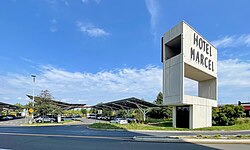
Key Facts
- Architects: Designed by the legendary Marcel Breuer and Robert F. Gatje.
- Sustainability: America's first net-zero energy and fossil fuel-free hotel.
- Historic Status: Added to the National Register of Historic Places on April 29, 2021.
- Capacity: Features 165 guestrooms.
- Location: 500 Sargent Drive, New Haven, Connecticut.
Architectural Design and Features
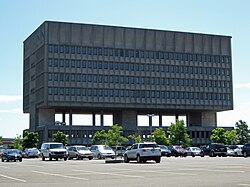
Completed in 1970, the structure was originally designed as the Armstrong Rubber Company Building. The design is a masterclass in Brutalist principles, utilizing heavy concrete to create a striking silhouette against the New Haven skyline.
Exterior Form and Facade
The building's exterior is defined by its rhythmic concrete panels and recessed windows. A notable feature of the south elevation is the central bay, which is wider than the surrounding bays, with beveled spandrels—the horizontal panels between stories—adding a sense of depth and texture to the facade.
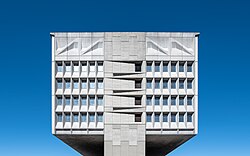
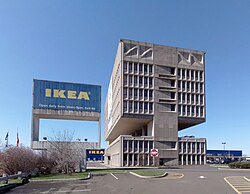
The upper mechanical story is particularly unique, featuring concrete panels with reliefs that cleverly conceal the building's diagonal trusses. One of the most striking structural elements is the air gap and supporting columns located under the upper stories, which create a floating effect for the massive concrete volume.
Interior Layout
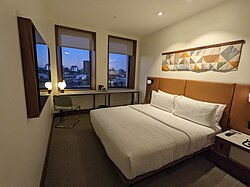
The interior has been reimagined to balance the raw aesthetic of the original concrete with the luxury expected of a modern hotel. The lobby serves as a grand introduction to the space, blending the building's historic industrial feel with contemporary hospitality design.
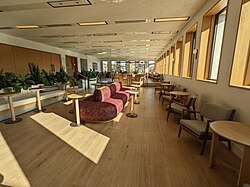
The guestrooms continue this theme, offering a sophisticated environment that respects the architectural heritage of Marcel Breuer while providing modern comforts.
A Turbulent History: From Rubber to Retail
The building's history is as complex as its architecture. After serving as the headquarters for the Armstrong Rubber Company, it later became the Pirelli Tire Building. However, as corporate needs shifted, the building fell into a period of abandonment and disuse.
During the early 2000s, the site faced significant uncertainty. Plans for a million-square-foot indoor mall were proposed, and the property was eventually acquired by IKEA. During this period of ownership, the western portion of the base was demolished in 2003 to make room for surface parking.
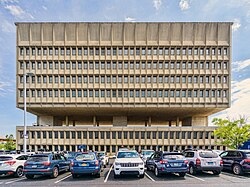
For years, the building was viewed by some as an eyesore, even being labeled as one of the city's ugliest buildings. Despite this, architectural historians recognized its value as a prime example of Breuer's work, leading to its eventual preservation and conversion.
The Path to Sustainability
The renovation between 2020 and 2022 turned the building into a global model for sustainable hospitality. By eliminating all fossil fuels from its operations, Hotel Marcel achieves net-zero energy, meaning the energy it uses is balanced by the amount of renewable energy it creates.
This transformation proves that even the most energy-inefficient structures of the past—such as concrete-heavy Brutalist buildings—can be retrofitted to meet the highest modern environmental standards.
| Feature | Detail |
|---|---|
| Original Name | Armstrong Rubber Company Building |
| Architectural Style | Brutalism |
| Total Floor Area | 107,100 sq ft |
| Floor Count | 9 (7 excluding two-story gap) |
| Number of Rooms | 165 |
| Parking | 130 surface spaces |
| Hotel Chain | Tapestry Collection by Hilton |
Frequently Asked Questions
What makes Hotel Marcel a "net-zero" hotel?
Hotel Marcel is designed to produce as much energy as it consumes over the course of a year, utilizing renewable energy sources and eliminating the use of fossil fuels for heating, cooling, and electricity.
Who was the architect of the original building?
The building was designed by the renowned modernist architect Marcel Breuer, in collaboration with Robert F. Gatje.
What is Brutalism in architecture?
Brutalism is a style that emerged in the mid-20th century, characterized by the use of raw, unfinished concrete, bold geometric shapes, and a focus on structural honesty and functionality.
Was the building always a hotel?
No, it was originally built between 1968 and 1970 as the headquarters for the Armstrong Rubber Company and later served as the Pirelli Tire Building before its conversion to a hotel.
Is the building recognized as a historic site?
Yes, the building was added to the U.S. National Register of Historic Places on April 29, 2021, recognizing its architectural significance.