Honam High-Speed Railway: Connecting Seoul to the Southwest
The Honam High-Speed Railway (Honam HSR) is a critical piece of South Korea's transportation infrastructure, designed to bridge the gap between the capital region and the southwestern provinces. By linking Osong—a key junction on the Gyeongbu high-speed line—to Mokpo, the Honam HSR significantly accelerates travel for millions of passengers and stimulates economic growth in the Jeollanam-do region.
As part of the Korea Train Express (KTX) system, this line replaces the reliance on conventional tracks for long-distance travel, drastically reducing journey times and enabling daily commuting between major urban centers like Seoul and Gwangju.
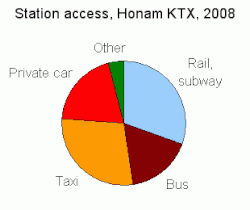
Key Facts
- Operational Status: Fully operational since April 2, 2015.
- Route: Connects Osong Station to Mokpo Station.
- Maximum Speed: Operating speeds reach up to 305 km/h (190 mph).
- Total Length: 230.99 km (143.53 mi).
- Major Impact: Reduced Seoul–Gwangju travel time from 2 hours 40 minutes to just 90 minutes.
- Infrastructure: Features a high percentage of viaducts (48.35%) and tunnels (21.26%).
History and Development
Origins and Planning
The project began as a plan to accelerate services on the existing route from Seoul to Mokpo. An initial 2003 feasibility study suggested a two-stage construction process due to demand concerns. The first stage focused on connecting a second Seoul terminus to the Gyeongbu HSR and extending a branch to Iksan. The second stage aimed to complete the extension to Gwangju and Mokpo by 2020.
Despite early skepticism regarding profitability, the South Korean government reversed its stance in 2005 due to local demand in the affected provinces. By August 2006, official plans were set with a total projected cost of approximately 10.57 trillion won for the 230.99 km line.
Construction and Inauguration
Construction on the Osong-to-Gwangju section began in December 2009. The project was financed through a split of 50% direct government funds and 50% loans. The line was officially inaugurated on April 1, 2015, by President Park Geun-hye at Gwangju Songjeong Station, entering revenue service the following day.
The engineering of the line was complex, requiring 111.7 km of viaducts and 49.12 km of tunnels to navigate the terrain efficiently.
Technical Specifications and Stations
The Honam HSR utilizes standard gauge (1,435 mm) tracks and is electrified via a 25 kV/60 Hz catenary system. It supports various rolling stock, including KTX-I, KTX-Sancheon, and SRT trains.
| Station | Line Distance | Distance from Seoul | Travel Time (Limited Stops) |
|---|---|---|---|
| Osong | 0.00 km | 121.4 km | - |
| Gongju | 43.8 km | 165.2 km | - |
| Iksan | 89.8 km | 211.2 km | 1h 01m |
| Jeongeup | 131.9 km | 253.3 km | - |
| Gwangju Songjeong | 182.4 km | 303.8 km | 1h 30m |
| Naju | 198.2 km | 319.6 km | - |
| Mokpo | 249.2 km | 370.6 km | - |
Service and Ridership
Honam KTX Operations
The Honam KTX service typically originates from Yongsan Station or Haengsin Station in Seoul. Before the full high-speed line was completed, services used the Gyeongbu HSR until Daejeon and then transitioned to the upgraded conventional Honam Line. The completion of the dedicated HSR tracks further optimized these travel times.
On-board amenities include first and standard class seating, vending machines, and multi-channel audio broadcasts for first-class passengers.
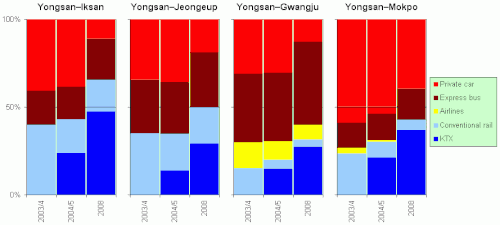
Market Impact and Ridership
Initial ridership in 2004 was lower than predicted, leading to selective fare reductions in 2005 to encourage use. However, ridership grew steadily, reaching 17,599 daily passengers by 2008. The service successfully captured market share from conventional trains, private cars, and air transport, particularly on routes between Yongsan and the endpoints of Mokpo and Gwangju.
Frequently Asked Questions
How much did the Honam HSR reduce travel time to Gwangju?
The journey time between Seoul and Gwangju was reduced from 2 hours 40 minutes to approximately 90 minutes, making daily commuting feasible.
Which stations are served by the Honam HSR?
The line includes stops at Osong, Gongju, Iksan, Jeongeup, Gwangju Songjeong, Naju, and Mokpo stations.
What types of trains operate on this line?
The line is used by KTX-I, KTX-Sancheon, and SRT rolling stock.
What is the maximum operating speed of the Honam HSR?
The trains on the Honam HSR can reach an operating speed of 305 km/h (190 mph).
How was the project funded?
The construction of the Honam HSR was financed equally, with 50% coming from direct government funds and 50% from loans.