Hodoyoshi Satellites: Advancing Earth Observation and Hosted Payload Technology
The Hodoyoshi satellite series serves as a critical platform for space-based technology verification. By testing advanced hardware in the harsh environment of orbit, these missions pave the way for more sophisticated satellite applications, ranging from high-resolution environmental monitoring to innovative commercial partnerships.
Primary Mission: High-Resolution Earth Observation
The central objective of the satellite is the verification of an Earth observation telescope. This instrument utilizes a pushbroom scan—a method where the sensor captures a line of pixels at a time as the satellite moves forward—to create detailed imagery of the planet's surface.
Operating at an altitude of 650 km, the telescope achieves a nominal Ground Sample Distance (GSD)—the distance between the centers of two adjacent pixels measured on the ground—of 6.7 meters. This allows for precise observation across a 24 km swath of land.
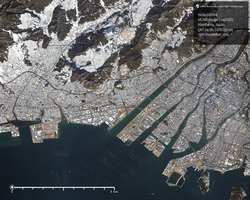
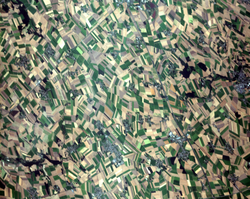
The imaging system captures data in four distinct spectral bands: Blue, Green, Red, and Near-Infrared (NIR). This multi-spectral approach enables the satellite to distinguish between different types of terrain and vegetation.
Secondary and Tertiary Objectives
Beyond its primary imaging goals, the satellite supports two additional missions designed to enhance utility and market exploration.
Flood Monitoring and Water Level Measurement
The secondary mission focuses on environmental safety through the measurement of river water levels. By utilizing a Store&Forward System—which collects data at one location and transmits it to a ground station at a later time—the satellite provides critical data for monitoring floods.
The Hosted Payload Program
The third mission involves a Hosted Payload system, designed to explore new markets in satellite utilization. This system consists of 10 cm-cubic boxes that allow external users to install their own specialized apparatuses via private partnerships.
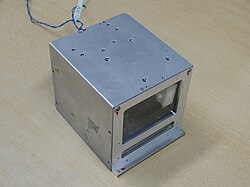
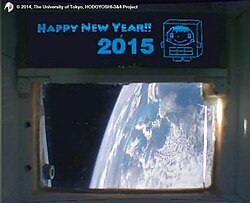
One notable application within this program is the Space Message Display System. This system features an electronic display that operators can update via commands from a ground station. This display is paired with an observation window, allowing users to capture photographs of their custom messages set against the backdrop of Earth.
Key Facts
- Primary Goal: Technology verification of an Earth observation telescope.
- Imaging Resolution: 5-7m GSD at an altitude of 600-650 km.
- Spectral Range: Covers Blue, Green, Red, and NIR bands.
- Swath Width: 24 km.
- Hosted Payload: 10 cm-cubic modular boxes for third-party apparatuses.
- Special Feature: An electronic message display system with an observation window.
Technical Specifications Summary
| Parameter | Specification |
|---|---|
| Ground Sample Distance (GSD) | 5-7m @ 600-650 km |
| Scan Type | Pushbroom scan |
| Telescope Diameter | 150 mm |
| Focal Length | 1,000 mm |
| Swath Width | 24 km |
| Data Format | Raw, 12-bit |
| Spectral Bands | Blue (0.45-0.52 μm), Green (0.52-0.60 μm), Red (0.63-0.69 μm), NIR (0.73-0.90 μm) |
Frequently Asked Questions
What is the primary purpose of the Hodoyoshi satellite?
The satellite is primarily intended for technology verification in space, specifically testing an Earth observation telescope with a nominal GSD of 6.7m at an altitude of 650 km.
How does the satellite monitor floods?
It performs measurements of water levels in rivers using a Store&Forward System to transmit data for flood monitoring.
What is a Hosted Payload in the context of this mission?
A Hosted Payload refers to 10 cm-cubic boxes where private partners can install their own apparatuses to explore new applications for satellite utilization.
How does the Space Message Display System work?
Operators send commands from a ground station to change characters on an electronic display. Because the display is located by an observation window, photos can be taken of the message with Earth in the background.
What spectral bands does the telescope use?
The telescope captures data in four bands: Blue (0.45-0.52 μm), Green (0.52-0.60 μm), Red (0.63-0.69 μm), and Near-Infrared (0.73-0.90 μm).