HMS Tracker: The Versatile Escort Carrier of World War II
The story of HMS Tracker is a testament to the rapid industrial mobilization of the Second World War. Originally conceived as a civilian merchant vessel, this ship underwent a dramatic transformation to become a vital asset in the Allied effort to secure the seas against Axis threats.
From Merchant Ship to Naval Powerhouse
The vessel began its life on November 3, 1941, under a Maritime Commission (MARCOM) contract as MC hull 233. Built by Seattle-Tacoma Shipbuilding in Tacoma, Washington, it was initially intended to be the Mormacmail, a replacement merchant ship for Moore-McCormack Lines, Inc. However, the urgent needs of the war effort led the US Navy to purchase the vessel before it was completed.
In 1942, the ship was designated as BACV-6 and sent to Willamette Iron & Steel in Portland, Oregon, to be converted into an escort carrier—a smaller, slower aircraft carrier designed to protect convoys from submarines and aircraft. After being launched on March 7, 1942, and commissioned on January 31, 1943, the ship was transferred to the Royal Navy and officially renamed HMS Tracker.
Combat Operations and Convoy Duty
Between 1943 and 1944, HMS Tracker played a critical role in safeguarding North Atlantic and Arctic convoys. These missions were perilous, requiring constant vigilance against German U-boats and harsh weather conditions.
The ship's air wing evolved to meet changing tactical needs. Initially, she operated Swordfish torpedo-bombers and Seafire fighters from the 816 Naval Air Squadron. By January 1944, the complement shifted to the more robust Grumman Avengers and Grumman Wildcats of the 846 Naval Air Squadron.
One of the ship's most significant achievements occurred in April 1944 during convoy JW 58. Aircraft from HMS Tracker, working in coordination with those from HMS Activity, successfully located and sank the German U-boat U-288 east of Bear Island.
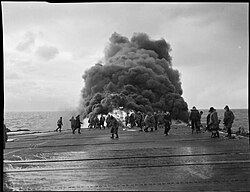
D-Day and Later Service
During the preparations for the D-Day landings in June 1944, HMS Tracker served as part of the antisubmarine screen for the Western Approaches Command. However, on June 10, 1944, the ship collided with the HMCS Teme, a River-class frigate of the Royal Canadian Navy. Despite suffering stove-in bows, HMS Tracker continued her operations until June 12, 1944, before heading to Liverpool for repairs and a partial refit.
Following her repairs, the ship's role shifted. On December 8, 1944, she sailed back to the United States to serve as an aircraft transport, spending the final months of the war ferrying personnel and planes across the Pacific theater.
Post-War Transition and Legacy
After a final voyage to the UK in August 1945, the vessel was returned to the US Navy in November 1945. Her military career ended shortly after when she was sold in November 1946. She returned to her merchant roots, serving as the Argentine ship Corrientes until she was finally scrapped in 1964.
| Category | Details |
|---|---|
| Original Name | Mormacmail (intended) / BACV-6 |
| Builder | Seattle-Tacoma Shipbuilding |
| Commission Date | January 31, 1943 |
| Primary Aircraft | Swordfish, Seafire, Grumman Avenger, Grumman Wildcat |
| Key Achievement | Sinking of U-288 (April 1944) |
| Final Fate | Scrapped in 1964 (as Corrientes) |
Key Facts
- Origin: Built in Tacoma, Washington, and converted in Portland, Oregon.
- Naval Transfer: Transferred from the US Navy to the Royal Navy in 1943.
- Combat Success: Contributed to the destruction of German U-boat U-288.
- Resilience: Continued operations for two days after a collision with HMCS Teme during the D-Day period.
- Versatility: Served as both an escort carrier and an aircraft transport.
Frequently Asked Questions
What was the original purpose of HMS Tracker?
HMS Tracker was originally intended to be a replacement merchant ship named Mormacmail for Moore-McCormack Lines, Inc., before being acquired by the US Navy.
Which aircraft did HMS Tracker carry during the war?
She initially carried Swordfish torpedo-bombers and Seafire fighters, later switching to Grumman Avengers and Grumman Wildcats.
What happened during the collision on June 10, 1944?
HMS Tracker collided with the Royal Canadian Navy frigate HMCS Teme, resulting in stove-in bows for the carrier, though she remained operational for two more days.
What were the battle honours awarded to HMS Tracker?
The ship earned battle honours for the Atlantic (1943-44), the Arctic (1944), and Normandy (1944).
What happened to the ship after World War II?
She was returned to the US Navy in 1945, sold in 1946, and operated as the Argentine merchant ship Corrientes until being scrapped in 1964.