Hiragana: The Graceful Foundation of the Japanese Writing System
Hiragana is one of the most essential components of the Japanese writing system. As a syllabary—a writing system where each symbol represents a specific syllable—it provides the phonetic backbone for much of the Japanese language. From casual correspondence to complex literature, Hiragana offers a fluid and graceful way to express sounds that are not easily captured by Chinese characters alone.
While modern Japanese uses a combination of Kanji (logographic characters), Katakana, and Hiragana, this specific script is celebrated for its curved, flowing aesthetic. It is used for grammatical particles, verb endings, and words for which Kanji might be overly complex or unavailable.
The Historical Evolution of Hiragana
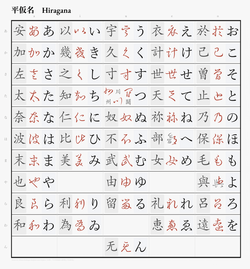
The origins of Hiragana can be traced back to Man'yōgana, a system used starting around the 5th century where Chinese characters (Kanji) were employed solely for their phonetic values rather than their meanings. Over time, these characters were written in a highly stylized, cursive manner.
This evolution led to the development of the script we recognize today. The forms of Hiragana are directly derived from the sōsho (cursive script) style of Chinese calligraphy. For example, the character あ (a) originated from an abbreviated version of the bottom portion of the Kanji 安.
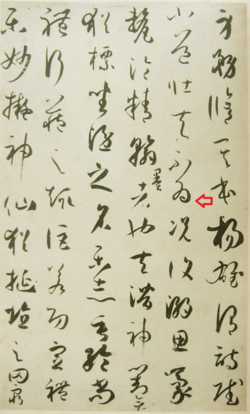
Historically, Hiragana was often associated with unofficial writing, such as personal letters, and was frequently used by women in literature. In contrast, Katakana and Kanji were traditionally reserved for official documents. Following a major script reform in 1900, the system was simplified to ensure each syllable had a single, standardized Hiragana character, a process that rendered many older variant forms, known as hentaigana, obsolete.
Understanding the Structure: The Gojūon
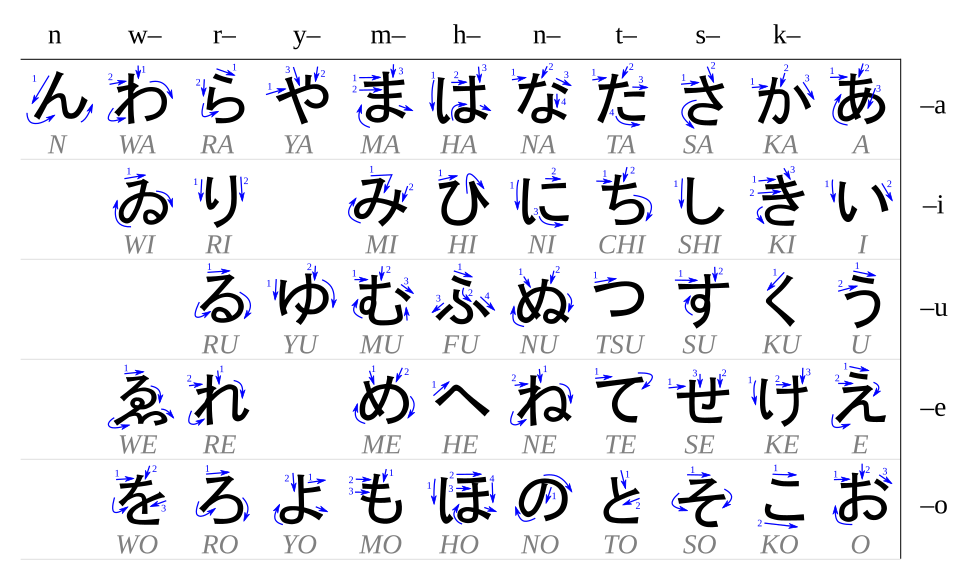
The Hiragana system is organized into a logical grid known as the gojūon (literally "fifty sounds"). This grid is structured around five singular vowels and various consonant-vowel combinations. Although the name implies fifty sounds, the modern standard set consists of 48 base characters.
The Core Components
- Five Vowels: あ (a), い (i), う (u), え (e), and お (o).
- Consonant-Vowel Unions: 42 combinations such as き (ki), て (te), and ほ (ho).
- The Nasal 'n': The character ん (n) is a singular consonant and sits outside the standard 5x10 grid.
- Special Characters: Two characters, ゐ (wi) and ゑ (we), are preserved in the system but are primarily used only in specific proper names.
To modify sounds, Japanese uses diacritics. The dakuten (voiced marks) and handakuten (semi-voiced marks) can transform sounds, such as turning か (ka) into が (ga) or は (ha) into ぱ (pa).
Summary of Hiragana Characteristics
| Feature | Details |
|---|---|
| Script Type | Syllabary |
| Period of Origin | c. 800 – present |
| Direction | Vertical (right-to-left) or Horizontal (left-to-right) |
| Base Characters | 48 (including ゐ and ゑ for proper names) |
| Parent System | Man'yōgana (via cursive Kanji) |
Key Facts
- Hiragana is a syllabary, meaning each character represents a syllable rather than a single letter or a whole word.
- The script is derived from the cursive forms of Chinese characters (Kanji).
- The gojūon is the traditional 5x10 grid used to organize the sounds.
- Modern spelling rules, established in 1986, govern how certain characters like ぢ (ji) and づ (zu) are used in compound words.
- The Iroha poem is a famous 10th-century pangram that uses every Hiragana character exactly once.
Frequently Asked Questions
What is the difference between Hiragana and Katakana?
While both are phonetic syllabaries, they serve different purposes. Hiragana is used for native Japanese words, grammar, and particles. Katakana is primarily used for foreign loanwords, names of animals, and for emphasis.
What are Hentaigana?
Hentaigana refers to variant forms of Hiragana that were used before the script was standardized in 1900. While they are no longer part of the modern standard, they are still recognized by scholars and encoded in Unicode.
How do diacritics change the pronunciation?
Diacritics like the dakuten (small dots) and handakuten (small circle) are added to base characters to change their sound. For example, adding a dakuten to the "k" row (か, き, く, け, こ) changes the sounds to the "g" row (が, ぎ, ぐ, げ, ご).
Why are some characters like ゐ and ゑ rarely used?
These characters (wi and we) were part of the historical phonetic system but have become uncommon in modern Japanese speech and writing. They are now mostly restricted to specific historical contexts or certain proper names.
What is the 'n' character (ん) in Hiragana?
The character ん is unique because it is the only Hiragana character that represents a single consonant (a nasal sound) without an accompanying vowel. Because of this, it is considered to be outside the standard 5x10 gojūon grid.