Hierarchy: Structures of Order Across Science and Society
At its most basic level, a hierarchy is an arrangement of items—such as objects, names, values, or categories—represented as being "above," "below," or "at the same level" as one another. Derived from the Ancient Greek hierarkhía (meaning "rule of a high priest"), the concept has evolved from its religious origins to become a fundamental tool for organizing information and power across nearly every field of human study.
From the architecture of a computer's memory to the chain of command in a military unit, hierarchies allow us to simplify complex systems by establishing clear relationships of authority, importance, or containment.
![The mediaeval scala naturae as a staircase, implying the possibility of progress:[1] Ramon Llull's Ladder of Ascent and Descent of the Mind, 1305](/images/c8/fd/c8fd11f1e280d58abb44390371f9c5cded4653edc351821e0df1d2cb5ba36b04.jpg)
Key Facts
- Universal Application: Used in biology, computer science, philosophy, linguistics, and political science.
- Directional Links: Entities can be linked vertically (superior/subordinate) or horizontally (peers).
- Structural Variety: Includes nested, containment, and overlapping hierarchies.
- Alternative Models: Heterarchy serves as a non-ranked alternative to traditional hierarchical organization.
The Mechanics of Hierarchical Systems
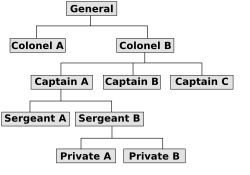
A hierarchy functions by linking entities either directly or indirectly. The only direct links exist between an immediate superior and their immediate subordinate. However, these links can extend vertically through multiple paths to connect distant ancestors or descendants.
When two entities are not linked vertically, they may be linked "horizontally." This occurs when two objects share a common superior but possess the same relative authority, effectively making them colleagues or co-workers.
Core Nomenclature
To accurately describe a hierarchy, specific terminology is used to define the roles and positions of the objects within the system:
- Object: A single entity, such as a person, department, or member of a set.
- System: The entire set of objects being arranged (e.g., a corporate administration).
- Rank: The relative value, power, importance, or complexity of an object.
- Level or Tier: A group of objects that share the same rank.
- Superior: An object at a higher level (also known as a parent or ancestor).
- Subordinate: An object at a lower level (also known as a child or descendant).
- Leaf: A member at any level who has no subordinates.
- Peer: An object with the same rank as another.
- Span: The number of subordinates a single object possesses.
Types of Hierarchical Representations
Hierarchies are not one-size-fits-all; they vary based on how the objects relate to one another.
Nested and Containment Hierarchies
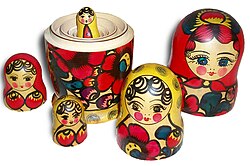
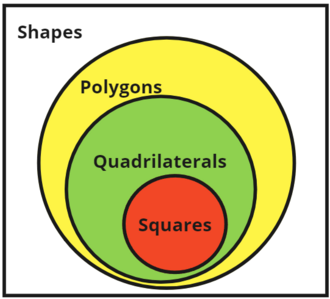
A nested hierarchy occurs when each element is encompassed within another, similar to Russian Matryoshka dolls. A containment hierarchy describes a system where a set of items is completely contained within a larger set (for example, all squares are contained within the set of quadrilaterals).
Overlapping Hierarchies
Some systems are more complex than a simple tree. An overlapping hierarchy occurs when an object has multiple parents. A prime example is the Canadian postal code system, where "zones" (digits 0–9) are linked to multiple "postal districts" (letters), creating a complex web of associations rather than a linear path.
Applications Across Disciplines
Hierarchies appear in diverse contexts, often serving as the primary method for classification and analysis.
Science and Technology
- Biology: Used in biological classification (taxonomy) and phylogenetic trees to track evolutionary development.
- Computer Science: Essential for memory hierarchies (cache), file systems, and object-oriented programming through inheritance.
- Physics: Applied to the organization of the universe, from star systems to subatomic structures.
Arts and Humanities
- Music: Schenkerian analysis views musical compositions as hierarchies, moving from the detailed "foreground" to the fundamental "background" (Ursatz).
- Linguistics: Utilized in parse trees and the study of language family trees.
- Philosophy: Used to categorize levels of consciousness or spiritual development.
| Field | Example of Hierarchy | Primary Function |
|---|---|---|
| Organizational | Military Chain of Command | Authority and Reporting |
| Information | Dewey Decimal Classification | Knowledge Categorization |
| Biology | Taxonomy | Species Classification |
| Technology | IP Address Structure | Network Routing |
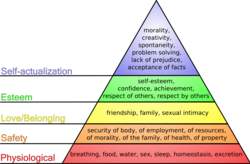
| Psychology | Maslow's Hierarchy of Needs | Prioritization of Needs |
Frequently Asked Questions
What is the difference between a hierarchy and a heterarchy?
A hierarchy is a ranked system where elements are placed above or below one another. A heterarchy is an alternative form of organization where elements are unranked and do not follow a strict vertical chain of command.
What is a "leaf" in a hierarchical system?
A leaf is a member of a hierarchy that does not have any subordinates. It represents the end of a specific branch in the organizational tree.
How does a containment hierarchy work?
A containment hierarchy organizes items based on inclusion. For example, in a geometric hierarchy, a "square" is contained within the category of "rectangles," which is further contained within "quadrilaterals."
Can a hierarchy have more than one parent?
Yes. While traditional trees have one parent per node, overlapping hierarchies allow an object to have multiple superiors, as seen in certain postal code or database systems.