Hickam Air Force Base: A History of America's Bridge Across the Pacific
Strategically positioned in the heart of the Pacific, Hickam Air Force Base has served as a cornerstone of American aerial power for nearly a century. From its origins as a solution to congestion at Luke Field to its current role as a global logistics hub, the base has witnessed the evolution of military aviation and played a pivotal role in some of the most significant events of the 20th century.
Origins and Early Construction
In 1934, the Army Air Corps identified a critical need for a new airfield in Hawaii, as Luke Field on Ford Island had become too crowded to support both air operations and the Hawaiian Air Depot. To address this, the War Department purchased 2,225 acres of land and fishponds from the Bishop, Damon, and Queen Emma estates for $1,095,543.78. This acquisition marked the largest peacetime military construction project in the United States at that time.
The Quartermaster Corps, led by Capt. Howard B. Nurse, transformed the site—which consisted of ancient coral reef covered by thin soil—from sugar cane fields and algaroba brush into a modern airdrome. The facility was dedicated on May 31, 1935, and named after Lt Col Horace Meek Hickam, an aviation pioneer who died in a night landing accident in Texas in November 1934.
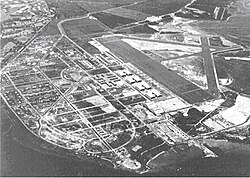
Operations began modestly on September 1, 1937, with 12 men and four aircraft. By September 15, 1938, the field was officially activated. A defining feature of the base was the "Hickam Hotel," a massive three-story, nine-winged barracks completed in 1940. Costing $1,039,000, it was the largest structure on any American military installation, housing 3,200 men and featuring its own medical dispensary, laundry, and mess hall.
The Path to World War II
As the principal army airfield in Hawaii, Hickam was the only local facility capable of accommodating the B-17 Flying Fortress, a heavy bomber essential for Pacific defense. Throughout 1941, the base saw a surge in activity as aircraft arrived to prepare for potential hostilities, including a mass flight of 21 B-17Ds from California in May 1941.
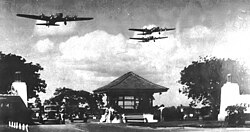
By December 1941, the integrated Hawaiian Air Force consisted of 754 officers and 6,706 enlisted men, operating 233 aircraft across Hickam, Wheeler Field, and Bellows Field.
The Attack on Pearl Harbor and World War II
On December 7, 1941, the Imperial Japanese Navy targeted Hickam in a bombing and strafing campaign intended to neutralize American air opposition. The attack resulted in devastating losses, with 189 people killed and 303 wounded. During the chaos, unarmed B-17s arriving from California were attacked while attempting to land, forcing some to divert to other airfields.
The attack also saw extraordinary bravery from civilian responders. Nine Honolulu Fire Department (HFD) firefighters fought the resulting blazes; three were killed and six injured. These men became the only civilian firefighters in peacetime history to be awarded the Purple Heart.
Following the attack, Hickam evolved into a major center for pilot training and aircraft assembly. It became the central hub for the Pacific aerial network, ferrying troops and supplies to forward areas and evacuating the wounded, earning the nickname "America's Bridge Across the Pacific."
The Cold War and Modern Era
In the post-war era, the base transitioned through various commands, including the Military Air Transport Service (MATS). In 1957, the Headquarters Far East Air Forces moved from Japan to Hawaii and was redesignated as the Pacific Air Forces (PACAF).
During the 1960s and 1980s, the 15th Air Base Wing supported high-profile missions, including NASA's Apollo astronauts and Space Shuttle flights. The base also managed critical humanitarian and diplomatic operations, such as Operation Homecoming (POW return from Vietnam in 1973) and Operation Babylift/New Life (evacuating nearly 94,000 refugees from Southeast Asia in 1975).
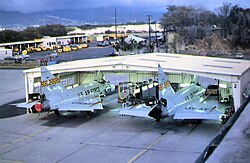
In 2003, the 15th Air Base Wing became the 15th Airlift Wing to accommodate the C-17 Globemaster III, the Air Force's newest transport aircraft, which first arrived in February 2006.
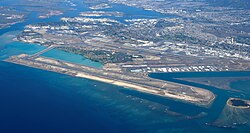
Preserving History
Recognized for its role in the Pacific campaign, Hickam AFB was designated a National Historic Landmark on September 16, 1985. The base maintains several physical reminders of the 1941 attack, including bullet holes in WWII-era hangars and the base hospital. The tattered American flag that flew during the attack is displayed in the PACAF Headquarters, a building whose bullet-scarred walls were once part of the "Big Barracks."
Key Facts
- Nickname: "America's Bridge Across the Pacific."
- Land Area: 2,225 acres purchased in 1934.
- Historic Landmark: Designated a National Historic Landmark in 1985.
- Major Aircraft: Historically hosted the B-17 Flying Fortress; currently operates the C-17 Globemaster III and C-37B/C-40 Clipper.
- Casualties: 189 killed and 303 wounded during the December 7, 1941 attack.
| Period | Assigned Command |
|---|---|
| 1935–1940 | Hawaiian Dept, United States Army |
| 1940–1942 | Hawaiian Air Force |
| 1942–1946 | Seventh Air Force / AAF Pacific Ocean Areas |
| 1946–1955 | Pacific Air Command / Military Air Transport Service |
| 1955–1957 | Far East Air Forces |
| 1957–Present | Pacific Air Forces (PACAF) |
Accidents and Incidents
The region's aviation history is also marked by tragedy. On March 22, 1955, a U.S. Navy Douglas R6D-1 Liftmaster crashed into Pali Kea Peak during heavy rain and darkness. All 66 people on board perished, marking the deadliest heavier-than-air accident in U.S. naval aviation history and the worst air disaster in Hawaii.
Frequently Asked Questions
Who was the base named after?
The base was named in honor of Lt Col Horace Meek Hickam, an aviation pioneer who was killed in an aircraft accident in November 1934 while practicing night landings in Galveston, Texas.
What was the "Hickam Hotel"?
The "Hickam Hotel" was the nickname for the main barracks, a massive three-story, nine-winged structure completed in 1940 that housed 3,200 men and included various services like a medical dispensary and a consolidated mess hall.
Why is Hickam called "America's Bridge Across the Pacific"?
It earned this nickname due to its role as the central hub of the Pacific aerial network, supporting the transport of troops and supplies to forward areas and the evacuation of wounded personnel during World War II, the Korean War, and the Vietnam War.
Which civilian group received Purple Hearts for their actions at Hickam?
Nine firefighters from the Honolulu Fire Department (HFD) received Purple Hearts for their heroism while fighting fires during the December 7, 1941 attack; they are the only civilian firefighters to receive this honor in peacetime history.
What current aircraft are operated by the 65th Airlift Squadron at Hickam?
The 65th Airlift Squadron utilizes C-37B and C-40 Clipper aircraft to transport senior military leaders throughout the world.