Heraldic Eagles: History, Symbolism, and Evolution in Global Armory
The eagle is one of the most enduring and powerful symbols in human history, serving as a charge (a figure placed on a shield), a supporter, and a crest in heraldry. From the ancient Achaemenid Empire to the modern Republic of Indonesia, the eagle has consistently represented power, divinity, and sovereignty. In European traditions, its symbolism is primarily split between the political legacy of the Roman Empire—most notably through the double-headed eagle—and the religious iconography of Saint John the Evangelist.
Key Facts
- Ancient Origins: Used by the Achaemenid Empire to symbolize khvarenah (God-given glory).
- Imperial Symbolism: The Reichsadler (Imperial Eagle) became the definitive symbol of the Holy Roman Empire.
- Double-Headed Meaning: In the Byzantine Empire, the two heads symbolized the West (Rome) and the East (Constantinople).
- Evolution: Heraldic depictions shifted from curled wing edges in the 13th century to more ornate and ferocious styles by the 16th century.
- Global Reach: Modern usage spans from the United States' Great Seal to the national emblems of Russia, Germany, and Egypt.
Ancient and Early European Origins
Long before the formalization of European heraldry, the golden eagle appeared on the banners of the Achaemenid Empire of Persia. Legend suggests the founder, Achaemenes, was raised by an eagle, linking the dynasty to the bird's divine glory. This tradition continued through the Seleucid and Parthian eras, where eagles often served as banner finials.
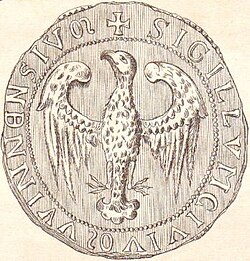
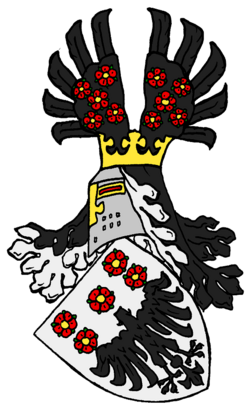
In early European proto-heraldry of the 12th century, the eagle was not always tied to imperial or biblical themes. For example, the Anglo-Norman L'Aigle family used the bird as canting arms (a visual pun on their name). The earliest documented use of the eagle as a formal heraldic charge appears in the Great Seal of Leopold IV of Austria in 1136.
The Imperial Eagle and the Holy Roman Empire
![Or two eagles sable armed gules for Homberg (Zürich armorial, c. 1340). At this time, the black-on-gold eagle could still be used for a family of the lower nobility without association to the imperial eagle.[a]](/images/61/4a/614af511ae5638d40ae73dfed38e31e2b8d601d2fd243ef3933427cb87e24ac4.jpg)
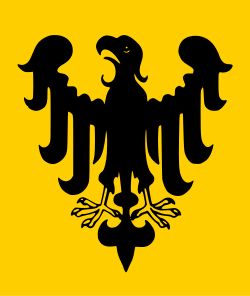
By the late medieval period, the eagle became inextricably linked to the Holy Roman Empire. The Reichsadler (Imperial Eagle) became so dominant that the bird was rarely used as an independent charge outside of imperial contexts. In Italy, the Ghibelline faction—those loyal to the Emperor—displayed a black eagle in the capo dell'impero (chief of the empire) on their coats of arms.
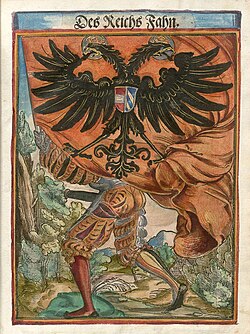
The transition from a single-headed to a double-headed eagle was gradual. While the single-headed eagle was used on the Königsfahne (royal banner) during the 14th century, the double-headed version became the standard for Habsburg emperors starting with Frederick III in 1440. Eventually, a distinction was made: the double-headed eagle represented the Emperor, while the single-headed eagle represented the heir apparent (the King of the Romans).
Evolution of Visual Depiction
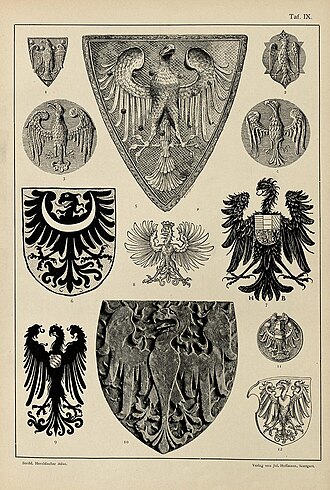
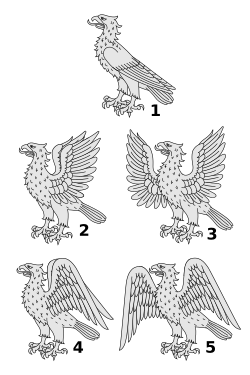
The artistic rendering of the heraldic eagle evolved significantly between the 12th and 16th centuries:
- 13th Century: Characterized by raised heads, closed beaks, and wing edges rolled into spirals.
- Late 14th Century: Beaks opened to reveal the tongue; wing spirals disappeared, and tail feathers began to curve.
- 15th Century: Wing edges became half-circles with radiating feathers, and legs were positioned at right angles.
- 16th Century: The style became highly ornamental, extravagant, and ferocious.
The Byzantine and Eastern Influence
![Royal coat of arms for Frederick IV of Germany (1446)[3]](/images/42/c8/42c820b36235d67d2dfc027b5f7d665259eb4f424871f463938baa600e3fb8ac.webp)
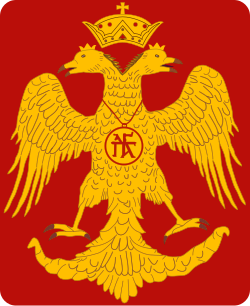
The double-headed eagle first appeared in Byzantine art during the 10th century, though it only became a formal imperial emblem by the 15th century. This symbol represented the empire's dual reach over both the East and the West. This motif was later adopted by other Balkan states, including Serbia, Bulgaria, and Albania.
The influence extended to Russia after 1472, when Ivan III married Sophia Palaiologos, daughter of Thomas Palaiologos, bringing the Byzantine double-headed eagle to Muscovy.
Dynastic and Religious Eagles
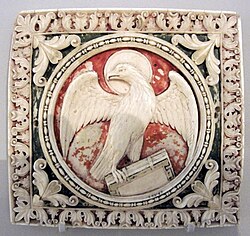
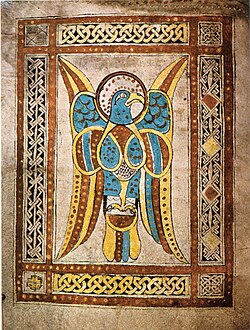
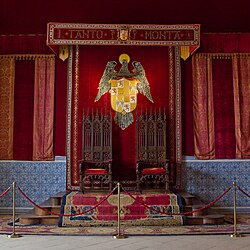
Beyond empires, the eagle served specific dynastic and religious purposes. The Eagle of Saint John is a recurring motif in Christian art and was historically used in the armorial achievements of Spain.
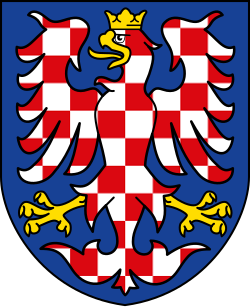
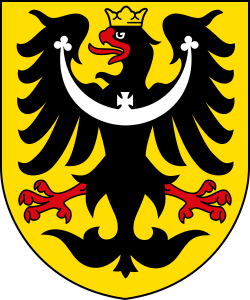
In Eastern Europe, the Piast and Přemyslid dynasties utilized the eagle. The Silesian Piasts were the first of their dynasty to adopt the bird, followed by Przemysł II, who used the Polish Eagle to represent all of Poland in 1295. Similarly, the Margraviate of Moravia utilized a chequered eagle starting in the 1270s.
Modern National Emblems
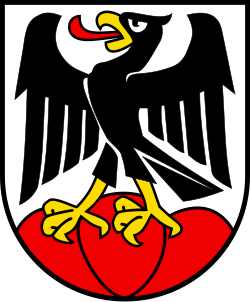
Today, the eagle remains a primary symbol for many sovereign states, appearing in both stylized heraldic and naturalistic forms.
| Country | Eagle Type/Origin | Significance |
|---|---|---|
| Germany | Bundesadler | Continuation of the Reichsadler design. |
| Russia | Double-headed Eagle | Derived from the Byzantine imperial eagle. |
| United States | Bald Eagle | Naturalistic representation on the Great Seal. |
| Indonesia | Garuda | Mythological bird styled after the Javan hawk-eagle. |
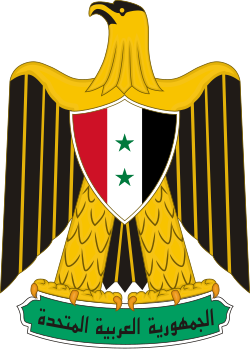
| Egypt/Syria | Eagle of Saladin | Symbol of Arab nationalism. |
| Namibia | African Fish Eagle | Regional naturalistic symbol. |
The Napoleonic Imperial Eagle
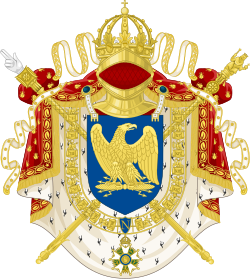
Napoleon I utilized a specific naturalistic bronze eagle as a regimental standard. Weighing 1.85 kg and standing 310 mm high, these sculptures were mounted atop blue flagpoles. For French Imperial regiments, the eagle was a sacred object; losing it in battle was considered a profound disgrace.
Frequently Asked Questions


What is the difference between a single-headed and double-headed heraldic eagle?
Historically, in the Holy Roman Empire, the double-headed eagle represented the Emperor, while the single-headed eagle represented the heir apparent. In the Byzantine context, the two heads symbolized the empire's dominion over both the East (Constantinople) and the West (Rome).
What are "canting arms" in relation to the eagle?
Canting arms are heraldic designs that create a visual pun on the bearer's name. An example is the Anglo-Norman L'Aigle family, who used an eagle (aigle in French) as their emblem because it sounded like their surname.
How did the depiction of the heraldic eagle change over time?
The eagle evolved from a stiff, stylized bird with curled wing edges and closed beaks in the 13th century to a more naturalistic and eventually highly ornate, ferocious-looking creature by the 16th century.
Which modern countries still use the Byzantine double-headed eagle?
Russia and Montenegro both utilize the double-headed eagle in their national symbols, a tradition that traces back to the Byzantine Empire and the Palaiologos dynasty.
What is the Eagle of Saladin?
The Eagle of Saladin is a heraldic symbol used by several Arab nations, including Egypt and Syria, serving as a symbol of strength and Arab unity.