Henry IV: The Rise and Reign of the First Lancastrian King
Henry IV, born as Henry Bolingbroke around April 1367 at Bolingbroke Castle, was a pivotal figure in English history who shifted the course of the monarchy. Ruling from 1399 to 1413, he was the first monarch from the House of Lancaster and the first English ruler since the Norman Conquest over 300 years prior whose native language was English rather than French.
The son of John of Gaunt and Blanche of Lancaster, and grandson of King Edward III, Henry's path to the throne was marked by political volatility, exile, and a daring usurpation that would leave a lasting legacy of dynastic instability in England.
Key Facts
- Reign: 30 September 1399 – 20 March 1413.
- Dynasty: House of Lancaster.
- Predecessor: Richard II (deposed).
- Successor: Henry V (his eldest son).
- Notable Achievement: First English-speaking native monarch since 1066.
- Major Conflicts: Rebellions by Owain Glyndŵr and the Percy family.
Early Life and Education
Henry's upbringing was designed to prepare him for leadership and nobility. In 1374, Thomas Burton was appointed as his tutor, followed by William Montendre, a Gascon who instructed him in military affairs in 1376. He gained literacy in English, French, and some Latin under the guidance of his long-time chaplain, Hugh Herle.
As a young man, Henry excelled in the traditional pursuits of the aristocracy, becoming a highly successful jouster and frequenting hunts with his father. His early life was not without peril; during the Peasants' Revolt of 1381, he was besieged in the Tower of London and narrowly escaped death, saved by a man named John Ferrour of Southwark.
The Path to the Throne
Henry's relationship with his cousin, King Richard II, was fraught with tension. Henry was involved in the 1388 revolt of the Lords Appellant against the King, which eventually led to his exile from England in 1397.
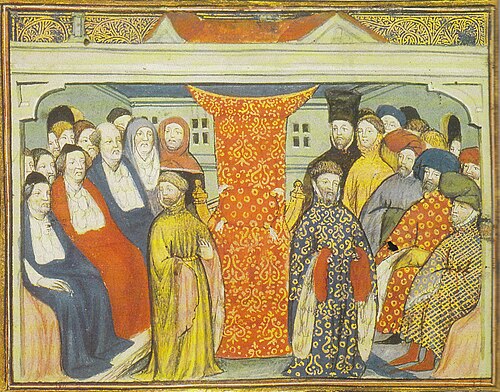
The turning point came in 1399 following the death of Henry's father, John of Gaunt. When Richard II blocked Henry's inheritance of the House of Lancaster holdings, Henry rallied his supporters, returned to England, and imprisoned the King. By formally deposing Richard II and usurping the throne, Henry established the Lancastrian dynasty, though this act of seizure planted the seeds for the future dynastic disputes known as the Wars of the Roses.
Challenges of the Reign
Henry IV's tenure was characterized by a constant struggle for legitimacy and the suppression of internal threats. One of his first dilemmas was the fate of the deposed Richard II. Following a foiled assassination plot in January 1400, Richard died in prison; while some suggest he starved himself, others believe it was on Henry's orders. Forensic examination of the skeleton later showed no signs of violent death.
Internal Rebellions
The first decade of his reign was plagued by uprisings. Most notable were the efforts of Owain Glyndŵr, who declared himself Prince of Wales in 1400, and the rebellions led by Henry Percy, 1st Earl of Northumberland.
The Percy rebellion culminated in the Battle of Shrewsbury in 1403. This conflict resulted in the death of Henry "Hotspur" Percy and saw the King's eldest son, Henry of Monmouth (the future Henry V), wounded by an arrow in the face. Despite the injury, the battle ended in a royalist victory.
Foreign Relations and Crusades
Beyond the borders of England, Henry pursued religious and military ambitions. In 1392, he led a small army of over 100 men, including longbow archers, on an expedition to Lithuania. Though costly, the attacks on Vilnius were fruitless. He also undertook a pilgrimage to Jerusalem in 1392–93, where he vowed to lead a crusade to free the city, a goal he never achieved before his death.
![Manuel II Palaiologos (left) with Henry IV (right) in London, December 1400[37]](/images/0a/0d/0a0d067db41cbf802151020ad3e6adb29ab18446ceb0501708130cb298dbbb0c.png)
Family and Succession
Henry's first marriage to Mary de Bohun in 1381 produced six children, including the future Henry V. This large number of male heirs was a critical factor in making his claim to the throne more acceptable to the nobility. After Mary's death in 1394, Henry married Joan of Navarre in 1403, though this union produced no surviving children.
As the King's health declined, his eldest son, Henry of Monmouth, began assuming the reins of government in 1410. Henry IV died on 20 March 1413, at the age of 45, in the Jerusalem Chamber, Westminster, and was buried in Canterbury Cathedral.
| Category | Details |
|---|---|
| Born | c. April 1367, Bolingbroke Castle |
| Died | 20 March 1413, Westminster |
| Spouses | Mary de Bohun, Joan of Navarre |
| Key Successor | Henry V |
| Primary Rival | Richard II |
| Burial Site | Canterbury Cathedral |
Frequently Asked Questions
How did Henry IV become King of England?
Henry IV took the throne by deposing his cousin, Richard II, in 1399. After Richard blocked Henry's inheritance of the House of Lancaster estates following the death of his father, John of Gaunt, Henry rallied supporters, imprisoned Richard, and usurped the crown.
Who was "Hotspur" and why was he significant?
Henry Percy, known as "Hotspur" for his speed and readiness to attack, was a renowned military figure who led a rebellion against Henry IV. He was killed during the Battle of Shrewsbury in 1403, which was a decisive victory for the King.
What was the significance of Henry IV's native language?
Henry IV was the first English monarch since the Norman Conquest (1066) whose mother tongue was English rather than French, marking a cultural shift in the English royal court.
Did Henry IV have any children with his second wife?
No. While Henry IV had six children with his first wife, Mary de Bohun, his second marriage to Joan of Navarre produced no surviving children, including a set of stillborn twins in 1403.
How did the reign of Henry IV contribute to the Wars of the Roses?
By deposing Richard II and seizing the throne, Henry IV established a precedent of usurpation. This created a dynastic dispute between the House of Lancaster and other claimants, eventually leading to the Wars of the Roses (1455–1487).