Hellenistic periodAlexander the GreatDiadochiPtolemaic KingdomSeleucid Empire

Hellenistic Period: The Expansion of Greek Culture and Power

Hellenistic Period: The Expansion of Greek Culture and Power The Hellenistic period represents a transformative era of ancient history, spanning from the death of Alexander the Great in 3...

Hellenistic Period: The Expansion of Greek Culture and Power

The Hellenistic period represents a transformative era of ancient history, spanning from the death of Alexander the Great in 323 BC to the eventual dominance of the Roman Empire. This epoch was characterized by the spread of Greek language, art, and administration across a vast territory stretching from the Eastern Mediterranean to Central and South Asia.

While historians debate the exact end date—with suggestions ranging from the Roman conquest of Greece in 146 BC to the move of the Roman capital to Constantinople in AD 330—the most widely accepted conclusion is 31/30 BC, marking the final defeat of the Ptolemaic Kingdom at the Battle of Actium.
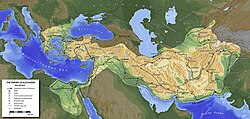
Alexander's empire at the time of its maximum expansion

Key Facts

A papyrus document (Papyrus Bingen 45) received in February 33 BC granting tax exemptions to a person in Egypt with γινέσθωι (ginésthōi; lit. "make it happen" or "so be it") added in Greek, possibly by Cleopatra's own hand[17][18]
  • Timeline: Generally accepted as 323 BC to 30 BC.
  • Geographic Reach: Extended across the Middle East, Central Asia, and South Asia.
  • Core Dynasties: Dominated by the Ptolemies in Egypt and the Seleucids in Asia.
  • Cultural Impact: Facilitated Hellenization, the spread of Greek culture and language to non-Greek peoples.
  • End Point: Most scholars mark the end with the fall of the Ptolemaic Kingdom.

Historical Foundations and the Rise of Macedon
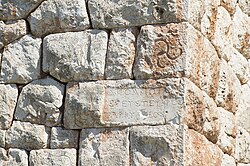
Inscriptions on the bricks of the Hellenistic tower in Kanlıdivane

Before the Hellenistic era, Greece was a fragmented collection of independent city-states, or poleis. Following the Peloponnesian War and subsequent shifts in power between Sparta and Thebes, the northern kingdom of Macedon rose to prominence under King Philip II. Although some southern Greeks viewed Macedon as less urbanized, the Argead dynasty claimed Greek descent and utilized a strong centralized monarchy to achieve predominance.
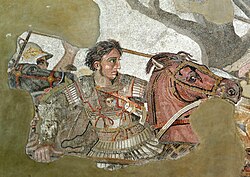
Alexander fighting the Persian king Darius III. From the Alexander Mosaic, Naples National Archaeological Museum

The Diadochi and the Fragmentation of Empire
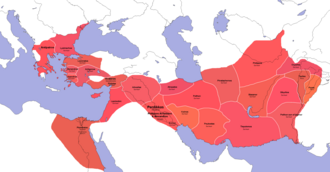
The distribution of satrapies in the Macedonian Empire after the Settlement in Babylon (323 BC)

Following Alexander's death, his generals, known as the Diadochi (successors), fought for control of his vast territories. This struggle led to the creation of several major Hellenistic kingdoms.

The Major Eastern Powers

The Seleucid Empire, founded by Seleucus I Nicator, controlled much of the Near East, while the Ptolemaic Kingdom established a powerful dynasty in Egypt. Other significant entities included Attalid Pergamum and various minor monarchies in Anatolia, such as Bithynia.
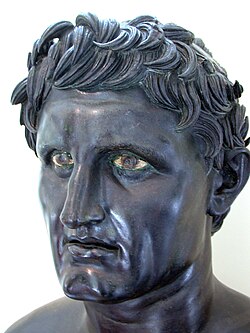
Seleucus I Nicator founded the Seleucid Empire.

The Far East: Greco-Bactrians and Indo-Greeks

In the furthest reaches of the empire, the Greco-Bactrian kingdom emerged as a breakaway satrapy (a provincial governor's territory) in present-day Afghanistan. Under leaders like Euthydemus and later the Indo-Greek king Menander I Soter, Greek influence reached as far as the Punjab region of India. Menander is notably remembered in Buddhist texts as 'Milinda' and was a significant patron of Buddhism.
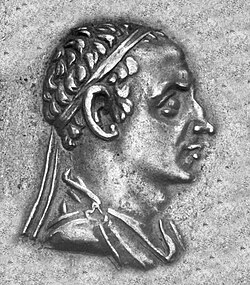
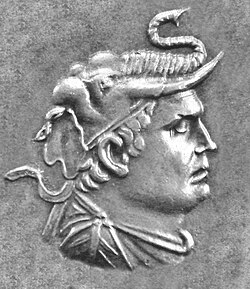
Menander I Soter (r. 165/155–130 BC), wearing a royal diadem as shown on his silver coin, was one of the most powerful Indo-Greek kings.

Hellenism in Europe and the Mediterranean
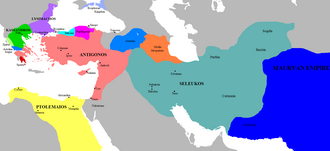
The kingdoms of Antigonos and his rivals c. 303 BC

Greek influence was not limited to the east. In Southern Italy and Sicily, known as Magna Graecia, figures like Agathocles of Syracuse expanded their power, imitating the royal styles of the eastern monarchs. In Iberia, the city of Emporion served as a vital trading hub and center of Hellenistic civilization before becoming fully Romanized.
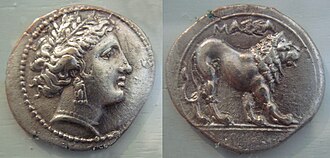
A silver drachma from Massalia (modern Marseille, France), dated 375–200 BC, with the head of the goddess Artemis on the obverse and a lion on the reverse

The Kingdom of Macedon and the Roman Shadow

In the Greek heartland, Philip V of Macedon attempted to unite Greece and preserve its independence against the rising power of the Roman Republic. Despite his efforts, the Roman Republic's expansion eventually absorbed the Greek leagues and the Macedonian kingdom.
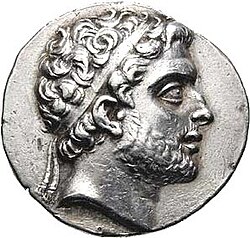
Philip V, "the darling of Hellas", wearing the royal diadem

Regional Interactions and Cultural Synthesis
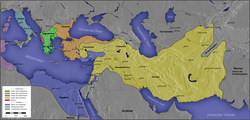
Kingdoms of the Diadochi after the battle of Ipsus, c. 301 BC

The Hellenistic period was defined by the blending of Greek and local cultures. In Parthia, the Arsacids adopted Greek as an administrative language and integrated Greek deities with Iranian gods. In Judea, the era saw a conflict between Hellenized Jews and those adhering to orthodox Judaism, leading to the rise of the Hasmonean dynasty.
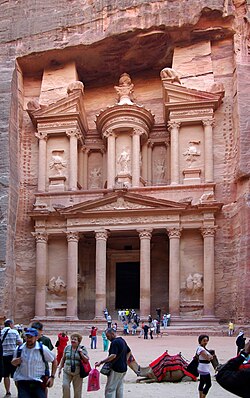
Al-Khazneh in Petra shows the Hellenistic influences on the Nabatean capital city.

Even under the rule of Herod the Great, a Roman client king, the architecture of the Second Temple showed significant Hellenistic influence, demonstrating that Greek aesthetic and structural standards remained prestigious long after political independence vanished.
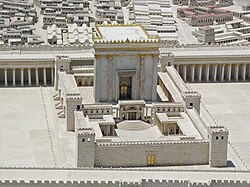
Reconstruction of the Second Temple in the Holyland Model of Jerusalem

Historical Records and Sources

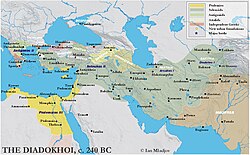
The major Hellenistic kingdoms in 240 BC, including territories controlled by the Seleucid dynasty, the Ptolemaic dynasty, the Attalid dynasty, the Antigonid dynasty, and independent poleis of Hellenistic Greece

Much of our knowledge comes from later historians, as few complete works from the first century after Alexander survive. Polybius of Megalopolis is the most credible surviving source, providing a detailed account of the years 220 to 167 BC. Other vital contributions include Diodorus Siculus, Plutarch, and Appian of Alexandria.

One of the oldest surviving fragments of Euclid's Elements, found at Oxyrhynchus and dated to c. AD 100 (P. Oxy. 29). The diagram accompanies Book II, Proposition 5.[137]

Kingdom/Region Key Figures Primary Region Notable Characteristic
Ptolemaic Kingdom Ptolemy I Egypt Last Hellenistic kingdom to fall
Seleucid Empire Seleucus I Nicator Near East / Asia Largest of the successor states
Indo-Greek Kingdoms Menander I Soter Northwestern India / Punjab Synthesis of Greek and Buddhist culture
Kingdom of Macedon Philip V Balkans / Greece Last major Greek bulwark against Rome
Parthian Empire Arsaces I Iran / Mesopotamia Adopted Greek administration and art

Frequently Asked Questions
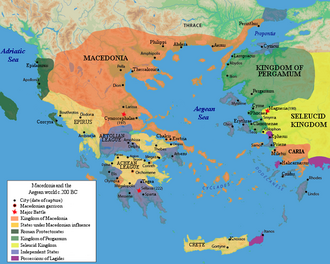
Greece and the Aegean world c. 200 BC
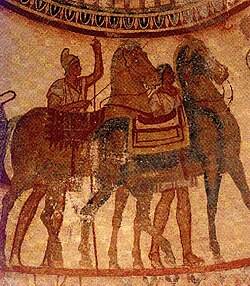
Painting of a groom and bride from the Hellenistic Thracian Tomb of Kazanlak, near the ancient city of Seuthopolis, 4th century BC
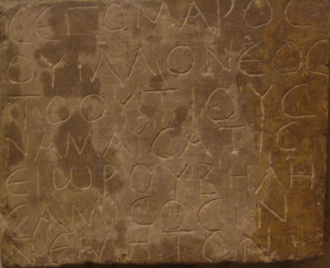
Gallo-Greek inscription: "Segomaros, son of Uillū, citizen (toutious) of Namausos, dedicated this sanctuary to Belesama"
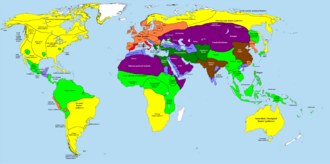
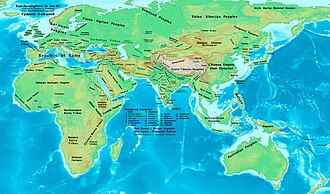
Map of the world in 200 BC, showing the Hellenistic kingdoms (dark green) and Bithynia
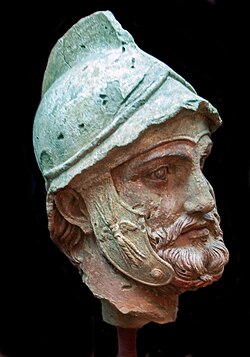
The Nisa helmeted warrior, a Hellenistic figure or deity, from the Parthian royal residence and necropolis of Nisa, Turkmenistan, 2nd century BC
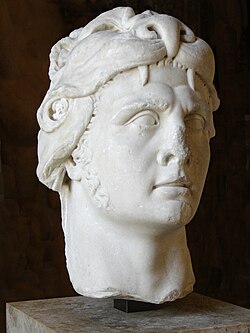
Bust of Mithridates VI depicted as Herakles
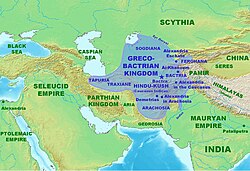
The Greco-Bactrian kingdom at its maximum extent (c. 180 BC)
Greco-Bactrian king Demetrius I (r. 200 – 180 BC) wearing an elephant scalp, a symbol of his conquests of Northwestern India
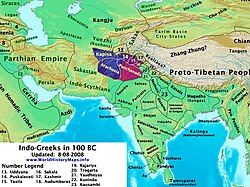
Indo-Greek kingdoms in 100 BC
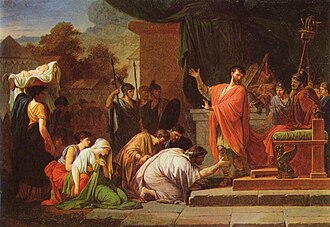
King Perseus of Macedon in front of Aemilius Paulus by Jean-François Pierre Peyron, 1802 (Museum of Fine Arts, Budapest)
The Roman Republic and contemporary polities in 100 BC
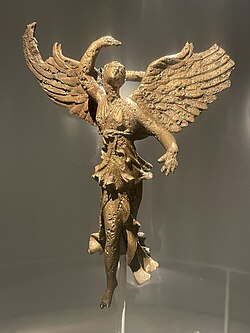
Statuette of Nike, Greek goddess of victory, from Vani, Georgia
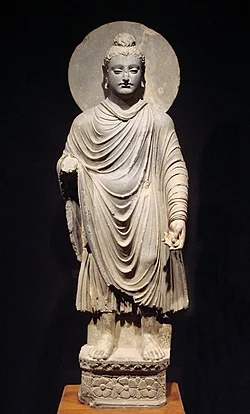
One of the first representations of the Buddha, and an example of Greco-Buddhist art, 1st-2nd century AD, Gandhara: Standing Buddha (Tokyo National Museum)
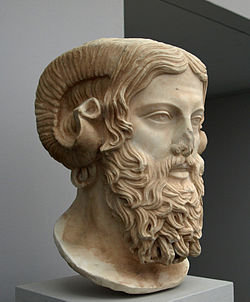
Bust of Zeus-Ammon, a deity with attributes from Greek and Egyptian gods
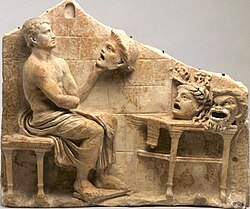
Relief with Menander and New Comedy masks (Roman, AD 40–60). The masks show three New Comedy stock characters: youth, false maiden, old man. Princeton University Art Museum.
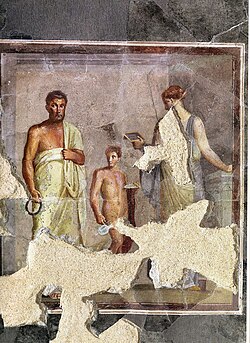
An ancient fresco depicting a poet (thought to be Euphorion) and a woman reading a diptych
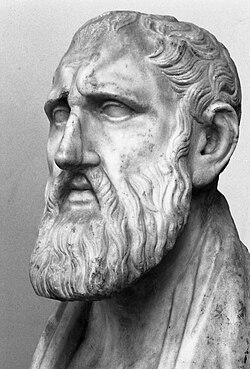
Zeno of Citium founded Stoic philosophy.
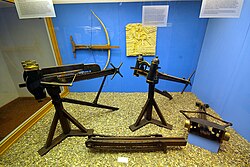
Ancient mechanical artillery: Catapults (standing), the chain drive of Polybolos (bottom center), Gastraphetes (on wall)
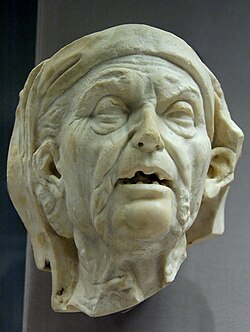
Head of an old woman, a good example of realism
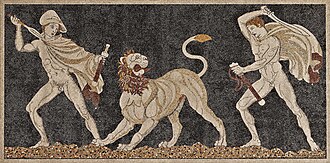
A lion hunt on a mosaic floor from Pella in Macedonia. Last quarter of the 4th century BC (Pella, Archaeological Museum).

When did the Hellenistic period end?

While dates vary among scholars, the most generally accepted date is 31/30 BC, coinciding with the defeat of the Ptolemaic Kingdom at the Battle of Actium.

Who were the Diadochi?

The Diadochi were the generals and successors of Alexander the Great who fought for control of his empire, eventually splitting it into several competing kingdoms.

What is Hellenization?

Hellenization is the process by which Greek culture, language, and institutions were adopted by non-Greek peoples across the Mediterranean and Asia.

How did the Indo-Greek kingdoms influence India?

The Indo-Greek kingdoms, particularly under King Menander I, fostered a unique blend of Greek and Indian culture, which is most evident in the development of Greco-Buddhist art.

Who is the most reliable primary source for this era?

Polybius of Megalopolis is considered the earliest and most credible surviving source, having written a comprehensive history covering 220 to 167 BC.

References

  1. Professor Gerhard Rempel, Hellenistic Civilization (Western New England College) Archived 2008-07-05 at the Wayback Machine.
  2. Ulrich Wilcken, Griechische Geschichte im Rahmen der Altertumsgeschichte.
  3. Green 2008, pp. xv–xvii.
  4. Art of the Hellenistic Age and the Hellenistic Tradition. Heilbrunn Timeline of Art History, Metropolitan Museum of Art, 2013. Retrieved 27 May 2013. Archived here.
  5. "Hellenistic Age". Encyclopædia Britannica Online. Encyclopædia Britannica, Inc. Retrieved 8 September 2012.