Head-Mounted Displays: Applications Across Military, Medicine, and Entertainment
A Head-Mounted Display (HMD) is a wearable device that projects visual data directly before the user's eyes, blending digital information with the physical world or replacing it entirely. From the early days of bulky cathode-ray tubes to modern, sleek holographic waveguides, HMDs have evolved into essential tools for high-stakes professional environments and immersive consumer entertainment.
Key Facts
- Versatility: Used across military, government, medical, engineering, and commercial sectors.
- Technological Range: Spans from simple monocular displays to complex stereoscopic VR systems with room-scale tracking.
- Critical Utility: Enables "x-ray vision" for technicians and real-time vital sign monitoring for anesthesiologists.
- Consumer Growth: Powering industries from FPV drone racing to high-resolution virtual cinemas.
Aviation and Tactical Ground Operations
The integration of HMDs into tactical environments dates back to 1962, when the Hughes Aircraft Company introduced the Electrocular, a compact 7-inch monocular CRT (cathode-ray tube) display. Today, ruggedized HMDs are standard in modern fighter aircraft and helicopter cockpits, often integrated into flight helmets with protective visors and night vision devices.
On the ground, military, police, and firefighters utilize HMDs to overlay maps or thermal imaging onto their real-world view. A notable example is the 2005 Liteye HMD, a waterproof, lightweight OLED (organic light-emitting diode) display that clips into U.S. PVS-14 helmet mounts. This device can operate in see-through mode for augmented reality (AR)—where digital elements are overlaid on the physical environment—and runs for 35 hours on four AA batteries.
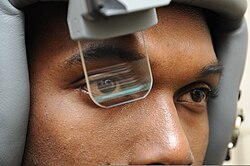
Looking forward, DARPA (Defense Advanced Research Projects Agency) is funding the Persistent Close Air Support (PCAS) Program. Through partners like Vuzix, they are developing AR glasses using holographic waveguides, aiming for a thickness of only a few millimeters.
Engineering and Industrial Design
In the realm of engineering, HMDs provide stereoscopic views of CAD (computer-aided design) schematics. This allows designers to interact with full-scale models, identifying flaws that would otherwise remain hidden until physical prototyping. While CAVEs (Cave Automatic Virtual Environment) are used for collaborative sessions, HMDs are the preferred tool for single-person interaction.
Maintenance technicians also benefit from HMDs, which provide a simulated "x-ray vision" by combining system diagrams and graphics with the technician's natural sight, a process known as modified or augmented reality.

Medicine and Scientific Research
Medical professionals use HMDs to enhance precision during surgery by combining the surgeon's view with radiographic data, such as MRI (magnetic resonance imaging) and CAT (computed axial tomography) scans. Similarly, anesthesiologists use them to keep patient vital signs constantly within their field of view.
Research universities employ HMDs to study neuroscience, cognition, and balance. For instance, as of 2010, researchers have used HMDs with eye-tracking capabilities to identify mild traumatic brain injuries by measuring a patient's ability to perform smooth pursuit eye movements while tracking a moving object.
Gaming, Video, and Virtual Cinema
Consumer HMDs began gaining traction in the 1990s with devices like the Forte VFX1 (1994) and the Sony Glasstron (1997). Early gaming applications, such as MechWarrior 2, allowed players to see the battlefield from inside a virtual cockpit. Modern gaming is dominated by high-fidelity systems like the Oculus Rift, HTC Vive (featuring room-scale tracking), PlayStation VR, and the Windows Mixed Reality platform.
Beyond gaming, "virtual cinema" HMDs focus on high resolution over a wide field of view (FOV). While VR headsets prioritize immersion, cinema displays like the Cinera Prime (2560×1440 resolution) and the Goovis G2 (1920×1080 resolution) prioritize pixel density for film consumption.
Remote Control and Sports
First-person view (FPV) drone flying relies heavily on "FPV goggles." Drone racers often prefer analog goggles, such as those from Fat Shark, due to lower video latency, while cinematography professionals often use digital goggles from brands like DJI for higher resolution.
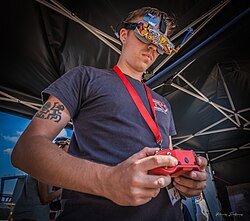
In professional sports, Kopin Corp. and the BMW Group developed an HMD for Formula One drivers to display critical race data without taking their eyes off the track. Additionally, Recon Instruments introduced the MOD and MOD Live ski goggles in 2011 to bring data to winter sports.
Training and Simulation
HMDs are invaluable for training in scenarios that are too dangerous or expensive to replicate, such as flight simulation, welding, spray painting, and medical procedures. However, the industry continues to work on resolving symptoms caused by prolonged use to ensure optimal training outcomes.
HMD Application Summary
| Sector | Primary Use Case | Key Technology/Example |
|---|---|---|
| Military/Tactical | Tactical overlays & Night Vision | Liteye HMD, PCAS Program |
| Engineering | CAD Validation & Maintenance | Stereoscopic VR, AR X-ray vision |
| Medicine | Surgical Guidance & Diagnostics | MRI/CAT integration, Eye-tracking |
| Entertainment | Gaming & Virtual Cinema | Oculus Rift, HTC Vive, Cinera Prime |
| Remote Ops | Drone Piloting | FPV Goggles (Fat Shark, DJI) |
Frequently Asked Questions
What is the difference between VR and AR in HMDs?
Virtual Reality (VR) completely replaces the user's environment with a simulated one, whereas Augmented Reality (AR) overlays digital information, such as maps or diagrams, onto the user's natural view of the real world.
Why do drone racers prefer analog FPV goggles over digital ones?
Analog goggles are preferred for racing because they offer the lowest video latency, which is critical for making split-second maneuvers at high speeds.
How are HMDs used in medical diagnostics?
They are used in research to identify mild traumatic brain injuries by using eye-tracking technology to see if a patient can follow a moving object with smooth, correct trajectories.
What is a "virtual cinema" HMD?
These are displays designed for watching movies. They typically have a narrower field of view (50–60°) than VR headsets but offer much higher resolution (pixels per degree) for a clearer image.
Can HMDs be used for industrial maintenance?
Yes, they can provide technicians with a simulated "x-ray vision" by overlaying system diagrams and computer graphics over the physical equipment they are repairing.