The Global Titan of Shipbuilding: An Overview of HD Hyundai Heavy Industries
In the competitive landscape of global maritime engineering, few names carry as much weight as HD Hyundai Heavy Industries (HHI). As the world's largest shipbuilding company, HHI stands as a cornerstone of South Korea's industrial prowess. Headquartered in Ulsan, the company has evolved from a visionary startup into a diversified powerhouse spanning defense, heavy machinery, and advanced maritime technology.
As one of South Korea's "Big Three" shipbuilders—alongside Hanwha and Samsung—HHI plays a critical role in global trade and national security. From massive crude oil carriers to sophisticated naval vessels, the company's reach extends to every corner of the ocean.
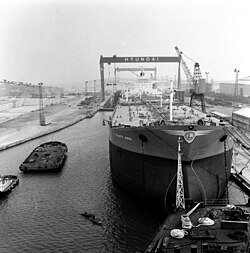
Key Facts
- Industry Leader: Recognized as the world's largest shipbuilding company.
- Headquarters: Ulsan, South Korea.
- Core Sectors: Shipbuilding, offshore engineering, industrial plants, and defense.
- Historical Milestone: Delivered its first ship, the Atlantic Baron, in 1974.
- Global Reach: Serves markets worldwide, including specialized MRO (Maintenance, Repair, and Overhaul) services for the U.S. Navy.
A Legacy of Visionary Growth
Founding and Early Success
The story of HHI began in 1972, founded by Chung Ju-yung, the visionary leader of the Hyundai Group. At a time when the South Korean government was eager to transition from light manufacturing to heavy industry, Chung secured the necessary momentum through strategic diplomacy and technical partnerships.
A pivotal moment in the company's history was Chung's ability to secure international financing. By obtaining a recommendation from the British firm A&P Appledore, he secured a USD 43 million loan from Barclays. This capital allowed the company to fulfill its first major order from Greek shipping magnate George Livanos: two Very Large Crude Carriers (VLCCs), each with a capacity of 259,000 deadweight tons (DWT).
Corporate Evolution and Restructuring
Over the decades, HHI has undergone significant structural changes to adapt to the global economy. Following a period of internal succession battles within the Hyundai Group in the early 2000s, the company spun off to form the Hyundai Heavy Industries Group in 2002.
The company has also navigated complex restructuring to maintain its competitive edge. In 2016, HHI split into four entities to manage its core shipbuilding, offshore, and industrial plant businesses more effectively. Most recently, in late 2025, HHI completed a strategic merger with HD Hyundai Mipo (HMD). This merger combined HMD's expertise in mid-sized vessels with HHI's capacity for large-scale production, solidifying its position as the undisputed global leader.
Diverse Business Operations
Maritime and Offshore Engineering
HHI's product portfolio is vast, encompassing a wide range of specialized vessels including:
- Crude oil carriers and LNG (Liquefied Natural Gas) carriers.
- Container ships and mid-sized vessels.
- Drillships and FPSOs (Floating Production Storage and Offloading units).
The company is also at the forefront of environmental technology. Through a partnership with Capital Product Partners, HHI is developing four specialized ships designed for ocean-based carbon capture and storage, scheduled for delivery in 2025 and 2026 at a cost of $300 million.
Defense and Aerospace Contributions
Beyond commercial shipping, HHI is a major player in the defense sector. In July 2024, it became the first Korean shipbuilder to sign a Master Ship Repair Agreement (MSRA) with the U.S. Naval Supply Systems Command, qualifying it for the U.S. Navy's MRO business. The company also manufactures submarines and other naval vessels.
HHI's engineering expertise extends to space exploration. The company manufactured the launch pad systems for South Korea's Naro-1 (KSLV-I) rocket in 2013 and subsequently built the launch pad for the Nuri (KSLV-II) rocket.
Financial and Operational Summary
| Metric | Value (2024) |
|---|---|
| Revenue | ₩ 14.4865 trillion |
| Operating Income | ₩ 705.2 billion |
| Net Income | ₩ 621.5 billion |
| Total Assets | ₩ 19.3909 trillion |
| Total Equity | ₩ 5.7044 trillion |
| Number of Employees | 15,000 (as of 2025) |
Controversies and Criticisms
Despite its industrial success, the company has faced scrutiny. A June 2025 UN expert report alleged that HD Hyundai provided heavy machinery used in the destruction of property in occupied Palestinian territories. Additionally, Amnesty International Korea documented the use of HD Hyundai machinery during home demolitions in the occupied West Bank.
Frequently Asked Questions
What is the main difference between HHI and KSOE?
Korea Shipbuilding & Offshore Engineering (KSOE) serves as an intermediate holding company that oversees various entities, including HHI, HD Hyundai Mipo, and HD Hyundai Samho.
What does MRO stand for in the context of HHI?
MRO stands for Maintenance, Repair, and Overhaul. HHI's qualification for U.S. Navy MRO business allows them to provide essential servicing and repairs for naval vessels.
How did HHI start its shipbuilding journey?
HHI began with a massive loan from Barclays and a landmark order from Greek shipper George Livanos for two Very Large Crude Carriers (VLCCs), which helped establish the company's reputation early on.
What role has HHI played in South Korea's space program?
HHI has been instrumental in building the launch pad systems for South Korea's major rocket programs, specifically the Naro-1 (KSLV-I) and the Nuri (KSLV-II).
Is HHI involved in green technology?
Yes. The company is working on specialized vessels designed for ocean-based carbon capture and storage to help address environmental challenges.