Hay Production and Management for Livestock Fodder
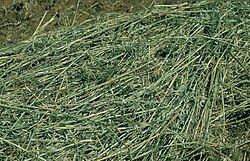
Hay consists of grasses, legumes, or other herbaceous plants that have been cut and dried to be stored as animal fodder. It serves as a critical food source for a wide range of animals, from large livestock like cattle, horses, goats, and sheep to smaller domesticated pets such as rabbits and guinea pigs. While pigs can consume hay, they do not digest it as efficiently as true herbivores.
For most grazing animals, hay or fresh grass forms the foundation of their diet, sometimes providing up to 100% of their required fodder. It is primarily used when pasture is unavailable due to winter, drought, or other environmental conditions.
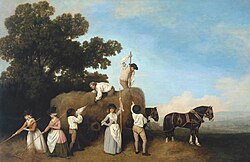
Key Facts
- Purpose: Provides essential nutrition when fresh pasture is unavailable.
- Moisture Levels: Hay is considered fully dry at 20% moisture; levels above 40% can lead to heat production.
- Storage Risks: Improperly dried hay can lead to mold, spoilage, or spontaneous combustion.
- Animal Safety: Toxic plants in a pasture remain toxic when dried into hay.
- Horse Nutrition: Horses require small, frequent portions and can suffer from "hay belly" if fed low-quality, calorie-empty hay.
Nutritional Composition and Animal Use
The type of hay required depends on the species of animal, as they vary in how they consume and digest different plants. Generally, animals should be fed hay consisting of plants similar to those they would graze in a natural pasture. In most livestock diets, hay or pasture forage must comprise at least 50% of the total diet by weight.
Feeding schedules often follow a twice-daily routine (morning and evening) for human convenience, though grazing animals naturally prefer multiple feedings throughout the day. Some animals, such as those raised for meat, may have constant access to hay, while working animals may have limited rations to prevent obesity.
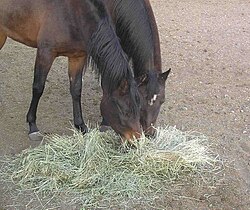
Special Considerations for Horses
Unlike ruminants, horses digest food in small portions and can only utilize about 2.5% of their body weight in feed every 24 hours. Because they evolved to graze continuously while moving, their stomachs process food quickly. Poor quality hay can lead to obesity or "hay belly," while moldy or toxic hay can cause respiratory issues or colic, a leading cause of death in horses. To mitigate dust, some owners soak, sprinkle, or steam the hay.
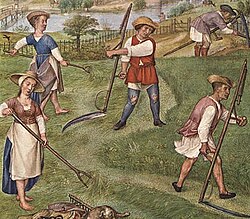
Harvesting and Baling History
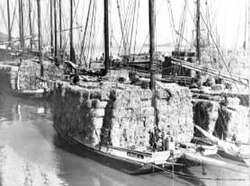
Hay production became largely mechanized by the 1930s following the invention of the tractor and the baler. The first hay presses appeared around 1850, with the first patent for a horse-powered, screw-operated press granted to HL Emery in 1853. Early bales typically weighed around 300 pounds.
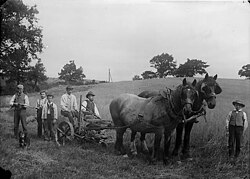
By 1914, the continuous hay baler was introduced, and by 1940, mobile balers were developed to gather and bale hay in a single process. These early machines produced small rectangular bales weighing between 70 and 100 pounds, which were easy for individuals to lift and stack by hand.
Modern Baling and Storage Techniques
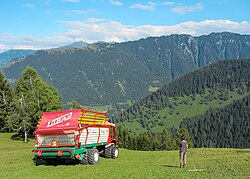
Modern farming utilizes various baler types to maximize efficiency and protection from the elements. Bales generally fall into two categories: large square and large round.
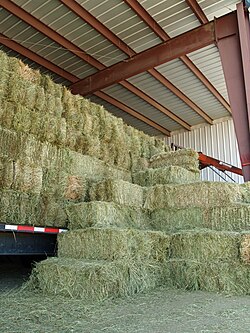
- Large Square Bales: Can weigh up to 1,000 kg (2,200 lb). They are easily stacked and transported via trucks.
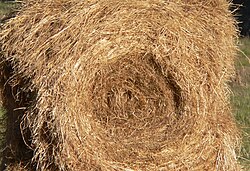
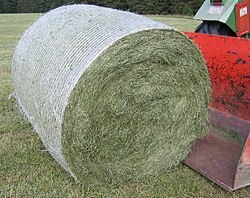
- Large Round Bales: Typically weigh 300 to 400 kg (660–880 lb). These are more moisture-resistant and densely packed at the center.
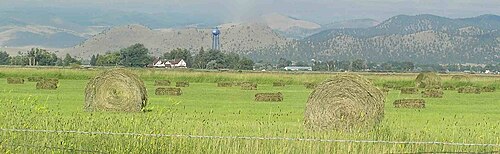
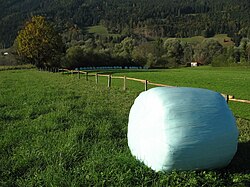
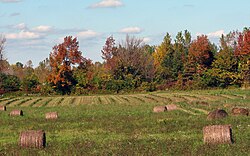
Because of their volume-to-surface area ratio, round bales are often left outdoors. In wet climates, farmers may use plastic wrap that repels moisture while leaving the ends exposed so the hay can "breathe" and avoid fermentation. However, storing any hay under a shed or cover is the best way to prevent rot.
Traditional and Alternative Methods
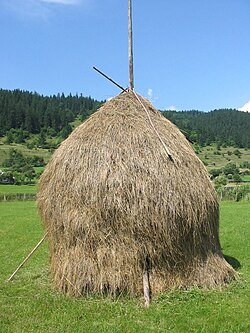
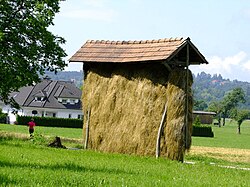
Beyond modern baling, some regions use traditional methods, such as the Kozolec (Slovenian hayrack) or loose stacking around central poles. Other materials, such as baled cornstalks, are also used as fodder.
![Baled cornstalks[3]](/images/ab/a2/aba2581fb0a44545908091576409443208025f13003c4be8e7df59f231a31578.jpg)
Safety and Risk Management
Spontaneous Combustion
Hay baled before it is fully dry can undergo bacterial fermentation, producing internal heat. If moisture levels are above 40%, the hay can ignite. Hay is considered fully dry at 20% moisture. Bales between 120°F and 140°F (49°C to 60°C) must be separated to cool, as temperatures exceeding 140°F can lead to combustion.
Physical Hazards
The sheer weight of hay presents significant risks. Poorly constructed stacks can collapse, and large round bales—which can exceed 1,000 pounds—require specialized equipment to move. Due to their cylindrical shape, they can roll unexpectedly, leading to serious injuries or fatalities.
Chemical Composition of Common Hay Types
The nutritional value of hay varies significantly based on the plant species and the quality of the harvest.
| Hay Type | Water | Ash | Albuminoids | Crude Fiber | Extractive Matter | Fat |
|---|---|---|---|---|---|---|
| Meadow Hay (Prime) | 16.0 | 7.7 | 13.5 | 19.3 | 40.8 | 2.6 |
| Red Clover Hay (Prime) | 16.5 | 7.0 | 15.3 | 22.2 | 35.8 | 3.2 |
| Alfalfa (Legume) | 8.4 | 7.4 | 14.3 | 25.0 | 42.7 | 2.2 |
| Timothy Grass | 14.3 | 5.0 | 7.5 | 33.5 | 38.2 | 1.5 |
| Soybean (Legume) | 11.3 | 7.2 | 15.4 | 22.3 | 38.6 | 5.2 |
Frequently Asked Questions
What is the difference between round and square bales?
Large square bales are easier to stack and transport on trucks, while large round bales are more moisture-resistant and can often be stored outdoors more effectively due to their density and shape.
Why is moisture content critical in hay baling?
Moisture levels above 40% can cause bacterial fermentation and heat buildup, potentially leading to spontaneous combustion. Hay is only considered fully dry and safe for storage when it reaches 20% moisture.
Can any animal eat any type of hay?
No. Animals require hay similar to what they would graze naturally. Furthermore, plants that are toxic to a specific animal in a fresh pasture remain toxic once dried into hay.
What are the risks of feeding low-quality hay to horses?
Horses may over-consume "empty calories" from low-quality hay, leading to an unhealthy condition known as "hay belly." Additionally, moldy or contaminated hay can cause respiratory problems or fatal colic.
How can farmers test for hay moisture?
Farmers can use their hand, an oven, or a moisture tester. A moisture tester is the most efficient method, providing results within a few seconds.