Harrier V/STOL Aircraft: Operational History and Global Deployment
The Harrier represents a milestone in aviation history as one of the first successful V/STOL (Vertical/Short Take-Off and Landing) jets. By allowing aircraft to take off and land vertically or from very short runways, the Harrier fundamentally changed the concept of flexible basing, removing the absolute necessity for massive, permanent airfields in combat zones.
Royal Air Force Service
The Royal Air Force (RAF) began converting No. 1 Squadron to the Harrier GR.1 in April 1969 at RAF Wittering. The aircraft's versatility was showcased almost immediately in May 1969 during the Daily Mail Transatlantic Air Race. Two Harriers flew from London's St Pancras railway station to central Manhattan using aerial refuelling, completing the journey in 6 hours and 11 minutes.
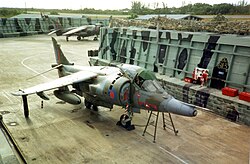
Throughout the Cold War, the RAF utilized the Harrier for reconnaissance, ground-attack, and close air support (CAS)—the use of aircraft to provide direct support to friendly ground forces. A significant presence was maintained in West Germany as a deterrent against Soviet aggression, with aircraft operating from camouflaged rough bases to target armor columns. Additionally, Harriers were deployed to Norway and Belize. In Belize, the Harrier was the only RAF combat jet capable of operating from the local airport's short runway during tensions with Guatemala.
The Falklands War
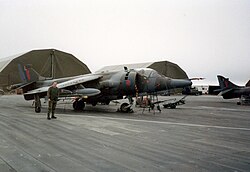
The 1982 Falklands War (Guerra de las Malvinas) served as a critical proving ground for the Harrier. Ten Harrier GR.3s from No. 1 Squadron operated from HMS Hermes. Because the GR.3 was not originally designed for naval use, it required rapid modifications, including anti-corrosion sealants, deck-based inertial guidance aids, transponders for night operations, and flares and chaff dispensers.
Due to limited carrier space, the merchant ships Atlantic Conveyor and Atlantic Causeway were fitted with temporary flight decks to transport aircraft and helicopters. While Sea Harriers focused on combat air patrols, the GR.3s focused on suppressing Argentine artillery and attacking the Stanley airfield. To provide emergency air defense, GR.3s were modified to carry Sidewinder air-to-air missiles.
Falklands Conflict Loss Summary
| Aircraft Type & Serial | Pilot | Date | Cause / Weapon |
|---|---|---|---|
| Sea Harrier XZ450 | Lt Nick Taylor | 4 May 1982 | 35mm Oerlikon AA fire |
| Sea Harrier XZ452 | Lt Cdr John Eyton-Jones | 6 May 1982 | Night collision (accident) |
| Sea Harrier XZ453 | Lt Alan Curtis | 6 May 1982 | Night collision (accident) |
| Harrier GR.3 XZ972 | Flt-Lt Jeff Glover | 21 May 1982 | Blowpipe SAM |
| Sea Harrier ZA192 | Cdr Gordon Batt | 23 May 1982 | Crashed on take-off |
| Harrier GR.3 XZ988 | Sqn Ldr Bob Iveson | 27 May 1982 | 20mm cannon AA fire |
| Sea Harrier ZA174 | Lt Cdr Mike Broadwater | 29 May 1982 | Slid off deck (accident) |
| Harrier GR.3 XZ963 | Sqn Ldr Jerry Pook | 30 May 1982 | Small-arms fire / fuel exhaustion |
| Sea Harrier XZ456 | Flt-Lt Ian Mortimer | 1 June 1982 | Roland SAM |
| Harrier GR.3 XZ989 | Wg Cdr Peter Squire | 8 June 1982 | Mechanical failure on landing |
Over 2,000 sorties were flown during the conflict, averaging six per aircraft per day.
Post-War Innovations and Skyhook
Following the war, British Aerospace developed "Skyhook," a system designed to operate Harriers from even smaller ships using a crane to hold the aircraft in midair for launching, landing, and re-arming. Despite its potential to save fuel and operate in rougher seas, the system failed to attract customers. The first-generation Harriers were eventually replaced by the jointly developed Harrier II.
United States Marine Corps (USMC) Integration
The USMC adopted the AV-8A in 1971, viewing it as a gateway to "vertical development" and flexible basing. The Marines explored various naval integrations, including the "Sea Control Ship" concept—a 15,000-ton light carrier—and "Arapaho," a plan to convert civilian cargo ships into temporary Harrier platforms.
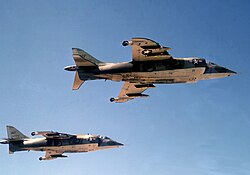
The USMC also tested the VIFF (Vectoring-in-Forward-Flight) capability, using thrust vectoring to outmaneuver opponents in mock dogfights against F-4 Phantom IIs. On land, the USMC focused on rapid deployment, aiming to establish forward bases within 24 hours, located approximately 20 miles from the forward edge of battle (FEBA) to maximize sortie rates.
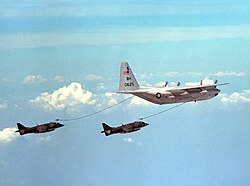
The AV-8A was upgraded to the AV-8C configuration starting in 1979 to improve VTOL performance and service life. Both were retired by 1987 and replaced by the AV-8B Harrier II, which is now being succeeded by the F-35B Lightning II.
International Operators and Potential Sales
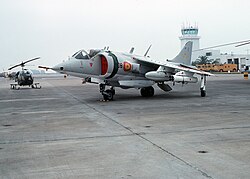
The Harrier's success led other nations to adopt the platform. Spain operated the AV-8S Matador from the aircraft carrier Dédalo starting in 1976. In 1998, Spain sold several Matadors to Thailand for use on the HTMS Chakri Naruebet, though Thailand struggled with logistical funding, leading to the retirement of the fleet by 2006.
Several other nations nearly purchased the Harrier. Argentina considered the GR.1 in 1969 but chose the A-4Q Skyhawk. Australia explored buying HMS Invincible and Harriers in 1981, but the offer was withdrawn after the Falklands War. China negotiated for up to 200 aircraft in the 1970s, but the deal was cancelled due to the Sino-Vietnamese War. Switzerland also expressed interest in using Harriers for dispersed Cold War operations.
Key Facts
- First RAF Deployment: No. 1 Squadron began conversion in April 1969.
- Falklands Performance: Over 2,000 sorties flown; 10 Harrier GR.3s and several Sea Harriers utilized.
- USMC Innovation: Developed VIFF (Vectoring-in-Forward-Flight) for superior close-range maneuverability.
- Global Reach: Operated by the UK, USA, Spain, and Thailand.
- Technical Legacy: Paved the way for the Harrier II and the modern F-35B.
Frequently Asked Questions
What is V/STOL?
V/STOL stands for Vertical/Short Take-Off and Landing, a capability that allows an aircraft to take off and land vertically like a helicopter or use a very short runway.
How were RAF Harrier GR.3s adapted for the Falklands War?
They were modified with anti-corrosion sealants, deck-based inertial guidance aids, night-operation transponders, and chaff/flare dispensers to allow them to operate from aircraft carriers.
What was the VIFF maneuver?
VIFF, or Vectoring-in-Forward-Flight, involved using the Harrier's thrust-vectoring nozzles during forward flight to perform abrupt maneuvers that could outposition opposing aircraft in dogfights.
Why did Thailand struggle with its Harrier fleet?
The Royal Thai Navy faced significant logistical problems and a shortage of funds for spare parts and equipment, leaving very few aircraft airworthy by 1999.
What was the "Skyhook" system?
Skyhook was a proposed technique to use cranes on small ships to hold Harriers in midair for launching, landing, and rapid re-arming, though it never entered service.