Harlem Globetrotters: The Evolution of Basketball's Greatest Show
The Harlem Globetrotters are more than just a basketball team; they are a global symbol of athletic skill and entertainment. From their humble beginnings in Chicago to becoming international ambassadors of sport, the Globetrotters have blended high-level competition with comedic artistry to captivate audiences for nearly a century.
The Origins of a Legend
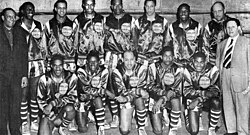
The team's roots trace back to 1926 at the Giles American Legion Post #87 on the South Side of Chicago. The original players were all raised in the area and attended Wendell Phillips High School in the Bronzeville neighborhood. They initially performed as the Savoy Big Five, an attraction at the Savoy Ballroom designed to boost attendance during dances starting in January 1928.
Following a dispute in 1928, several players split off to form the "Globe Trotters," touring southern Illinois the following spring. It was during this era that Abe Saperstein joined the organization as a coach, manager, promoter, and occasional player. By 1929, Saperstein rebranded the group as the "New York Harlem Globe Trotters." He chose "Harlem" because the neighborhood was the epicenter of Black American culture at the time, and "Globetrotter" to create a mythos around the team's international travels.
From Competitive Dominance to Entertainment
Before they were known primarily for comedy, the Globetrotters were a formidable competitive force. They were regular participants in the World Professional Basketball Tournament, winning the championship in 1940. One of their most significant milestones occurred in 1948 when they defeated the Minneapolis Lakers, one of the top white teams in the United States, in a high-profile matchup.
The team's dominance was partly due to the fact that they attracted the finest Black basketball talent in the country. However, the rise of the National Basketball Association (NBA) in the 1950s shifted the landscape. As the NBA began recruiting Black players, the Globetrotters' role evolved. In 1950, Chuck Cooper became the first Black player drafted into the NBA by the Boston Celtics, while teammate Nat "Sweetwater" Clifton became the first to sign an NBA contract after the New York Knicks purchased his contract for $12,500 (approximately $167,000 in 2025).
To adapt, the team began integrating comic routines into their games, a shift credited to Reece "Goose" Tatum, who joined in 1941. This transition turned the games into spectacles of coordination, featuring ball juggling, fingertip spinning, and impossible shots.
The Washington Generals and Global Diplomacy
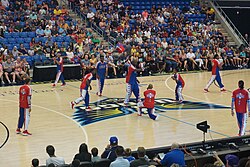
In 1952, the Globetrotters invited Louis "Red" Klotz to form a companion team for their tours. This led to the creation of the Washington Generals. While the Generals played a serious game when in possession of the ball, they effectively served as "stooges," allowing the Globetrotters to showcase their skills through thousands of handily won games.
The team also played a role in international relations. In 1959, the Globetrotters—including the legendary Wilt Chamberlain—traveled to Moscow for nine games at the Lenin Central Stadium. While some Soviet spectators and the state-run newspaper Pravda were initially confused by the "tricks," the team was ultimately welcomed by authorities and met with Premier Nikita Khrushchev, receiving the Athletic Order of Lenin medal.
These games were viewed by the American press as a sign of improving U.S.–Russian relations and a shift in Soviet propaganda regarding American race relations. Reports indicated the Soviet government paid the team the equivalent of $4,000 per game (approximately $44,000 in 2025), though the funds could only be spent within Moscow.
Ownership, Diversity, and Legacy
The ownership of the Globetrotters has passed through several hands over the decades. After an attempted acquisition by Metromedia in 1967, the team was sold to George N. Gillett Jr. in 1968. Metromedia eventually acquired them for $11 million in 1976, and later sold them to the International Broadcasting Corporation for $30 million in 1986. In 1993, former player Mannie Jackson purchased the team to save it from bankruptcy.
The team has also broken barriers in representation. In 1985, Olympic gold medalist Lynette Woodard became the first female player. In 1995, Orlando Antigua became the first Hispanic player and the first non-Black player on the roster since Bob Karstens in the early 1940s.
Despite their success, the team faced criticism during the Civil Rights era. Some advocates accused them of "Tomming for Abe," suggesting the comedy routines played into stereotypes. However, activist Jesse Jackson defended the team, arguing that the Globetrotters demonstrated Black superiority through their immense skill.
The Nature of the Game
A common misconception is that Globetrotters games are entirely scripted. While the comedic hijinks are planned, the basketball is not. Roughly 20% to 30% of a game is "real" basketball. This unpredictability led to a shocking 100-99 overtime loss to the New Jersey Reds on January 5, 1971, after the Globetrotters lost track of the score and failed to overcome a late deficit.
| Year | Event/Milestone | Significance |
|---|---|---|
| 1926 | Founded in Chicago | Originated as the Savoy Big Five |
| 1940 | World Professional Basketball Tournament | Won the championship |
| 1948 | Victory over Minneapolis Lakers | Defeated a premier white basketball team |
| 1950 | NBA Integration | Chuck Cooper and Nat Clifton join the NBA |
| 1952 | Washington Generals Formed | Established primary touring opponents |
| 1959 | Moscow Tour | Diplomatic games in the Soviet Union |
| 1985 | Lynette Woodard Joins | First female player signed |
| 2021 | NBA Petition | Filed to join as an expansion franchise |
Key Facts
- Founding: Started in 1926 in Chicago by players from Wendell Phillips High School.
- Naming: Abe Saperstein chose "Harlem" to represent Black culture and "Globetrotter" to suggest international reach.
- NBA Impact: Helped pave the way for Black players in the NBA, including Chuck Cooper and Nat "Sweetwater" Clifton.
- Opponents: The Washington Generals were created in 1952 specifically to tour with the team.
- Diversity: Lynette Woodard (1985) was the first woman; Orlando Antigua (1995) was the first Hispanic player.
- Game Format: Approximately 20% to 30% of their exhibition games are played as serious competition.
Frequently Asked Questions
Are Harlem Globetrotters games fixed?
No, the games are not entirely fixed. While the comedic routines and "hijinks" are pre-planned, the actual basketball play is real, with about 20% to 30% of the game being competitive. This has occasionally resulted in actual losses.
Who are the Washington Generals?
The Washington Generals were created in 1952 at the invitation of the Globetrotters to serve as their primary touring opponents. They act as the "stooges" in the performances, though they play seriously when they have the ball.
Why is the team called the "Harlem" Globetrotters if they started in Chicago?
Abe Saperstein chose the name "Harlem" because the neighborhood in New York City was considered the center of Black American culture at the time, and "Globetrotter" was used to mythologize the team's international venues.
Did the Globetrotters ever play in the Soviet Union?
Yes, in 1959, the team played nine games in Moscow. They were welcomed by the public and met with Premier Nikita Khrushchev, receiving the Athletic Order of Lenin medal.
Who was the first woman to play for the Globetrotters?
Olympic gold medalist Lynette Woodard became the first female player to sign with the team in 1985.