Hardware Abstraction Layer
In the complex architecture of a computer, a Hardware Abstraction Layer (HAL) serves as a critical software intermediary between the physical hardware and the operating system. Its primary purpose is to hide the intricate differences of specific hardware components from the operating system kernel. By doing so, the majority of kernel-mode code can remain unchanged even when the system is moved to different hardware configurations.
On Microsoft Windows, the HAL effectively acts as the driver for the motherboard. It enables high-level computer languages to communicate with low-level components while preventing the software from accessing the hardware directly, ensuring system stability and compatibility.
Key Facts
- Purpose: Hides hardware differences from the OS kernel to ensure software portability.
- Position: Resides below the Application Programming Interface (API) in the software stack.
- Portability: Essential for embedded systems and portable operating systems like Linux, BSD, and macOS.
- Windows Implementation: Uses
hal.dllin NT-based systems to support various processors and I/O bus architectures. - Android Implementation: Project Treble (Android 8.0+) standardized the vendor interface to simplify firmware updates.
The Role of HAL in the Software Stack
To understand where the HAL fits, it is helpful to view the computer as a layered stack. At the top is the application layer, typically written in high-level languages. These applications do not talk to the hardware directly; instead, they call functions in the Application Programming Interface (API). The HAL sits below the API, translating those requests into instructions the physical hardware can execute.
This architecture is vital for portability. Operating systems with a well-defined HAL can be ported across different hardware platforms with minimal effort. This is particularly crucial for embedded systems, which may need to run on dozens of different hardware platforms.
HAL Implementations Across Operating Systems
Microsoft Windows
The Windows NT kernel utilizes a HAL located in the kernel space, specifically within the hal.dll file, positioned between the hardware and the executive services (found in ntoskrnl.exe). This design allows Windows NT kernel-mode code to run on various processors and memory management unit architectures without requiring significant code changes.
For example, the HAL allowed Windows 2000 to run on SGI Intel x86-based workstations, despite them not being IBM PC compatible. Since Windows Vista and Windows Server 2008, the system automatically determines the HAL during startup, and only ACPI-based (Advanced Configuration and Power Interface) HALs are supported.
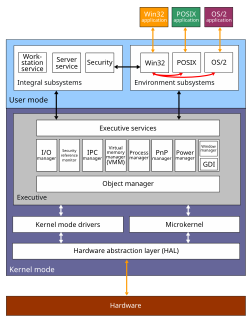
Other Windows variants also use abstraction: Windows CE employs an OEM Adaptation Layer (OAL) compiled into oal.exe or oal.dll, while Windows 9x integrated both the kernel and HAL into vmm32.vxd.
Unix-like and Portable Systems
Many portable operating systems, including Linux, BSD, Solaris, and macOS, utilize a HAL, even if not explicitly labeled as such. NetBSD is particularly noted for its clean HAL, which utilizes subsystems like uvm(9), pmap(9), bus_space(9), and bus_dma(9) to achieve high portability. Furthermore, common buses such as PCI, PCIe, ISA, and EISA are abstracted, allowing drivers to be portable with minimal modification.
Android and Mobile OS
With the release of Android 8.0 "Oreo," Google introduced Project Treble. This created a "vendor interface" HAL that abstracts low-level code from the Android OS framework. This ensures forward compatibility, making it easier for manufacturers to provide firmware updates. Additionally, Halium is an Android-based HAL that allows alternative mobile operating systems, such as Ubuntu Touch and LuneOS, to run on hardware designed for Android.
IBM AS/400 and System/38
The IBM i operating system (formerly AS/400 and System/38) represents an extreme version of hardware abstraction. Most compilers for these systems generate abstract machine code rather than native code. The Licensed Internal Code (LIC) then translates this virtual machine code into the native code of the specific processor in use.
This approach has been so successful that software compiled for the original S/38 can run on modern AS/400 systems without modification or recompilation, despite the underlying hardware and processors changing entirely over time.
HAL Summary Table
| System/OS | HAL Name/Component | Key Characteristic |
|---|---|---|
| Windows NT | hal.dll |
Supports various I/O bus and processor architectures. |
| Windows CE | OEM Adaptation Layer (OAL) | Compiled into oal.exe or oal.dll. |
| Android 8.0+ | Project Treble | Standardized vendor interface for easier updates. |
| NetBSD | Clean HAL (e.g., bus_space) |
High portability across diverse architectures. |
| IBM AS/400 | Licensed Internal Code (LIC) | Translates abstract machine code to native code. |
Frequently Asked Questions
What is the main purpose of a Hardware Abstraction Layer?
The main purpose of a HAL is to hide hardware-specific differences from the operating system kernel. This allows the OS to run on different hardware platforms without needing to rewrite the core kernel-mode code.
Where does the HAL sit in a computer's software stack?
The HAL resides below the Application Programming Interface (API) and above the physical hardware. The application layer communicates with the hardware by calling functions in the API, which then interact with the HAL.
How did Project Treble change Android?
Project Treble introduced a standardized vendor interface HAL in Android 8.0. This separated the low-level vendor code from the Android OS framework, allowing for faster and easier firmware updates by ensuring forward compatibility.
Why is the IBM AS/400 HAL considered "extreme"?
It is considered extreme because it uses a virtual machine approach. Compilers generate abstract machine code, which the Licensed Internal Code (LIC) translates into native code at runtime, allowing software to run across multiple generations of hardware without recompilation.
Does Linux use a Hardware Abstraction Layer?
Yes, Linux and other portable operating systems like BSD and macOS use a HAL to maintain portability, although it may not always be explicitly named as such. Some Linux systems can even insert a HAL, such as Adeos, while running.