Hall Effect Sensors: Applications and Industrial Implementations
The Hall effect sensor is a versatile transducer that detects magnetic fields and converts them into electrical signals. Because they operate without physical contact, these sensors provide a robust alternative to traditional mechanical switches and potentiometers, offering increased longevity and reliability in demanding environments.
From the internal combustion engines of automobiles to the propulsion systems of spacecraft, Hall effect technology is integrated into a vast array of modern electronics. Its ability to measure position, speed, and current without wear-and-tear makes it indispensable for high-precision industrial and consumer applications.
Key Facts
- Contactless Operation: Eliminates mechanical wear, significantly extending the lifespan of switches and sensors.
- Versatile Measurement: Capable of detecting position, rotational speed, magnetic field strength, and electrical current.
- High Reliability: Can be encapsulated in protective materials for use in extreme environments.
- Digital Integration: Modern ICs often include digital signal processing (DSP) and temperature correction.
- Space Propulsion: Used in Hall-effect thrusters to ionize propellant for spacecraft propulsion.
Position and Motion Sensing
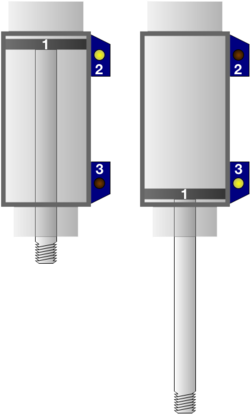
One of the most prevalent uses of Hall sensors is as binary switches for position sensing. By detecting the presence of a magnet, these sensors can determine if a component is in a specific location.
- Consumer Electronics: Smartphones use them to detect when a magnetic cover is closed.
- Printing: Computer printers detect open covers or missing paper, while 3D printers measure filament thickness.
- Automotive: Fuel-level indicators use Hall sensors to track the position of a floating element in the tank.
- Industrial Gauges: Magnetized indicator needles can be translated into electrical signals for digital displays.
In motion sensing, the lack of moving parts within the sensor itself ensures a higher life expectancy than electromechanical switches. This makes them ideal for limit switches in harsh industrial settings.
Current Sensing and Ammeters
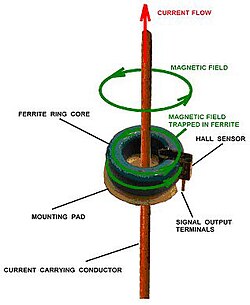
Hall sensors allow for the contactless measurement of direct current (DC). When electrons flow through a conductor, they produce a magnetic field; a Hall sensor placed in a gap in the magnetic core around the conductor can measure this flux to calculate the current.
This method offers significant safety and technical advantages over traditional shunts (resistors inserted into the circuit). Specifically, it prevents the line voltage from being transmitted to the sensor and avoids adding resistance to the primary circuit.
Improving Signal-to-Noise Ratio
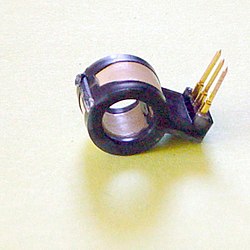
To enhance accuracy, sensors are often integrated into a ferrite ring. Because magnetic flux flows more efficiently through ferrite than air, this configuration concentrates the flux density and reduces the influence of stray fields by a factor of 100 or more, improving the signal-to-noise ratio by over 20 times.
Range Extension and Clamps
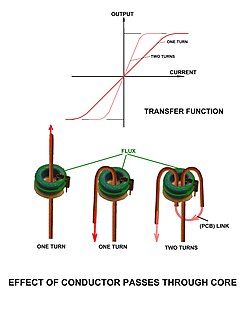
The sensing range can be adjusted through specific wiring techniques. To detect lower currents, multiple turns of the wire are passed through the sensor opening. For higher currents, a current divider is used to pass a smaller proportion of the total current through the sensor.
A variation known as the current clamp uses a split sensor that can be clamped onto a line. This allows for testing existing circuits without the need to dismantle them.
Automotive and Motor Control
Hall effect sensors are critical for timing and synchronization in automotive systems. They have largely replaced mechanical breaker points in ignition timing.
Ignition and Braking
In ignition systems, a metal rotor with windows or tabs rotates between a permanent magnet and a Hall chip. As the tabs pass through the gap, they shield the chip from the magnetic field, creating a square wave signal used by the Engine Control Unit (ECU) to time ignition.
Similarly, these sensors monitor wheel rotation for anti-lock braking systems (ABS), enhancing vehicle handling and preventing skidding.
Brushless DC Motors
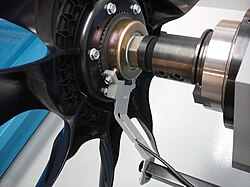
In brushless DC motors, Hall sensors detect the rotor's position. This information is fed to the motor controller to switch transistors in the correct sequence, allowing for precise motor control.
Specialized Applications
Magnetometers
Hall effect magnetometers (also known as gauss meters or tesla meters) utilize a calibrated Hall probe to measure the strength and direction of magnetic fields. These are often used to inspect materials, such as pipelines, via magnetic flux leakage.
Hall-Effect Thrusters (HET)
In spacecraft propulsion, HETs use a radial magnetic field to trap electrons. These energetic electrons ionize a neutral propellant, which is then ejected as a quasineutral plasma. While this produces very low thrust, it offers a very high specific impulse (exhaust velocity), though it requires significant electrical power (tens of kW per Newton of thrust).
Human Interface Devices (HID)
From high-reliability aerospace keyboards developed in the 1960s to modern gaming peripherals, Hall effect switches are gaining popularity. In gaming controllers, they are used in analog sticks and triggers to provide high-resolution, low-latency movement without the wear associated with mechanical potentiometers.
Integrated Electronics and Advanced ICs
Modern Hall sensor Integrated Circuits (ICs) often include onboard digital electronics for temperature-coefficient corrections and fault protection. Some include Digital Signal Processing (DSP) or analog-to-digital converters for direct connection to microcontrollers via protocols like I2C.
To reduce wiring, some ICs use a two-wire interface, communicating data through varying current levels rather than a dedicated output pin.
Dual Hall Sensor ICs
Some ICs feature two Hall elements to create incremental encoders. By sensing an alternating magnetic pattern, these can provide a quadrature encoded pattern, allowing the system to determine both the speed and the direction of movement.
| Application Category | Common Use Case | Primary Benefit |
|---|---|---|
| Position Sensing | Smartphone covers, fuel levels | Contactless detection |
| Current Sensing | Ammeters, power sensing | Electrical isolation/safety |
| Automotive | Ignition timing, ABS | High reliability, no wear |
| Aerospace | Hall-effect thrusters | High exhaust velocity |
| Consumer HID | Gaming joysticks, keyboards | Low latency, long lifespan |
Frequently Asked Questions
How does a Hall effect sensor differ from a mechanical switch?
Unlike mechanical switches, Hall effect sensors are contactless. They detect magnetic fields rather than relying on physical contact to complete a circuit, which eliminates mechanical wear and increases the device's lifespan.
What is the purpose of a ferrite ring in a current sensor?
A ferrite ring concentrates the magnetic flux density of the current's field through the sensor. This reduces the influence of stray magnetic fields by a factor of 100 or more and significantly improves the signal-to-noise ratio.
How do Hall sensors enable direction detection in encoders?
By using two Hall elements placed at a precise distance (Dual Hall ICs), the sensor can detect a quadrature encoded pattern. This alternating pattern allows the system to determine whether a magnet is moving forward or backward.
What are the advantages of using Hall sensors for current measurement?
They allow for non-contact measurement, meaning no shunt resistor is needed in the primary circuit. This prevents additional resistance and ensures that the high voltage of the line being sensed is not transmitted to the measuring equipment.
How is the Hall effect used in spacecraft propulsion?
In a Hall-effect thruster, a magnetic field traps electrons to create an electric field. These electrons ionize a neutral propellant, and the resulting positive ions are accelerated out of the thruster to create thrust.