Haikouichthys: The Dawn of the First Vertebrates
Deep in the fossil beds of China's Yunnan Province lies a tiny creature that represents one of the most significant milestones in evolutionary history. Haikouichthys, a primitive jawless fish from the Cambrian period, is recognized as one of the earliest known vertebrate animals in the fossil record. Living approximately 518 million years ago, this slender organism provides a critical window into how the complex body plans of modern vertebrates first emerged.
The discovery of Haikouichthys occurred within the Chengjiang fauna, a series of Lagerstätten—sedimentary deposits that allow for the exceptional preservation of soft-bodied organisms. Because of this rare preservation, paleontologists have been able to identify intricate anatomical features that are usually lost to time, allowing them to trace the lineage of the vertebrate stem.
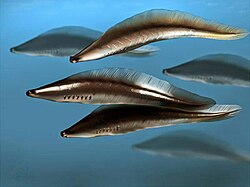
Key Facts
- Temporal Range: Cambrian Stage 3, approximately 518 million years ago.
- Location: Found in the Qiongzhusi Formation, Yunnan Province, China.
- Classification: A primitive jawless fish (Agnatha) and early vertebrate.
- Size: Approximately 2.5 cm (1 inch) in length.
- Distinguishing Feature: Possessed four camera-type eyes for advanced navigation and predator evasion.
Anatomy and Physical Characteristics
The Head and Sensory Systems
Haikouichthys possessed a defined skull and cranial cartilages, marking it as a craniate. One of its most remarkable features is its visual system. While it was long known to have a pair of lateral eyes, a 2026 study revealed that what were previously thought to be nasal sacs were actually a second pair of smaller, medial camera-type eyes (eyes capable of forming clear images). These four eyes likely served different functions in orientation and navigation, representing an ancestral condition for the vertebrate total group.
The head also featured otic capsules and between six to nine gills with fine filaments. Researchers have identified an "upper lip" that may have functioned similarly to the organs found in modern lamprey larvae, potentially acting as a tool to stir up or drape over food particles on the ocean floor for filter-feeding.
Body Structure and Locomotion
The body of Haikouichthys was slender, characterized by a notochord (a flexible rod-like structure) supported by vertebral elements. Its musculature consisted of zigzag-shaped myomeres (muscle segments), which provided the power for swimming. For stability and movement, it featured a sail-like dorsal fin that merged into a caudal (tail) fin, as well as a slender ventral fin.
Internally, the fish possessed an intestine, a pericardic cavity, and approximately 13 serially arranged gonads. This specific arrangement of gonads is considered a basal trait shared with lancelets, the simple chordates that bridge the gap between invertebrates and vertebrates.
Paleoecology and Behavior
Haikouichthys inhabited bright, shallow seas where it likely lived as a suspension feeder, filtering organic particles from the water. Its streamlined body and advanced visual system suggest it was an active swimmer. This agility was likely an evolutionary response to the dangers of the Cambrian seas; as a soft-bodied, high-calorie target, Haikouichthys was ideal prey for larger predators.
Interestingly, its ability to swim actively may be the reason its fossils are relatively rare compared to slower organisms. By swimming away from the sediment flows that typically buried and preserved creatures in the Chengjiang biota, Haikouichthys avoided fossilization more often than its less mobile neighbors.
Scientific Classification and Debate
The classification of Haikouichthys has been a subject of academic discussion. While it is grouped within the family Myllokunmingiidae, some researchers have argued that it is synonymous with its relative, Myllokunmingia. However, other paleontologists, including Simon Conway Morris, maintain that they are distinct taxa based on differences in gill arrangements and the more acute shape of the myomeres in Haikouichthys.
| Feature | Description |
|---|---|
| Length | ~2.5 cm |
| Eyes | 4 camera-type eyes (2 lateral, 2 medial) |
| Skeletal Support | Notochord with vertebral elements |
| Feeding Method | Suspension/Filter feeding |
| Habitat | Shallow Cambrian seas |
Frequently Asked Questions
What makes Haikouichthys a vertebrate?
Haikouichthys is classified as a vertebrate (or craniate) because it possesses a defined skull, cranial cartilages, and vertebral elements associated with its notochord.
How many eyes did Haikouichthys have?
Recent research indicates it had four camera-type eyes: two larger lateral eyes and two smaller medial eyes, the latter of which are thought to be homologous with the pineal system in modern vertebrates.
Where was Haikouichthys discovered?
Fossils of Haikouichthys were found in the Yuanshan member of the Qiongzhusi Formation in the Yunnan Province of China, specifically near Ercai Village.
How did Haikouichthys feed?
It is believed to have been a suspension feeder, possibly using a specialized "upper lip" to stir up food particles from the ocean floor or filter them from the water column.
Is Haikouichthys the same as Myllokunmingia?
This is debated. Some scientists view them as the same animal in different states of decay (taphonomic variants), while others argue they are distinct genera based on their gill structures and muscle shapes.