Güzel İstanbul: The Sculpture That Sparked a National Controversy
In March 1974, a piece of public art titled Güzel İstanbul (Beautiful Istanbul) became the center of a fierce national debate in Turkey. What began as a celebration of art in a public space quickly evolved into a political storm known as the Güzel İstanbul Affair, highlighting the tension between artistic expression and conservative social values.
The sculpture was erected on 10 March 1974 in Karaköy Square, a bustling open area near the northern end of the Galata Bridge. While intended to beautify the city, its placement and subject matter immediately drew intense scrutiny. Art historians and contemporaries have debated the cause of the backlash; Ahu Antmen suggested the sculpture's visibility in a crowded public space was the catalyst, while Onat Kutlar attributed the controversy to the realism and sensuality of the work.
Key Facts
- Installation Date: 10 March 1974.
- Location: Karaköy Square, Istanbul.
- The Conflict: A clash between artistic freedom and the views of the National Salvation Party (MSP).
- Outcome: The sculpture was forcibly removed and damaged on 18 March 1974.
- Legal Action: The Istanbul Public Prosecutors Office opened an inquiry into whether the work was obscene.
The Güzel İstanbul Affair
The controversy was surprising to many, as nude sculptures had previously been installed in Istanbul's public areas and were frequently displayed at the İstanbul State Art and Sculpture Museum without incident. It appears that the officials who commissioned the work did not anticipate such a strong reaction to the sculpture's nakedness.
The backlash was led primarily by politicians from the National Salvation Party (MSP), traditional conservatives within the coalition government. The media amplified the conflict, with the newspaper Sabah describing the work as erotic and claiming it corrupted the morals of Muslim Turks. This pressure pushed the issue onto the government's official agenda.
Various officials voiced their disapproval: Deputy-Prime Minister Necmettin Erbakan labeled it immoral, and Minister of the Interior Oğuzhan Asiltürk claimed it was a disgraceful representation of Turkish mothers. While Mayor Ahmet İsvan cited a lack of taste rather than the nudity itself, Governor Namık Kemal Şentürk ordered the removal, citing an incorrect choice of location.
The political friction was so intense that the Republican People's Party (CHP), the other coalition partner, supported the MSP's stance on the sculpture's indecency to maintain government stability, despite this contradicting their own ethical values. Scholar Hüseyin Gezer defended the piece, arguing there is a fundamental difference between a naked woman and a nude sculpture.
Removal and Public Backlash
On the night of 18 March 1974, just nine days after its installation, the sculpture was removed in what was described as a "sledgehammer operation." The work was broken off its plinth, resulting in a broken arm and destroyed motifs. It was subsequently dumped on a pile of sand near a municipal construction site in Kumkapı.
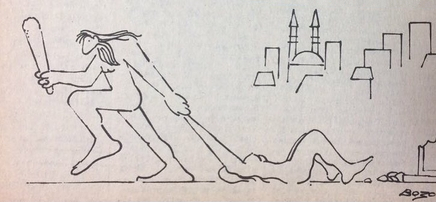
The removal sparked a wave of protest among intellectuals and artists. While Sabah celebrated the removal as a victory for the people, newspapers like Milliyet and Cumhuriyet argued that the sculpture's right to remain was a necessity for democracy. Critics such as Burhan Felek and Melih Cevdet Anday condemned the government for imposing its beliefs on the public, while Hıfzı Veldet Velidedeoğlu warned that allowing religious conservatism to dominate fine arts would lead to a "desert of bigotry."
Cartoonists, including Erdoğan Bozok and Altan Erbulak, used their art to criticize the censorious mindset and the politicization of art. In a direct response to the censorship, the Association of Turkish Sculptors organized an exhibition focused on nudity to demonstrate that artistic will could not be inhibited. This exhibition featured works such as Nü (Nude) by Füsun Onur.
Summary of the Controversy
| Perspective | Key Argument | Primary Figures/Entities |
|---|---|---|
| Opponents | The sculpture was indecent, immoral, and corrupted public morals. | MSP, Necmettin Erbakan, Sabah Newspaper |
| Defenders | The removal was an infringement on freedom of expression and democracy. | Republican intellectuals, Milliyet, Cumhuriyet |
| Government | The location was wrong or the work was tasteless. | Namık Kemal Şentürk, Ahmet İsvan |
Legal Consequences and Aftermath
The fallout extended into the legal system. On 20 March 1974, the Istanbul Public Prosecutors Office opened an inquiry to determine if the sculpture was legally obscene. Had it been found so, the 50th Anniversary Committee would have faced prosecution under articles 426 and 576 of Turkish law. Mustafa Aslıer, a committee member, later reflected on how press and political statements had implicated him in these charges.
The impact of the event resonated beyond the city; the provinces of Manisa and Zonguldak even offered to host the sculpture. Ultimately, Güzel İstanbul was one of 20 sculptures that were intentionally damaged or removed during this period of cultural tension.
Frequently Asked Questions
Where was Güzel İstanbul originally located?
The sculpture was installed in Karaköy Square, Istanbul, near the northern end of the Galata Bridge.
Why was the sculpture removed?
It was removed due to a campaign led by conservative politicians and media outlets who viewed the nude sculpture as indecent, immoral, and a disgrace to Turkish values.
How was the sculpture removed from its site?
It was removed during a midnight "sledgehammer operation" where it was broken off its plinth, resulting in a broken arm and damage to the plinth's motifs.
How did the artistic community respond to the removal?
Many intellectuals and cartoonists criticized the censorship. The Association of Turkish Sculptors organized a themed exhibition on nudity to protest the infringement of artistic freedom.
Were there legal repercussions for the artwork?
Yes, the Istanbul Public Prosecutors Office launched an inquiry to decide if the sculpture was obscene, which could have led to the prosecution of the 50th Anniversary Committee.