Gun Turret Warships: The Evolution of Naval Artillery
The transition from broadside cannons to rotating gun turrets marked a revolutionary shift in naval warfare. While the concept of a rotating turret dates back to the late 18th century, it was the advent of steam power in the mid-19th century that allowed Great Britain and the United States to independently develop practical turret warships. This innovation aimed to increase the arc of fire—the range of directions a weapon can be aimed—while reducing the ship's vulnerability to enemy fire.
British Developments in Turret Design
The British journey toward turret ships began during the Crimean War with Captain Cowper Phipps Coles. He developed a raft called the Lady Nancy, which featured guns protected by a "cupola" (a small, dome-like structure). After successfully shelling Taganrog in the Black Sea, Coles patented his rotating turret design.
In 1859, the British Admiralty ordered a prototype of Coles' design, which was installed on the floating battery vessel HMS Trusty. Trials in 1861 confirmed it as the first vessel fitted with a revolving gun turret. Coles' primary objective was to maximize the all-round arc of fire while keeping the ship as low in the water as possible to minimize its profile as a target.
Despite early success, the Admiralty rejected some of Coles' more ambitious ideas, such as a ship with ten domed turrets, as impractical. However, with the support of Prince Albert, the Admiralty agreed to build the HMS Prince Albert in January 1862. This coastal defense ship featured four turrets and a low freeboard (the distance from the waterline to the upper deck).
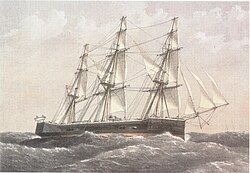
Further iterations followed, including the HMS Royal Sovereign in 1864, which replaced broadside guns with four turrets and a 5.5-inch (140 mm) waterline armor belt. While early designs were limited to coastal waters, Coles and Sir Edward James Reed eventually produced the HMS Monarch. Completed in June 1869, the Monarch was the first true seagoing warship to carry turreted guns, although its forecastle and poop deck restricted fire directly fore and aft.
American Innovations and the USS Monitor
Simultaneously, Swedish inventor John Ericsson was developing turret technology in the United States. His most famous creation, the USS Monitor (1861), featured a large cylindrical gun turret mounted amidships on a low-freeboard upper hull known as the "raft." This raft extended beyond the sides of the traditional lower hull to present the smallest possible target to enemies.
The Monitor's turret was rounded to deflect incoming cannon shot and was rotated by a pair of donkey engines (small auxiliary steam engines) using a set of gears. During testing on February 9, 1862, the turret completed a full rotation in 22.5 seconds. However, this system lacked the precision of Coles' design; if the turret overshot its target, the crew had to either reverse the engine or complete another full rotation.
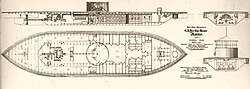
Engineering challenges plagued the Monitor's turret. The structure, weighing approximately 160 long tons (163 t), rested on a 9-inch (23 cm) iron spindle. While the spindle was ten times stronger than necessary to prevent sideways sliding, direct heavy hits could bend it, jamming the turret. Additionally, the brass ring intended to create a watertight seal between the turret and deck leaked heavily. This gap also allowed debris and shell fragments to enter, a flaw that jammed the turrets of several Passaic-class monitors during the First Battle of Charleston Harbor in April 1863.
The Monitor was designed for 15-inch (381 mm) smoothbore Dahlgren guns, but 11-inch (279 mm) guns were used instead. Each gun weighed roughly 16,000 pounds (7,300 kg) and fired a 136-pound (61.7 kg) round shot or shell. With a propellant charge of 15 pounds (6.8 kg), these guns could reach targets up to 3,650 yards (3,340 m) at a +15° elevation.
Key Facts
- First Revolving Turret: HMS Trusty (1861) was the first vessel to be fitted with a revolving gun turret.
- First Seagoing Turret Ship: HMS Monarch (1869) was the first turret ship capable of open-ocean operations.
- USS Monitor Rotation: The Monitor's turret could complete a full 360-degree rotation in 22.5 seconds.
- Monitor Armament: The USS Monitor utilized 11-inch Dahlgren guns capable of firing shells up to 3,650 yards.
- Design Goal: Both British and American designers sought to minimize the ship's target profile by using low freeboards.
| Feature | HMS Monarch | USS Monitor |
|---|---|---|
| Primary Role | Seagoing Warship | Coastal/Harbor Defense |
| Turret Mechanism | Coles Design (High Precision) | Ericsson Design (Donkey Engines) |
| Key Limitation | Fore/Aft fire blocked by decks | Pilot house blocked forward fire |
| Hull Characteristic | Seagoing hull | Low-freeboard "raft" |
Frequently Asked Questions
Who invented the naval gun turret?
The gun turret was developed independently in Great Britain by Captain Cowper Phipps Coles and in the United States by Swedish inventor John Ericsson.
What was the main advantage of a turret over broadside guns?
Turrets allowed for a much greater all-round arc of fire, meaning the ship did not have to maneuver its entire hull to aim its guns at a target.
Why did the USS Monitor's turret sometimes jam?
Turrets could jam if the central iron spindle was bent by a direct hit from heavy shot, or if debris and shell fragments entered the gap between the turret and the deck.
What is "low freeboard" and why was it used?
Low freeboard refers to a small distance between the waterline and the upper deck. It was used to make the ship a smaller, harder target for enemy gunners to hit.
Which was the first turret ship capable of ocean travel?
The HMS Monarch, completed in June 1869, was the first seagoing warship to carry its guns in turrets.