Green Iguana: Biology, Distribution, and Global Impact
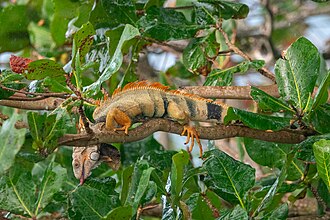
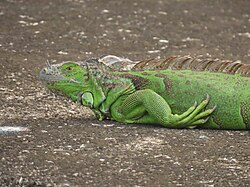
The green iguana (Iguana iguana) is a large, arboreal lizard and one of the most recognizable members of the Iguanidae family. Known for its impressive size and striking appearance, this reptile has expanded far beyond its native range through both natural occurrences and human activity. From the rainforests of Central and South America to the suburbs of Florida and the farms of Taiwan, the green iguana is a species of significant ecological and economic interest.

Key Facts
- Scientific Name: Iguana iguana
- Maximum Length: Can exceed 2 meters (6.6 ft) in rare cases.
- Conservation Status: Least Concern (IUCN 3.1).
- Diet: Primarily herbivorous.
- Key Health Risk: Susceptible to metabolic bone disease without proper UVB/UVA lighting.
- Global Trade: One of the most traded reptiles worldwide.
Physical Characteristics and Biology
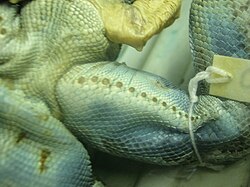
The green iguana is likely the largest species in its family, though some species in the genus Cyclura may match or exceed it in weight. Adults typically range from 1.2 to 1.7 meters (3.9 to 5.6 ft) in total length. A significant portion of this length is the tail; the snout-to-vent length (the distance from the tip of the nose to the cloaca) usually measures between 30 and 42 cm (12 to 17 in).
Sexual dimorphism is evident in their size. Adult males typically weigh around 4 kg (8.8 lb), while females are smaller, generally weighing between 1.2 and 3 kg (2.6 to 6.6 lb). Exceptionally large males have been recorded exceeding 8 kg (18 lb) and 2 meters in length.
Anatomy and Senses
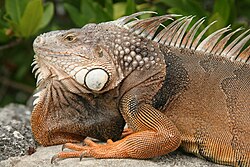
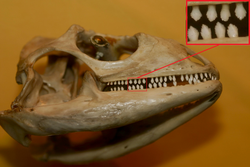
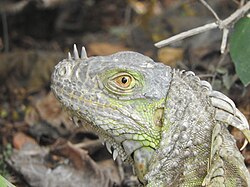
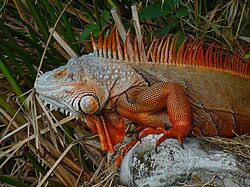
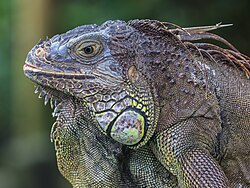
Their physical structure is adapted for an arboreal lifestyle. Key features include a dewlap (the fold of skin under the throat) and prominent spines along the back. Their skeletal structure and dental arrangement are specialized for their dietary needs.
Distribution and Range
Native to Central and South America, the green iguana has established populations in various other regions. These expansions occur through both intentional human introduction and remarkable natural events.
Natural Colonization
In 1995, following Hurricane Luis and Hurricane Marilyn, a group of 15 or more iguanas arrived on the island of Anguilla. They had rafted approximately 320 km (200 mi) from Guadeloupe on uprooted trees, spending an estimated three weeks at sea. A breeding colony was established on the island within two years.
Introduced and Invasive Ranges
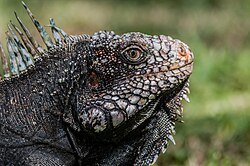
The species has become a problematic invasive species in several parts of the world:
- Taiwan: In the 21st century, green iguanas have caused significant agricultural damage. The government has implemented control programs, including annual bounties. In 2025, the Ministry of Agriculture set a quota of 120,000 iguanas for removal.
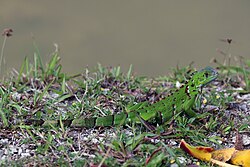
- United States: They are widely established in Florida, where they are often viewed as pests.
- Caribbean: They have spread across various islands, sometimes hybridizing with native species.
The Pet Trade and Captivity
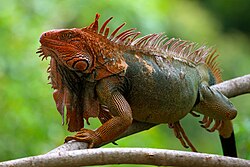
Green iguanas are among the most globally traded reptiles. Between 1996 and 2012, they represented 46% of the total reptile trade in the United States. In 1995 alone, 800,000 were imported into the U.S., mostly from captive farms in Panama, Colombia, El Salvador, and Honduras.
Despite their popularity, they are demanding pets. They require specific temperatures between 79°F (26°C) and 95°F (35°C). Crucially, they need UVB and UVA lighting to synthesize vitamin D, which is essential for calcium absorption. Without this, they develop metabolic bone disease, a potentially fatal condition.
Due to ecological risks, ownership is prohibited in certain areas, such as New York City and Hawaii. In Hawaii, strict regulations exist to protect the local ecosystem; violators can face fines up to $200,000 and up to three years in prison.
Summary of Species Data
| Feature | Typical Range/Value |
|---|---|
| Total Length | 1.2 to 1.7 m (up to 2 m) |
| Male Weight | Average 4 kg (up to 8+ kg) |
| Female Weight | 1.2 to 3 kg |
| Required Temp | 79°F to 95°F (26°C to 35°C) |
| Conservation Status | Least Concern |


Frequently Asked Questions
Why are green iguanas considered invasive in Taiwan?
They cause significant damage to farms, leading the Taiwanese government to issue annual bounties and set high quotas for their removal to protect agricultural productivity.
What is metabolic bone disease in iguanas?
It is a fatal condition caused by a lack of calcium absorption. This occurs when iguanas do not have access to proper UVB and UVA lighting, which is necessary for their bodies to produce vitamin D.
How did iguanas reach Anguilla?
They arrived via natural rafting. After hurricanes in 1995, iguanas were carried on a raft of uprooted trees from Guadeloupe across 320 km of ocean.
Are green iguanas legal as pets everywhere?
No. Ownership is prohibited in some locations, such as New York City and Hawaii, due to the potential for these animals to escape and damage local ecosystems.
How large can a green iguana grow?
While typical adults are 1.2 to 1.7 meters long, some large males can reach or exceed 2 meters (6.6 ft) in length and weigh more than 8 kg (18 lb).