Greater Downtown Miami: A Hub of Finance, Culture, and Urban Growth
Greater Downtown Miami serves as the vibrant core of the city, blending a rich historical legacy with an aggressive modern expansion. Known as the Central Business District (CBD), this area has evolved from its early settlements in the 1830s into one of the most populous downtowns in the United States, trailing only New York City and Chicago. With a skyline defined by high-rise residential towers and corporate headquarters, it is a primary engine for Florida's economic growth.
The region is characterized by its diverse subdistricts, ranging from the financial powerhouse of Brickell to the creative energy of Wynwood and the Arts & Entertainment District. This urban center attracts a massive daytime population, as thousands of professionals commute daily to work in its dense concentration of office towers and international banks.
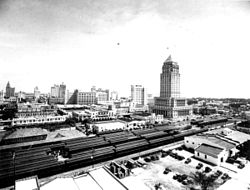
Key Facts
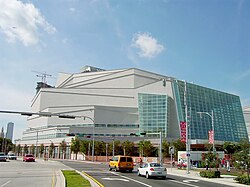
- Rapid Growth: The residential population grew from approximately 40,000 in 2000 to over 110,000 by 2020.
- Economic Power: Brickell Avenue hosts the largest concentration of international banks in the U.S.
- High Density: Brickell is one of the most densely populated neighborhoods in the U.S. outside of New York City.
- Cultural Hub: Home to the Adrienne Arsht Center, the second-largest performing arts center in the country.
- Historic Depth: The Downtown Miami Historic District features over 60 buildings dating between 1896 and 1939.
Neighborhoods and Urban Layout
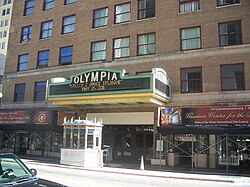
Greater Downtown is composed of several distinct neighborhoods, each contributing a unique flavor to the city's identity. The Central Business District acts as the administrative and commercial heart, while Brickell serves as the financial epicenter.
Other notable areas include Park West, Edgewater, Midtown, and Overtown. The Arts & Entertainment District and Wynwood provide a contrast to the corporate towers, offering galleries and creative spaces that attract tourists and residents alike.
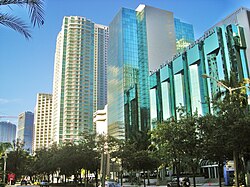
![Brickell, the fastest-growing neighborhood in Miami, has one of the highest population densities in the United States outside of New York City.[9]](/images/e0/30/e030176bd934dec8163ef0a3e448f7397e9383bbf0553ac2bdd202a87eb12fc4.jpg)
The Financial Core: Brickell
Brickell is recognized globally as a financial hub. Its high population density and concentration of international banking institutions make it a critical node for global commerce.
Historic Preservation
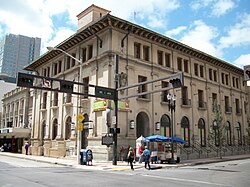
The Downtown Miami Historic District spans 380 acres and is characterized by Moderne and Classical Revival architectural styles. These structures, many built between 1900 and 1974, house a mix of government and commercial entities.
Economy, Retail, and Cost of Living
The economy of Downtown Miami is driven by professional services, international trade, and tourism. The area is a magnet for international business, hosting various chambers of commerce, including those from Britain, Italy, Spain, Germany, Chile, and France.
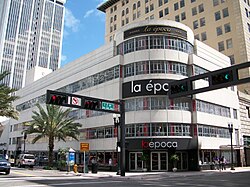
Retail activity is centered around Flagler Street, the city's primary shopping thoroughfare since the 1800s. This street is also home to the Miami Jewelry District, a four-block area featuring established jewelers some of whom have operated since 1900.
For tourists, the Bayside Marketplace is a premier destination. This outdoor mall overlooks Biscayne Bay and attracts over 15 million visitors annually. In Brickell, Mary Brickell Village offers a more upscale experience with high-end bars and restaurants.
Real Estate Trends
The first decade of the 21st century saw a massive building boom, with over 23,600 condominiums and apartments constructed. As of 2011, the average apartment sale price was $347,729, with a price point of roughly $300 per square foot. Renters make up approximately 56% of the downtown residential population.
Culture, Education, and Recreation
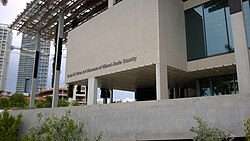
Downtown Miami is a center for the arts and spirituality. The Pérez Art Museum Miami and the Freedom Tower—a historic landmark and symbol of the city—are key cultural sites.
![Freedom Tower, built in 1925, a local historic landmark and a symbol of the city[52]](/images/81/e2/81e218b2f3523463c8754752020150a845cf186aa9876892d1c41c207f0ac6ba.jpg)
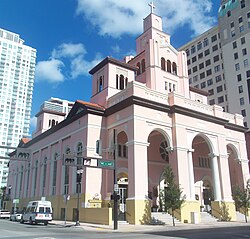
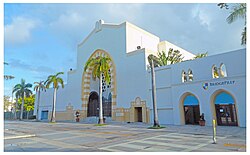
The area is also rich in religious diversity, featuring the Gesu Church (the oldest Catholic church in Miami, built in 1896) and Temple Israel of Greater Miami.
Parks and Public Spaces
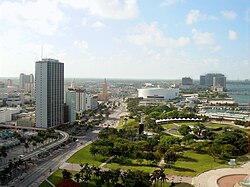
Bayfront Park stands as the largest and most visited park in the area, hosting major events like the New Year's Big Orange Drop and the Independence Day Celebration.
Education and Sports
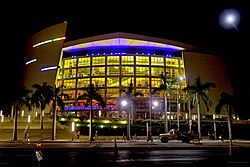
The district is well-served by higher education institutions, including Florida International University (Downtown Center) and Miami Dade College (Wolfson Campus). For sports enthusiasts, the Kaseya Center serves as the home arena for the Miami Heat.
Infrastructure and Transportation
To manage its high daytime population, Downtown Miami utilizes a multi-modal transit system. The Miami Metrorail provides heavy rail access via stations at Government Center, Brickell, and Historic Overtown. The Metromover offers an automated people mover service with three loops: Downtown/Inner Loop, Omni Loop, and Brickell Loop.
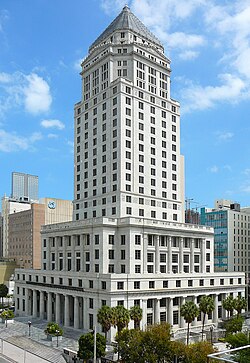
Governmental infrastructure is also concentrated here, with the Dade County Courthouse (built in 1925) and the Stephen P. Clark Government Center serving as primary administrative hubs.
Summary of Greater Downtown Miami
| Category | Details |
|---|---|
| Total Area | 3.80 sq mi (9.84 km) |
| Population (2020) | 110,006 |
| Daytime Population | 250,757 |
| Key Neighborhoods | Brickell, CBD, Park West, Wynwood, Overtown |
| Primary Transit | Metrorail, Metromover, Metrobus |
| Major Landmarks | Freedom Tower, Kaseya Center, Adrienne Arsht Center |
Frequently Asked Questions
What is the significance of Brickell Avenue?
Brickell Avenue is the financial heart of Miami and holds the largest concentration of international banks in the United States, contributing to the neighborhood's status as one of the fastest-growing and most densely populated areas in the country.
What are the main transportation options in Downtown Miami?
Residents and visitors primarily use the Miami Metrorail for longer distances, the Metromover for circulating within the downtown loops, and Metrobus for general area coverage.
What makes the Downtown Miami Historic District unique?
The district contains over 60 buildings constructed between 1896 and 1939, featuring a blend of Moderne and Classical Revival architectural styles used for commercial and government purposes.
Which major events take place in Bayfront Park?
Bayfront Park hosts several high-profile events, including the New Year's Big Orange Drop, the Independence Day Celebration, and the DWNTWN Concert Series.
What is the Miami Jewelry District?
The Jewelry District is a specialized retail area consisting of four blocks on Flagler Street, between Miami Avenue and SE 2nd Avenue, known for its long-standing jewelers dating back to the early 20th century.