Graptolites: The Colonial Architects of the Paleozoic Oceans
Graptolites are a fascinating group of colonial animals that once dominated the marine ecosystems of the early Paleozoic era. Members of the subclass Graptolithina within the class Pterobranchia, these filter-feeding organisms are primarily known through an extensive fossil record spanning from the Middle Cambrian to the Lower Carboniferous. While most are extinct, modern scientific analysis suggests that the living pterobranch Rhabdopleura is actually an extant graptolite, providing a vital biological link to the ancient past.
These organisms are characterized by their unique colony structures, consisting of interconnected individuals called zooids housed in organic tubes. Because of their abundance and rapid evolutionary changes, they serve as critical tools for geologists dating the Earth's crust.
Key Facts
- Classification: Belong to the phylum Hemichordata, class Pterobranchia.
- Temporal Range: Primarily Middle Cambrian through Lower Carboniferous, with one extant relative (Rhabdopleura).
- Ecological Role: Planktonic or benthic suspension feeders that strained nutrients from the water.
- Geological Value: Essential index fossils for the Ordovician and Silurian periods.
- Structure: Colonies (rhabdosomes) made of individual tubes (thecae) secreted by zooids.
Morphology and Colony Structure
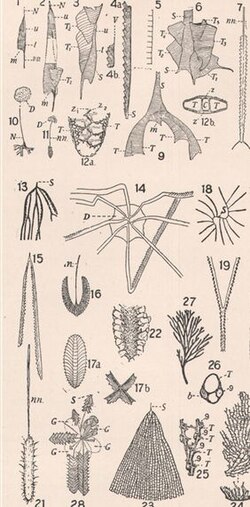
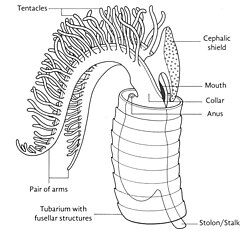
A graptolite colony begins with a single individual known as the sicular zooid. From this founder, subsequent zooids develop and remain interconnected via a system of stolons. The entire colony structure is referred to as a tubarium (or a rhabdosome in fossil specimens), which is composed of organic tubes called thecae. These tubes are built from stacked half-rings known as fuselli, likely composed of collagen or chitin.
Within some colonies, two distinct sizes of thecae exist: the larger autotheca and the smaller bitheca. Researchers suggest this variation may be a result of sexual dimorphism among the zooids.
The Nature of Zooids
The zooids themselves are small animals equipped with a cephalic shield and a pair of arms used for filter feeding. In the living Rhabdopleura, these zooids use their arms and tentacles to capture food particles from the surrounding water.
Taxonomy and Classification
Graptolites are closely allied with the pterobranchs of the phylum Hemichordata. While Rhabdopleura is classified within Graptolithina, the Cephalodiscida are considered a sister subclass. Unlike graptolites, Cephalodiscida are not colonial and lack the common canal connecting individuals; they also possess several arms rather than a single pair.
The extinct graptolites are divided into two primary orders:
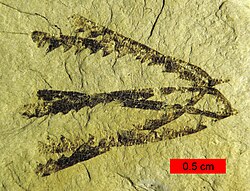
- Dendroidea: Benthic, bush-like colonies that lived attached to the sea floor.
- Graptoloidea: Planktonic, free-floating colonies that achieved immense diversity and global distribution.
Detailed Taxonomic Breakdown
The Graptoloidea order is particularly diverse, featuring suborders such as the Axonophora (which includes biserial graptolites like the Diplograptids and Neograptids). These groups were especially prominent during the Ordovician period.
Ecology and Life Cycle
As suspension feeders, graptolites played a major role in the zooplankton community of the early Paleozoic. While benthic species remained stationary, the locomotion of planktonic species remains a subject of scientific debate. Some theories suggest they moved via undulatory muscular appendages—similar to modern "sea butterflies" (Thecostomata)—while others consider buoyancy or passive drifting.
Development and Growth
The life cycle begins with a planktonic, ciliated larva produced via sexual reproduction. This larva eventually settles and metamorphoses into the sicular zooid to start a new colony. Growth occurs through asexual budding. In many fossils, this appears as monopodial budding (growth from a permanent terminal zooid) or sympodial budding (where new zooids form from the tip of the most recent one).
Geological Significance and Preservation
Graptolites are world-renowned index fossils. Because they evolved rapidly and were distributed globally by ocean currents, geologists use them to establish biozones—stratigraphic markers that can date rock layers to within one million years, particularly for the Ordovician and Silurian periods.
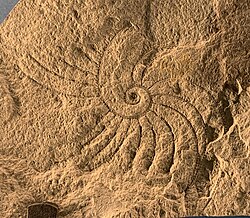
They are most commonly preserved in black shales and mudrocks. These environments were typically deep, oxygen-poor, and lacked scavengers, allowing the organic carbon films of the graptolites to remain undisturbed. While they often appear as flattened, shiny black markings on rock surfaces, some specimens are preserved in three dimensions through pyritization (replacement by iron pyrite).
| Feature | Dendroidea | Graptoloidea |
|---|---|---|
| Lifestyle | Benthic (Sessile) | Planktonic (Free-floating) |
| Form | Bush-like/Branching | Linear, Tuning-fork, or Sawblade |
| Geological Use | Limited | Primary Index Fossils |
| Environment | Attached to substrate | Open ocean water column |
Frequently Asked Questions
What does the name "graptolite" mean?
The name comes from the genus Graptolithus, which translates to "writing on the rocks," referring to the way their fossils resemble ancient script or markings on the stone.
Are there any graptolites alive today?
Yes. Recent phylogenetic analyses indicate that the living pterobranch Rhabdopleura is an extant member of the Graptolithina subclass.
Why are graptolites so useful for dating rocks?
They are ideal index fossils because they evolved very quickly, had a widespread global distribution due to their planktonic nature, and possess distinct morphologies that are easy for geologists to identify.
How did graptolites feed?
They were suspension feeders. The individual zooids used their arms and tentacles to strain plankton and other organic particles from the surrounding seawater.
What caused the decline of the graptolites?
A worldwide ice age at the end of the Ordovician period eliminated the majority of graptolite species, leaving only the neograptines to survive and eventually diversify again.