Grand Lycée Franco-Libanais de Beyrouth
The Grand Lycée Franco-Libanais (GLFL) is a prestigious private French international school located in the Achrafieh district of Beirut, Lebanon. Founded in 1909 by the Mission laïque française (a non-profit organization promoting French culture and language), the institution is recognized by the Agency for French Education Abroad (AEFE), ensuring a high standard of academic excellence aligned with French national requirements.
Key Facts
- Established: 1909
- Founder: Mission laïque française
- Location: Rue Beni Assaf, Achrafieh, Beirut
- Enrollment: Approximately 5,000 students
- Faculty: 180 educators
- Grades: 1 through 12
- Languages Taught: French, Arabic, English, Latin, Spanish, German, and Italian
History and Architectural Evolution
The GLFL has a rich history that mirrors the complexities of Beirut's urban development. Originally situated in the Sodeco neighborhood near the central district, the school eventually relocated to Beni Assaf Street, placing it in close proximity to the French embassy and Saint Joseph University in the Badaro neighborhood.
The campus consists of ten buildings. Notably, five of these structures were designed by the renowned French planner Michel Ecochard. These buildings represent a significant piece of the school's architectural heritage.
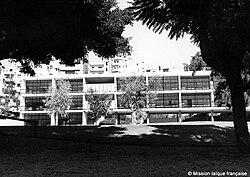
The most challenging period in the school's history occurred during the Lebanese civil war, which began in 1975. Due to its location near the "Green Line" (the demarcation line that divided East and West Beirut), the school faced severe accessibility issues and its buildings sustained heavy damage. To recover from this crisis, the lycée underwent extensive renovations between 1996 and 2003, which included the rehabilitation of the Ecochard buildings and the construction of new facilities.
Campus Facilities and Organization
The GLFL serves a large student body of over 3,600 students across its various departments. The school emphasizes literacy and research, providing three libraries equipped with computer networks and a collection of 27,000 books and literary archives. Younger students have access to a dedicated secondary library known as the BCD (Bibliothèque Centre Documentaire).
Physical education is a core component of the student experience. The school operates the Stade du Chayla on Damascus Street. Inaugurated on March 25, 2005, and later renovated in 2018, this athletic complex includes a track-and-field playground as well as specialized courts for tennis, badminton, basketball, and mini-soccer.
Athletic Programs
The school offers a diverse range of sports to foster student health and teamwork, including:
- Team sports: Football, basketball, volleyball, handball, and ultimate.
- Racket sports: Tennis, badminton, squash, and ping-pong.
- Individual and artistic disciplines: Swimming, athletics, gymnastics, and acrogym.
Academic Summary
The following table provides a concise overview of the Grand Lycée Franco-Libanais's institutional profile.
| Category | Details |
|---|---|
| Type | Private French International School |
| Principal | Xavier Ferrand |
| Affiliation | Mission laïque française / AEFE |
| Campus Features | 10 Buildings, 3 Libraries, Stade du Chayla |
| Curriculum Scope | Grades 1–12 |
Notable Alumni
The GLFL has educated many influential figures who have made significant impacts in politics, journalism, and academia, including:
- Amir-Abbas Hoveyda: Former Prime Minister of Iran.
- Marwan Hamadeh: Former Minister of Telecommunications, Economy, Trade, and Health.
- Gebran Tueni: Member of Parliament and Editor-in-chief of An-Nahar.
- Fares Souhaid: Member of Parliament and General Secretary of the March 14 Coalition.
- Samir Kassir: Renowned journalist.
- Nassim Nicholas Taleb: Author of The Black Swan.
- Nabil Bukhalid: Former Chief Enterprise Architect at the American University of Beirut.
Frequently Asked Questions
When was the Grand Lycée Franco-Libanais founded?
The school was established in 1909 by the Mission laïque française.
Which languages are taught at the GLFL?
Students have the opportunity to study French, Arabic, English, Latin, Spanish, German, and Italian.
What is the Stade du Chayla?
The Stade du Chayla is the school's athletic stadium located on Damascus Street, featuring a track-and-field area and courts for various sports like tennis and basketball.
How did the Lebanese civil war affect the school?
The war caused severe damage to the school buildings and made access difficult due to the school's proximity to the Green Line. This led to a major rehabilitation project between 1996 and 2003.
Who designed the school's architecture?
Five of the school's ten buildings were designed by the French planner Michel Ecochard.