Governor Raymond E. Baldwin Bridge: A History of Connectivity
The crossing that now hosts the Governor Raymond E. Baldwin Bridge has long been a vital link for transportation. Before the era of permanent structures, travelers relied on a ferry service, with the landing situated further downstream from the current site. Over the last century, the site has evolved through three distinct iterations of bridge engineering to meet the growing demands of the region.
The First and Second Generations
The first bridge on the site was completed in 1911. This structure featured a double-bascule span—a type of movable bridge with a counterweight that allows a section of the deck to pivot upward to allow maritime traffic to pass. Between 1913 and 1919, the bridge served as a route for the New London and East Lyme Street Railway.
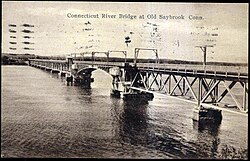
As traffic needs grew, a second bridge was opened in 1948. This version was a four-lane girder and floorbeam bridge, designed for greater stability and capacity. For several decades, this bridge operated as a toll facility, though tolls were eventually removed in the late 1980s.
The Modern Era: The Third Bridge
The current structure was commissioned to replace the aging 1948 bridge. Construction began in 1990, managed by a joint venture consisting of Perini, PCL, and O&G. The project was completed in 1993 at a total cost of $460 million. Following the opening of the new span, the 1948 bridge was demolished in 1994.
The bridge is named in honor of Raymond E. Baldwin, who served as the Governor of Connecticut during two separate terms: from 1939 to 1941 and again from 1943 to 1946.
Key Facts
- Original Crossing: A ferry service located downstream.
- First Bridge: Completed in 1911 as a double-bascule span.
- Transit History: Used by the New London and East Lyme Street Railway (1913–1919).
- Second Bridge: Opened in 1948; tolls were removed in the late 1980s.
- Current Bridge: Completed in 1993 at a cost of $460 million.
- Construction Firm: Joint venture of Perini, PCL, and O&G.
| Era/Bridge | Completion Year | Key Feature/Event |
|---|---|---|
| Pre-Bridge | N/A | Ferry crossing |
| First Bridge | 1911 | Double-bascule span |
| Second Bridge | 1948 | 4-lane girder and floorbeam |
| Third Bridge | 1993 | $460 million construction cost |
Frequently Asked Questions
Who is the bridge named after?
The bridge is named after Raymond E. Baldwin, who served as the Governor of Connecticut from 1939 to 1941 and 1943 to 1946.
What was the first bridge's design?
The first bridge, completed in 1911, was a double-bascule span.
Did the bridge ever carry trains?
Yes, the New London and East Lyme Street Railway operated over the first bridge from 1913 to 1919.
When were tolls removed from the second bridge?
Tolls on the 1948 bridge were removed in the late 1980s.
How much did the current bridge cost to build?
The third and current bridge cost a total of $460 million to construct.