Golf: History, Rules, and the Global Game
Golf is a precision club-and-ball sport where players use various clubs to hit a ball into a series of holes in as few strokes as possible. While variations of hitting balls with sticks have existed across cultures, the modern game of golf originated in 15th-century Scotland. From its humble beginnings on the Scottish coast to its current status as a global professional sport, golf combines physical skill with a deep commitment to fairness and etiquette.
The sport's evolution is marked by key milestones, such as the creation of the 18-hole round at the Old Course at St Andrews in 1764. The competitive spirit of the game was further solidified with the establishment of The Open Championship in 1860 at Prestwick Golf Club in Ayrshire, Scotland, which remains the world's oldest golf tournament.
![Stained Glass Window installed in Gloucester Cathedral in the 1350's. Said to be the oldest depiction of the sport.[10]](/images/f1/97/f197cf8db5ad998d6acce610ae799ac9fe03ce7ec3bfed23533158d02259bfc8.jpg)
Key Facts
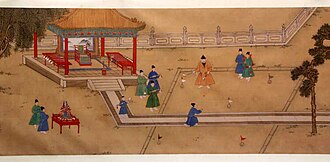
- Origin: Modern golf began in 15th-century Scotland.
- Governing Bodies: The R&A and the USGA jointly standardize international rules.
- Standard Round: A typical round consists of 18 holes.
- Major Championships: The four men's majors are The Open, The Masters, the U.S. Open, and the PGA Championship.
- Olympic Status: Featured in 1900 and 1904, and returned to the program in 2016.
The Golf Course and Equipment
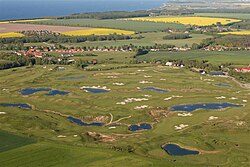
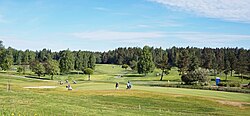
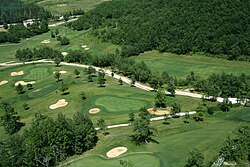
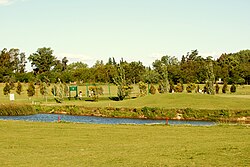
A golf course is a carefully designed landscape consisting of several holes. Each hole typically begins at the teeing ground, where the player takes their first shot. The ball then travels through the fairway (the short-cut grass) and potentially through the rough (longer grass) or hazards like sand bunkers and water obstacles, before reaching the putting green.
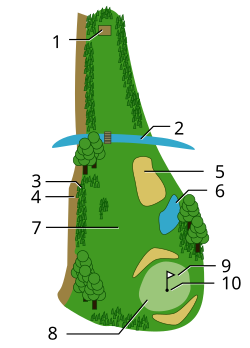
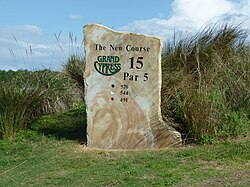
The ultimate goal is to hit the ball into the hole, marked by a flagstick. Depending on the design, holes are categorized as par-3, par-4, or par-5, indicating the expected number of strokes a proficient golfer should take to complete the hole.

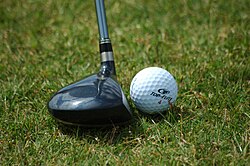
To navigate these terrains, golfers use a set of clubs—specialized tools with different heads designed for distance, accuracy, or putting. A tee, a small peg, is often used to elevate the ball for the initial shot of each hole.
Rules and Mechanics of Play
The rules of golf are governed internationally by The R&A (spun off from The Royal and Ancient Golf Club of St Andrews) and the United States Golf Association (USGA). In 2019, a comprehensive rewrite of the rule book was implemented to simplify the game while maintaining the core principle of fairness.
Playing the game involves a sequence of strokes. The golfer selects a club and grip based on the distance to the hole and the surrounding terrain. The process begins with the stance—the way the golfer positions their feet—followed by the swing to strike the ball.

Scoring and Terminology
Golf scoring is unique because the lowest score wins. Par is the predetermined number of strokes a golfer is expected to need to complete a hole. Scores are recorded relative to this number.
| Numeric Term | Name | Definition |
|---|---|---|
| −4 | Condor | Four strokes under par |
| −3 | Albatross (Double eagle) | Three strokes under par |
| −2 | Eagle | Two strokes under par |
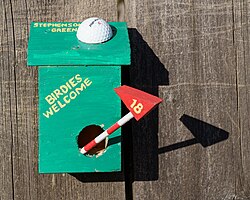
| −1 | Birdie | One stroke under par |
| E | Par | Equal to par |
| +1 | Bogey | One stroke over par |
| +2 | Double bogey | Two strokes over par |
| +3 | Triple bogey | Three strokes over par |
Professional Golf and Global Reach
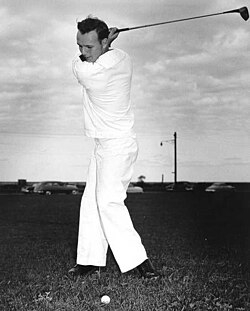
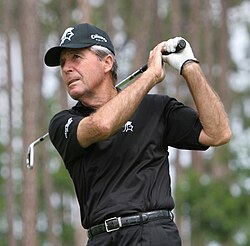
Professional golf is organized into various tours and championships. For men, the four major championships represent the pinnacle of the sport. Senior golf also maintains a strong presence, with the Senior PGA (founded in 1937) being the oldest senior major. Legends like Arnold Palmer and Gary Player helped propel senior golf into commercial success during the television era.
The game has seen significant growth in diversity. In the United States, women's participation has risen, with women making up 25 percent of golfers in 2021. Junior female golfers now account for approximately 1.1 million players (35 percent of female golfers).

Globally, the United States hosts the highest number of courses (16,752), while Ireland has the highest density of courses per capita (101.19 per million people). Other major hubs include Japan, Canada, and the United Kingdom.
Frequently Asked Questions


Who governs the rules of golf?
The rules are jointly governed and standardized internationally by The R&A and the United States Golf Association (USGA).
What is the difference between a birdie and an eagle?
A birdie is a score of one stroke under par for a hole, while an eagle is a score of two strokes under par.
Where did the 18-hole round originate?
The 18-hole standard was established at the Old Course at St Andrews in Scotland in 1764.
Which is the oldest golf tournament in the world?
The Open Championship, first played in 1860 at Prestwick Golf Club in Scotland, is the world's oldest golf tournament.
Has golf ever been in the Olympics?
Yes, golf was featured in the 1900 and 1904 Olympic Games and returned as a regular sport starting in 2016.