Glycogen: The Body's Essential Short-Term Energy Reserve
In the complex machinery of biological energy, the body requires a way to store fuel that can be accessed quickly. Glycogen is a multibranched polysaccharide—a complex carbohydrate made of glucose units—that serves as this critical energy reservoir in animals, fungi, and bacteria. In humans, it acts as the primary storage form of glucose, ensuring that cells have a steady supply of fuel even between meals or during intense physical exertion.
To understand where glycogen fits into the body's energy hierarchy, it is helpful to view it as the middle ground of energy reserves. While creatine phosphate provides immediate, very short-term energy and triglycerides (body fat) provide long-term storage, glycogen is the go-to source for short-term energy needs. Other sources, such as proteins broken down into amino acids, are typically reserved for extreme circumstances like starvation or glycolytic crises.
Key Facts
- Primary Locations: Stored mainly in the liver and skeletal muscles.
- Liver Capacity: Makes up 5–6% of liver weight (approx. 100–120g in an average adult).
- Muscle Capacity: Makes up 1–2% of muscle mass (approx. 400g in a 70kg adult).
- Chemical Structure: A branched polymer of glucose with $\alpha(1\to4)$ and $\alpha(1\to6)$ glycosidic linkages.
- Core Protein: Every glycogen granule is centered around a protein called glycogenin.
- Function: Maintains blood glucose homeostasis and fuels high-intensity muscle contraction.
The Molecular Architecture of Glycogen
Glycogen is a sophisticated biopolymer. It consists of linear chains of glucose residues, with an average chain length of 8 to 12 units. A single glycogen molecule can contain anywhere from 2,000 to 60,000 glucose residues. Its empirical formula is $C_{6n}H_{10n+2}O_{5n+1}$.
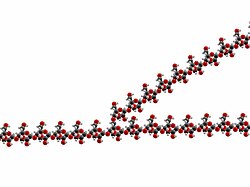
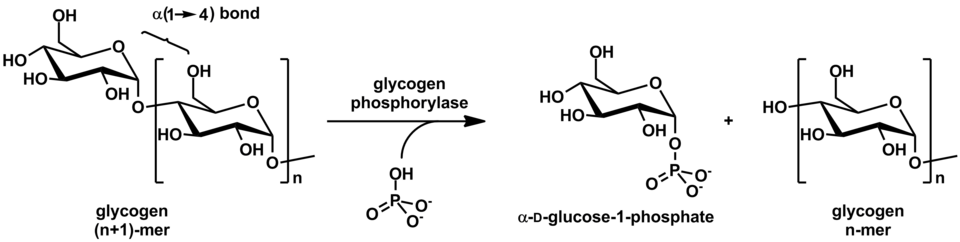
The structure is defined by two types of chemical bonds. Linear chains are formed by $\alpha(1\to4)$ glycosidic bonds, which link glucose units in a straight line. To create the branched structure, $\alpha(1\to6)$ glycosidic bonds attach new branches to the existing stem chains.
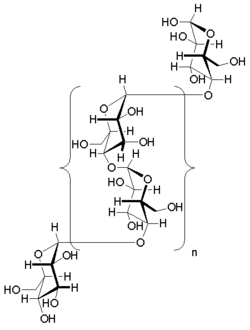
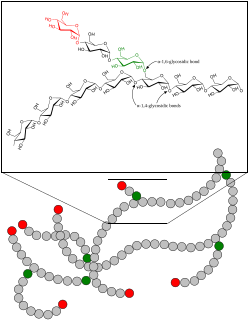
Visually, glycogen resembles a globular ball of "glucose trees" consisting of roughly 12 layers. At the very center is the glycogenin protein. The growth happens in stages: a single C-chain attaches to the glycogenin via self-glucosylation; from this C-chain, B-chains grow, and from B-chains, further B- and A-chains branch out. A-chains are terminal and unbranched, reaching the outer surface of the sphere.
![Schematic two-dimensional cross-sectional view of glycogen: A core protein of glycogenin is surrounded by branches of glucose units. The entire globular granule may contain around 30,000 glucose units.[1]](/images/f3/d3/f3d3851a1330db04efbb3a186138e394765684c2f5780ecbeef396f01d2fec06.webp)
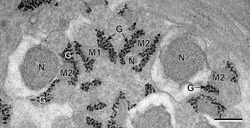
In the body, glycogen is stored in a hydrated state, meaning it associates with three to four parts water for every part of glycogen, along with approximately 18 mg of potassium per gram.
Distribution and Physiological Roles
While glycogen is found in small amounts in the kidneys, red blood cells, white blood cells, and glial cells in the brain, its primary concentrations are in the liver and skeletal muscles.
The Liver: Maintaining Homeostasis
The liver acts as a glucose reservoir for the entire body. By breaking down glycogen, the liver can release glucose into the bloodstream to maintain constant blood sugar levels, which is vital for the brain and other glucose-dependent tissues.
Skeletal Muscle: Powering Movement
In muscles, glycogen is used locally to produce ATP (adenosine triphosphate), the primary energy currency of the cell. The speed of ATP production from muscle glycogen is significantly faster than that from fatty acid oxidation. This is crucial during high-intensity aerobic activities like running or jogging.
During maximum intensity exercise, muscle glycogen can supply glucose at a rate of 40 mmol/kg wet weight/minute, compared to only 4–5 mmol from blood glucose. This efficiency prevents the muscles from draining blood glucose too quickly, which helps avoid hypoglycemia (dangerously low blood sugar).
Metabolism: Synthesis and Breakdown
The creation and destruction of glycogen are tightly regulated enzymatic processes.
Synthesis (Glycogenesis)
The glycogen branching enzyme is responsible for the complex structure of the molecule. It transfers a fragment of six or seven glucose residues from a nonreducing end to a C-6 hydroxyl group deeper in the molecule, provided the branch has at least 11 residues.
Breakdown (Glycogenolysis)
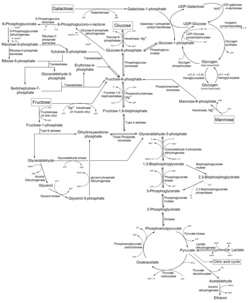
Breakdown occurs via phosphorolysis, where glucose-1-phosphate is released. This is then converted to glucose-6-phosphate (G6P) by the enzyme phosphoglucomutase. Because glycogen is branched, a specialized debranching enzyme is required to remove $\alpha(1\to6)$ linkages and return the chain to a linear form for further processing.
Clinical Relevance and Performance
When muscle glycogen stores are exhausted during prolonged exercise, athletes experience a sudden drop in energy and performance known as "hitting the wall" or "the bonk." To forestall this depletion, athletes often ingest high-glycemic index carbohydrates during exercise, which can replace approximately 35% of the glucose consumed during high-intensity efforts (heart rates above 80% of maximum).
Historically, glycogen was discovered by Claude Bernard in 1857, who identified it as "la matière glycogène" in the liver. Shortly after, M.A. Sanson discovered its presence in muscle tissue, and August Kekulé established its empirical formula in 1858.
| Storage Site | Concentration (% of mass) | Approx. Total Amount (Adult) | Primary Function |
|---|---|---|---|
| Liver | 5–6% | 100–120 grams | Blood glucose homeostasis |
| Skeletal Muscle | 1–2% | 400 grams | Rapid ATP production for contraction |
| Other Tissues | Trace | Variable | Local cellular energy needs |
Frequently Asked Questions
What is the difference between liver and muscle glycogen?
Liver glycogen is used to maintain blood glucose levels for the entire body, whereas muscle glycogen is used exclusively by the muscle cell itself to fuel contraction.
What does "hitting the wall" mean in athletic terms?
This refers to the point of muscle fatigue that occurs when glycogen stores in the skeletal muscles are depleted, leaving the body to rely on slower energy sources like fat oxidation.
How is glycogen structured differently from a simple chain of glucose?
Unlike a simple linear chain, glycogen is highly branched. It uses $\alpha(1\to4)$ bonds for linear growth and $\alpha(1\to6)$ bonds to create branches, allowing for more rapid synthesis and breakdown.
What is the role of glycogenin?
Glycogenin is the core protein that acts as a primer. It initiates the formation of the glycogen granule by creating the first short chain of glucose units (the C-chain) through self-glucosylation.
Can the body use protein for energy instead of glycogen?
Yes, but this is rare. Protein is typically only used as a main energy source during periods of starvation or severe glycolytic crisis.