Giuliano della Rovere: The Rise of a Power Broker in the Renaissance Church
The career of Giuliano della Rovere serves as a masterclass in the intersection of faith, family, and raw political power during the Italian Renaissance. Long before he would ascend to the papacy, Giuliano navigated the treacherous waters of the Roman Curia, leveraging nepotism and strategic alliances to become one of the most influential figures in Europe.
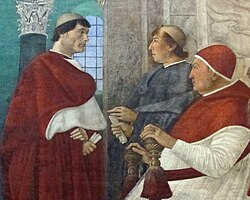
His ascent began through the patronage of his uncle, Pope Sixtus IV. Following his uncle's election on August 10, 1471, Giuliano was rapidly elevated within the church hierarchy. By December 1471, he was raised to the cardinalate—the college of cardinals who advise the pope—and assigned the titular church of San Pietro in Vincoli.
The Accumulation of Power and Wealth
Giuliano's early career was marked by simony (the buying or selling of ecclesiastical privileges) and pluralism (the practice of holding multiple church offices simultaneously). He amassed an extraordinary portfolio of power, serving as the Archbishop of Avignon and holding eight different bishoprics, including Lausanne and Catania.
Beyond his spiritual titles, Giuliano acted as a potent political agent. As a papal legate—a personal representative of the pope with diplomatic authority—he led armies to Todi and Spoleto and managed complex diplomatic missions in France. In 1479, he served as the Chamberlain of the College of Cardinals, overseeing the collection and disbursement of revenues for the cardinalate.
Diplomatic Missions to France
Giuliano's relationship with France was a cornerstone of his strategy. In 1480, he was sent to Paris with a threefold mission: to broker peace between King Louis XI and Archduke Maximilian of Austria, to secure funds for the war against the Ottoman Turks, and to negotiate the release of imprisoned clergy. His success was evident when the French provided a subsidy of 300,000 ecus of gold for the war effort.
Political Maneuvering and the War with Naples
Following the death of Sixtus IV in 1484, Giuliano became the principal advisor to the new Pope, Innocent VIII. This position allowed him to exert significant influence over papal policy, much to the chagrin of his rivals.
In 1485, Giuliano spearheaded the "Conspiracy of the Barons," an attempt to overthrow King Ferdinand I (Ferrante) of Naples. This conflict pitted the Papacy, supported by Genoa and Venice, against the Neapolitan monarchy, which was backed by Florence and Milan. The venture ended in disaster; Ferrante arrested and executed the rebellious barons, severely damaging the prestige of the della Rovere family.
The Bitter Rivalry with the Borgias
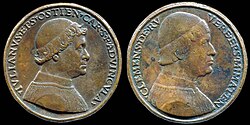
The Conclave of 1492 marked a turning point in Giuliano's life. Despite significant financial backing from France and Genoa, Giuliano lost the papal election to Cardinal Rodrigo Borgia, who became Pope Alexander VI. This loss sparked a lifelong hatred and a fierce rivalry between the two men.
Throughout Alexander VI's reign, Giuliano remained a constant threat. He frequently sought refuge in France, aligning himself with King Charles VIII to plot the removal of the Borgias from power. This alliance led to the French invasion of Italy in 1494, during which Charles VIII entered Rome with Giuliano by his side.
The Struggle for Survival
The relationship between Giuliano and Alexander VI fluctuated between open hostility and fragile reconciliation. At one point, Alexander deprived Giuliano of his benefices, labeling him an enemy of the Apostolic See. Later, the Pope attempted to have Giuliano kidnapped in Savona in 1502 to bring him back to Rome by force, though the mission failed.
Despite these conflicts, Giuliano remained one of the wealthiest men in the church. A list of cardinal incomes from 1499 reveals that he was the second-richest cardinal, earning an annual income of 20,000 ducats.
Key Facts
- Rapid Ascent: Appointed Bishop of Carpentras and raised to Cardinal in 1471 via nepotism from Pope Sixtus IV.
- Ecclesiastical Reach: Held the Archbishopric of Avignon and eight separate bishoprics simultaneously.
- Diplomatic Success: Secured 300,000 ecus of gold from France for wars against the Ottoman Turks.
- Political Rivalry: Engaged in a decades-long power struggle with Rodrigo Borgia (Pope Alexander VI).
- Financial Power: Ranked as the second-richest cardinal in 1499 with an annual income of 20,000 ducats.
Summary of Key Appointments
| Year | Position/Title | Location/Context |
|---|---|---|
| 1471 | Bishop of Carpentras / Cardinal | Comtat Venaissin / Rome |
| 1475 | First Archbishop of Avignon | France |
| 1479 | Chamberlain of the College of Cardinals | Roman Curia |
| 1483 | Suburbicarian Bishop of Ostia | Ostia |
| 1483 | Bishop of Bologna | Bologna |
Frequently Asked Questions
How did Giuliano della Rovere first enter the high clergy?
He entered the high clergy through the nepotism of his uncle, Pope Sixtus IV, who appointed him Bishop of Carpentras and raised him to the cardinalate in 1471.
What was the nature of his rivalry with Pope Alexander VI?
The rivalry was rooted in the Conclave of 1492, where Rodrigo Borgia (Alexander VI) was elected pope over Giuliano. This led to years of political conflict, including Giuliano's alliance with the French monarchy to oppose the Borgias.
What role did he play in the French invasion of Italy?
Giuliano collaborated with King Charles VIII of France, encouraging the military campaign to take Italy back from the Borgias, which resulted in the French entry into Rome in 1494.
What was the "Conspiracy of the Barons"?
It was a political effort led by Giuliano and Pope Innocent VIII to overthrow King Ferdinand I of Naples by supporting rebellious feudal barons who opposed the King's centralization of power and heavy taxation.
How wealthy was Cardinal Giuliano della Rovere?
He was exceptionally wealthy; records from 1499 indicate he was the second-richest cardinal in the church, with an annual income of 20,000 ducats.