George Stubbs: The Master of Animal Anatomy and Romanticism
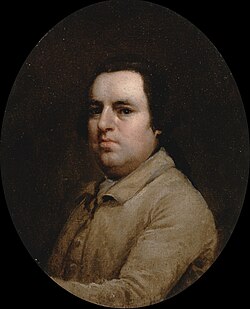
George Stubbs (1724–1806) stands as one of the most distinguished figures in English art, renowned primarily for his unparalleled ability to capture the form and spirit of animals. A self-taught artist, Stubbs blended a rigorous scientific approach to anatomy—the study of the bodily structure of humans and animals—with a keen artistic eye. While his portfolio includes history paintings and human portraits, his legacy is defined by his mastery of equine and wildlife subjects, which helped pave the way for the Romantic movement.
Stubbs' work is characterized by a precision that was rare for his time, stemming from his obsession with the physical mechanics of the creatures he painted. From the powerful stance of a thoroughbred to the raw violence of a predator's attack, his canvases offer a window into the natural world that is both scientifically accurate and emotionally charged.
Key Facts
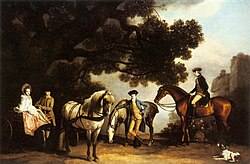
- Specialization: Best known for his paintings of horses, dogs, and lions.
- Methodology: Self-taught and heavily influenced by the independent study of anatomy.
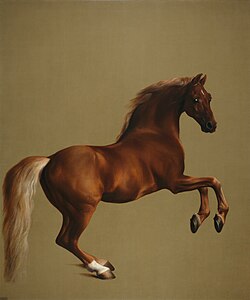
- Major Work: Whistlejacket, a masterpiece currently housed in the National Gallery, London.
- Scientific Contribution: Published The anatomy of the Horse in 1766.
- Artistic Movement: An early and significant contributor to Romanticism.
- Highest Auction Price: Gimcrack on Newmarket Heath sold for £22.4 million in 2011.
Early Life and Scientific Pursuits
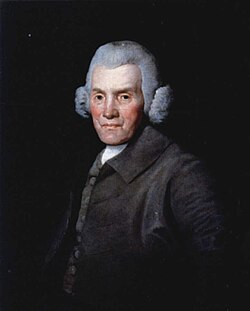
Born in Liverpool to John Stubbs, a currier (leather-dresser), and his wife Mary, George Stubbs' early years are sparsely documented. Much of what is known comes from the private memoirs of his friend, the artist Ozias Humphry. Driven by a lifelong passion for anatomy, Stubbs moved to York around 1744 to study under surgeon Charles Atkinson at York County Hospital.
His early professional work reflected this medical interest; in 1751, he provided illustrations for John Burton's textbook, Essay towards a Complete New System of Midwifery. This intersection of science and art became the cornerstone of his career.
The Journey to Mastery
In 1754, Stubbs traveled to Italy. Rather than simply imitating the classics, he used the trip to confirm his belief that nature is always superior to art, whether Greek or Roman. Upon returning to England, he dedicated himself to the physical study of animals. In 1756, he rented a farmhouse in Horkstow, Lincolnshire, where he spent 18 months dissecting horses with the assistance of his common-law wife, Mary Spencer.
This grueling research culminated in the 1766 publication of The anatomy of the Horse, a work whose original drawings are now preserved by the Royal Academy. This scientific foundation allowed him to paint animals with a structural accuracy that surpassed his contemporaries, such as Joshua Reynolds and Thomas Gainsborough.
Major Works and Artistic Style
Stubbs is perhaps most famous for Whistlejacket, a depiction of a thoroughbred racehorse commissioned by the 2nd Marquess of Rockingham. This painting, along with others for Rockingham, broke artistic conventions of the time by utilizing plain backgrounds, focusing the viewer's entire attention on the animal's form.
Portraits and Wildlife
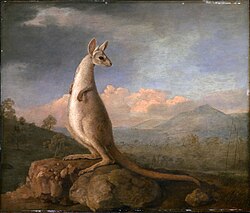
Throughout the 1760s, Stubbs produced a vast array of individual and group portraits of horses and hounds. He often included grooms in these works, treating them as distinct individuals rather than mere background figures. His curiosity extended to exotic wildlife as well; his 1772 painting of a kangaroo provided many 18th-century Britons with their first glimpse of the animal.
The Lion and the Horse Theme
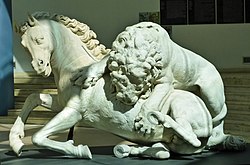
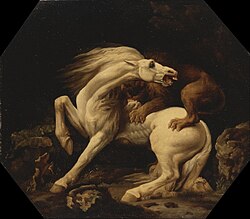
One of Stubbs' most significant contributions to the Romantic movement—which emphasized emotion and the grandeur of nature—was his series of paintings depicting a lion attacking a horse. While a popular anecdote suggested these were based on a trip to North Africa, research indicates the inspiration was actually a restored Roman copy of a Hellenistic sculpture, Lion Seizing a Horse, which he saw in Rome's Palazzo dei Conservatori.
Legacy and Modern Recognition
For nearly two centuries, Stubbs was viewed as a secondary figure in British art. His reputation was revived in the mid-20th century through the efforts of art historian Basil Taylor and collector Paul Mellon. Mellon amassed the world's largest collection of Stubbs' work, which eventually formed the basis of the Yale Center for British Art in Connecticut, USA.
| Category | Details |
|---|---|
| Primary Subjects | Horses, Dogs, Lions, Exotic Wildlife |
| Key Publications | The anatomy of the Horse (1766) |
| Notable Patrons | Marquess of Rockingham, Royal Family |
| Major Collections | National Gallery (London), Tate Britain, Yale Center for British Art |
| Artistic Style | Anatomical Precision, Early Romanticism |
Frequently Asked Questions
Was George Stubbs formally trained as an artist?
No, George Stubbs was self-taught. He developed his skills independently, though he was influenced by the works of other 18th-century masters and his own rigorous scientific studies.
What is the significance of the painting Whistlejacket?
Whistlejacket is one of Stubbs' most famous works, noted for its depiction of a thoroughbred racehorse and its unconventional use of a plain background, which emphasizes the animal's anatomy and presence.
Did Stubbs actually travel to Africa for his lion paintings?
Although a long-standing anecdote claimed he witnessed a lion kill a horse in North Africa, evidence suggests he never traveled there. The inspiration was likely a Roman sculpture he encountered during his visit to Rome in 1754.
How did Stubbs' study of anatomy influence his art?
Stubbs' obsession with anatomy led him to perform dissections on horses and study human anatomy under a surgeon. This allowed him to paint animals with a level of structural accuracy and realism that was unprecedented in his era.
Where can the largest collection of Stubbs' paintings be found?
The largest collection was amassed by Paul Mellon and is now housed at the Yale Center for British Art in Connecticut, USA.