Georg-August-Universität Göttingen: A Legacy of Scientific Excellence
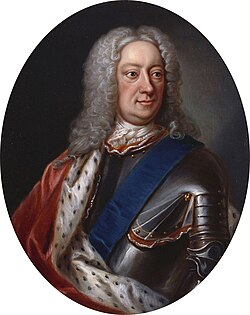
The Georg-August-Universität Göttingen, often referred to as Georgia Augusta, stands as a beacon of academic rigor and historical significance in Lower Saxony, Germany. Founded in 1734 by George II, King of Great Britain and Elector of Hanover, the university began its instructional journey in 1737. As the oldest university in Lower Saxony, it has evolved from a regional center of learning into a globally recognized public research institution dedicated to the motto In publica commoda ("For the good of all").
Throughout its nearly three-century history, the university has become synonymous with groundbreaking discoveries, particularly in the realms of mathematics and physics. Its commitment to the "free spirit" of scientific exploration has attracted some of the most brilliant minds in human history, resulting in associations with 47 Nobel Prize winners.
Key Facts
- Established: December 7, 1737 (Instruction began).
- Location: Göttingen, Lower Saxony, Germany.
- Student Population: Approximately 30,200 (2020–2021).
- Budget: €1.438 billion.
- Global Standing: Ranked 101st globally and 4th nationally in the TIME World's Top Universities 2026.
- Academic Strength: World-leading reputation in Agriculture, Forestry, and Life Sciences.
Historical Evolution
The Enlightenment and Early Growth
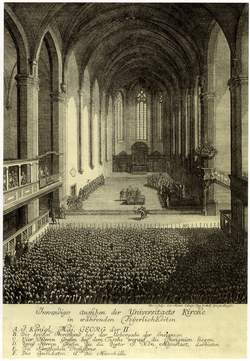
During the 18th century, Göttingen distinguished itself through a commitment to experimental science. A notable milestone occurred between 1769 and 1799, when Georg Christoph Lichtenberg held one of Germany's first professorships dedicated to experimental physics. By 1812, the university had solidified its international reputation, supported by a massive library containing over 200,000 volumes.
The Golden Age of Mathematics and Physics
The university reached its academic zenith between the late 19th and early 20th centuries. This era was defined by the presence of Carl Friedrich Gauss, known as the "Prince of Mathematicians," and later by the contributions of Dirichlet and Riemann in algebra, geometry, and number theory. By 1900, the arrival of David Hilbert and Felix Klein transformed Göttingen into the world's premier center for mathematics.
This intellectual magnetism extended to physics and aerodynamics, with scholars like Max Born and Ludwig Prandtl conducting pivotal research. The university became a global hub, attracting prominent American students such as J. Robert Oppenheimer.
The "Great Purge" and Reconstruction
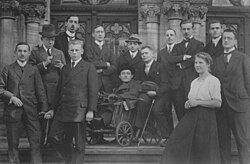
The university's trajectory was violently interrupted in 1933 with the rise of the Nazi regime. The subsequent "great purge" saw the dismissal or forced emigration of numerous faculty members, particularly those of Jewish descent or those who opposed the regime. Following the end of World War II, the university was reopened under British control in 1945, initiating a period of academic reconstruction and modernization.
Campus and Infrastructure
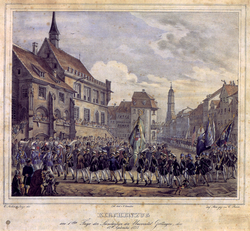
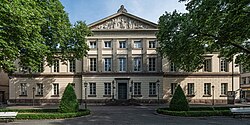
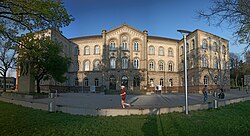
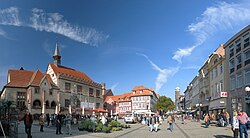
The university is integrated into the fabric of the town of Göttingen, creating a traditional "university town" atmosphere. While modern facilities have expanded into a new university quarter in the north, the historic architecture remains a point of pride. Notable landmarks include the Auditorium Maximum (built 1826–1865) and the Great Hall (Alte Aula) at Wilhelmsplatz, constructed between 1835 and 1837.
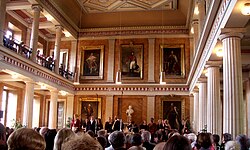
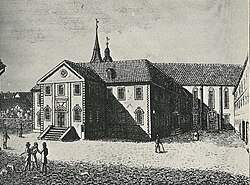
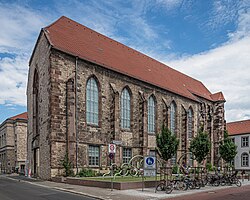
The university's intellectual heritage is also preserved in its library and the Pauliner Church, where legendary figures such as Goethe, the Brothers Grimm, and Heinrich Heine once worked.
Specialized Facilities
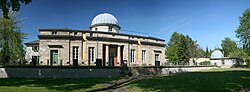
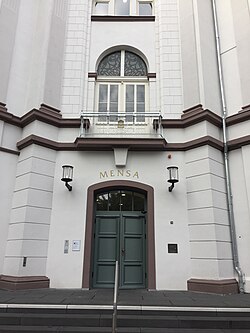
Beyond the lecture halls, the campus features specialized scientific infrastructure, including the traditional university observatory and the Alte Mensa.
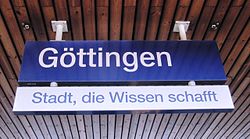
The city itself reflects this academic identity, most notably at the train station, where a sign displays the motto Stadt, die Wissen schafft ("City that creates knowledge"), a clever play on the German word Wissenschaft (science).
Academic Organization and Rankings
As of 2023, the university is organized into 13 faculties, ranging from Agricultural Sciences and Medicine to Law and Theology. It is supported by a massive workforce of over 4,500 academic staff and 8,800 administrative personnel.
Global Performance Summary
Göttingen consistently ranks among the top institutions globally, particularly in the natural sciences and agriculture.
| Ranking Body (Year) | Global Rank | National Rank (Germany) |
|---|---|---|
| TIME World's Top Universities (2026) | 101 | 4 |
| THE World Rankings (2024) | 111 | 10 |
| CWUR (2023) | 97 | 6 |
| QS World Rankings (2024) | 232 | 13 |
| ARWU World Rankings (2023) | 151–200 | 6–9 |
Notable Alumni and Faculty
The university's influence is best seen through the individuals who have walked its halls. In addition to the mathematical giants like Gauss and Hilbert, the university has been home to:
- Science: Max Planck, Werner Heisenberg, and Niels Bohr.
- Literature: The Brothers Grimm and Heinrich Heine.
- Politics: Otto von Bismarck, Gerhard Schröder, and Ursula von der Leyen.
- Sociology: Max Weber and Jürgen Habermas.
Frequently Asked Questions
Who founded the University of Göttingen?
The university was founded in 1734 by George II, who was the King of Great Britain and the Elector of Hanover.
What is the university's most famous academic strength?
Historically, the university is most renowned for its contributions to mathematics and physics, having been a global center for these fields in the late 19th and early 20th centuries.
What happened during the "great purge" of 1933?
The "great purge" was a period during the rise of the Nazi regime where numerous faculty members, particularly those of Jewish origin or political opponents of the regime, were dismissed or forced to emigrate.
How many Nobel laureates are associated with the university?
According to the university's own count, it has affiliations with 47 Nobel Prize winners.
What does the motto "In publica commoda" mean?
The Latin motto translates to "For the good of all" in English.