Gene Kelly: The Athletic Visionary of the American Musical
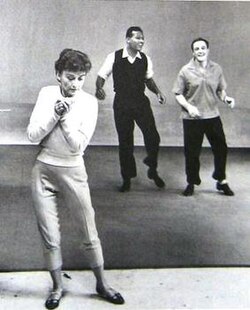
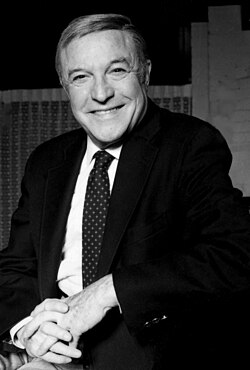
Eugene Curran Kelly was more than just a movie star; he was a transformative force in the world of dance and cinema. Known for his vigor, grace, and athletic precision, Kelly redefined the movie musical by introducing what he called "dance for the common man"—a style that was accessible, energetic, and deeply rooted in the American experience.
Throughout a career spanning over six decades, Kelly excelled as a dancer, actor, singer, director, and choreographer. His collaborations with Stanley Donen produced some of the most enduring images in film history, blending technical innovation with raw emotional power.
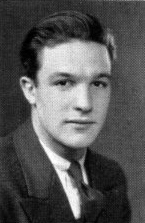
Key Facts
- Full Name: Eugene Curran Kelly
- Core Philosophy: Created "dance for the common man" to make dance accessible to the general public.
- Defining Works: Singin' in the Rain, An American in Paris, and On the Town.
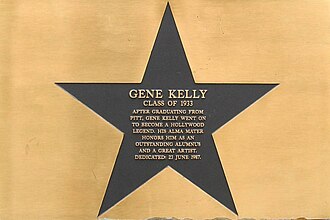
- Education: University of Pittsburgh (Economics and Law School).
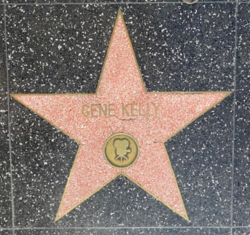
- Major Honors: Honorary Academy Award, National Medal of Arts, and a star on the Hollywood Walk of Fame.
Early Life and Education
Born in 1912, Kelly's journey began at the University of Pittsburgh, where he studied economics and joined the Theta Kappa Phi fraternity. His passion for performance flourished through the university's Cap and Gown Club, an organization that staged original musical productions. Kelly's commitment to the arts was so strong that he served as the club's director from 1934 to 1938, even while attending the University of Pittsburgh Law School.
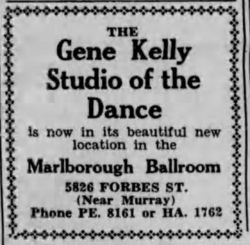
Parallel to his academic pursuits, Kelly was deeply involved in the family business. His family operated a dance studio in the Squirrel Hill neighborhood of Pittsburgh, which was renamed the Gene Kelly Studio of the Dance in 1932. Kelly's early teaching experience also extended to the Beth Shalom Synagogue, where he staged the annual Kermesse for seven years.
The Rise to Broadway and Hollywood
Kelly's professional breakthrough occurred on Broadway in 1939 with the Pulitzer Prize-winning play The Time of Your Life, where he performed his own original choreography for the first time. This success led to his first official assignment as a Broadway choreographer for Billy Rose's Diamond Horseshoe.
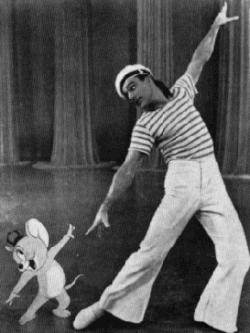
His transition to film began in 1942 with For Me and My Gal, starring alongside Judy Garland. By 1945, Kelly had established himself as a powerhouse in Hollywood, earning an Academy Award nomination for Best Actor for his role as Joseph "Joe" Bradley in Anchors Aweigh.
The Golden Era at MGM
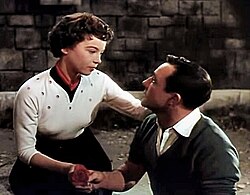
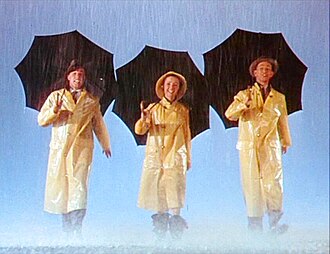
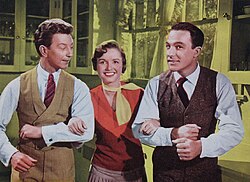
The late 1940s and early 1950s marked the peak of Kelly's creative influence at MGM. He co-directed his first film, On the Town (1949), with Stanley Donen. This partnership continued through the creation of An American in Paris (1951), which won the Academy Award for Best Picture, and the legendary Singin' in the Rain (1952).
Challenges and Evolution
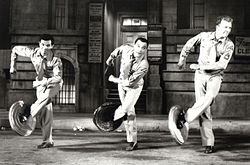
As the popularity of the traditional Hollywood musical began to wane in the mid-1950s, Kelly faced professional hurdles. A contract that sent him to Europe to utilize frozen MGM funds resulted in Invitation to the Dance (1956). While a personal passion project intended to bring modern ballet to the masses, the film was a commercial failure.
Returning to a changing industry, Kelly found MGM cutting budgets. Brigadoon (1954) was forced onto studio backlots rather than being filmed in Scotland. His final collaboration with Stanley Donen, It's Always Fair Weather (1955), signaled the end of an era for the duo.
Diversification into Drama and Television
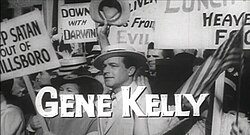
Kelly proved his versatility by stepping away from dance to tackle dramatic roles. He received critical praise for his performance in Inherit the Wind (1960). He also found success in television, producing and directing Jack and the Beanstalk (1967), which won an Emmy Award for Outstanding Children's Program.
Later Career and Legacy
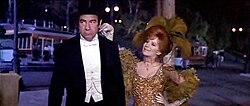
In his later years, Kelly continued to influence the arts through directing and producing. He directed Hello, Dolly! (1969), which earned a Best Picture nomination. He also remained a mentor and collaborator, working with Francis Ford Coppola on One from the Heart (1982) and serving as a choreographic consultant for the animated film Cats Don't Dance.
Kelly's final on-screen appearance was in 1994 for That's Entertainment! III. He passed away on February 2, 1996, leaving behind a legacy of athletic artistry that continues to inspire dancers and filmmakers worldwide.
| Category | Key Details |
|---|---|
| Primary Roles | Dancer, Actor, Singer, Director, Choreographer |
| Most Famous Films | Singin' in the Rain, An American in Paris, On the Town |
| Major Awards | Honorary Oscar, Emmy Award, National Medal of Arts |
| Education | University of Pittsburgh (Economics/Law) |
| Active Years | 1931–1994 |
Frequently Asked Questions
What was Gene Kelly's "dance for the common man"?
It was Kelly's vision to create a form of American dance that was athletic, energetic, and accessible to the general public, moving away from the more formal or elite styles of ballet.
Which films did Gene Kelly direct?
Kelly co-directed On the Town, Singin' in the Rain, and It's Always Fair Weather with Stanley Donen. He also directed Invitation to the Dance, A Guide for the Married Man, and Hello, Dolly!.
Did Gene Kelly win an Academy Award?
Yes, he received an Honorary Academy Award for his versatility as an actor, singer, director, and dancer, specifically for his achievements in film choreography.
What was Gene Kelly's educational background?
Kelly attended the University of Pittsburgh, where he studied economics and was admitted to the law school, though his passion for dance ultimately led him to a career in the performing arts.
Who were Gene Kelly's primary collaborators?
His most significant professional partnership was with Stanley Donen, with whom he co-directed and choreographed several landmark musicals. He also frequently starred alongside Judy Garland.