Geese: Biology, Migration, and Cultural Significance
Geese are highly social waterfowl belonging to the family Anatidae. While often grouped together, these birds encompass a variety of species across different genera, ranging from the iconic Canada goose to the snowy landscapes of the Arctic. As larger relatives of ducks and smaller relatives of swans, geese are recognized for their strong family bonds, impressive migratory journeys, and distinct vocalizations.
In biological terms, the term "goose" can refer to any bird of either sex. However, when distinguished by gender, a gander refers to the male, while a "goose" refers specifically to the female. The young of these birds are known as goslings. Depending on their environment, a group of geese is called a gaggle when on the ground, a skein, team, or wedge when in flight, and a plump when flying in close proximity.
Key Facts
- Taxonomy: True geese belong to the genera Anser (grey and white geese) and Branta (black geese).
- Social Structure: Geese are monogamous and form permanent pairs, though they are only territorial during nesting.
- Flight Pattern: They utilize a V formation to increase aerodynamics and conserve energy.
- Navigation: Migratory geese use an internal compass and Earth's magnetic field to orient themselves.
- Fossil Record: True geese have existed since the Miocene epoch, approximately 10 to 12 million years ago.
True Geese and Their Relatives
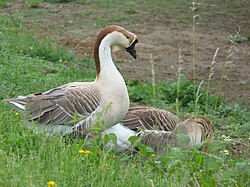
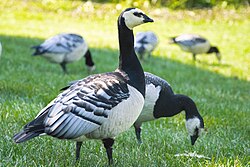
Taxonomically, "true geese" are divided into two primary living genera: Anser, which includes the greylag and snow geese, and Branta, which includes the Canada goose. While other birds like the Egyptian goose or Orinoco goose are commonly called geese, they belong to the Tadorninae subfamily (shelducks) and are not true geese.
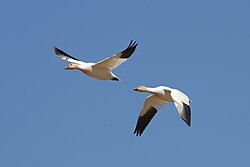
The evolutionary history of these birds is well-documented, particularly in North America. Fossil evidence suggests that true geese appeared around 10 million years ago. One notable prehistoric species, Garganornis ballmanni from the Late Miocene of Italy, was a flightless giant standing 1.5 meters tall and weighing roughly 22 kilograms.
Migration and Navigation
Most goose species are migratory, though some populations—such as Canada geese near human developments in the eastern United States—may become resident if food and open water are available year-round.
To time their journeys, geese rely on environmental cues such as temperature, food availability, and predation threats. They navigate using a combination of innate heritable directions and a learned internal compass that interacts with the Earth's magnetic field. A significant portion of their journey—up to 85%—is spent at perennial stopover sites to rest and replenish fat stores.
The Science of the V Formation
Geese are famous for flying in a V formation. This behavior is an aerodynamic strategy; trailing birds benefit from the air currents created by the bird in front, which reduces the number of wing flaps required and lowers their heart rates. To ensure fairness and manage energy, geese switch positions during long flights. In family groups, the parents typically take the lead.
Other Birds Termed "Geese"
Many birds are referred to as geese despite not being taxonomically "true geese." This includes the Southern Hemisphere sheldgeese, the spur-winged goose (subfamily Plectropterinae), and the maned goose. Even the northern gannet, a seabird, is sometimes called the "solan goose," despite being entirely unrelated to the order Anseriformes.

Summary of Goose Classifications
| Category | Genera/Group | Examples | Key Characteristic |
|---|---|---|---|
| True Geese (Grey/White) | Anser | Greylag, Snow Goose | True taxonomic geese |
| True Geese (Black) | Branta | Canada Goose | True taxonomic geese |
| Sheldgeese | Tadorninae | Egyptian, Orinoco Goose | Closely related to shelducks |
| Other Waterfowl | Anseranatidae | Magpie Goose | Distinct family lineage |
Cultural Impact and Idioms
Geese have left a lasting mark on human language and culture. From the fictitious children's author Mother Goose to the 2019 indie game Untitled Goose Game, these birds are often portrayed as either whimsical or ornery.
Many common English idioms derive from geese, such as a "wild goose chase" (a futile effort) or "killing the goose that lays the golden eggs" (destroying a source of long-term benefit). In Iceland, the oldest medieval laws are known as Grágás (Gray Goose Laws), possibly named for the goose quills used to write them or the goose skin used in their binding.
Frequently Asked Questions
Why do geese fly in a V formation?
The V formation increases aerodynamics for trailing birds, allowing them to stay aloft with fewer wing flaps and a lower heart rate, thereby conserving energy during long migrations.
What is the difference between a goose and a gander?
While "goose" can be a general term for the species, specifically it refers to the female, whereas a "gander" is the male.
Are all birds called "geese" actually geese?
No. Some birds, like the Egyptian goose or the solan goose (a gannet), are called geese due to their appearance or tradition but are not taxonomically "true geese" of the genera Anser or Branta.
How do geese navigate during migration?
Geese use a combination of innate heritable instincts and a learned internal compass that allows them to orient themselves using the Earth's magnetic field.
Are geese monogamous?
Yes, geese are monogamous and typically live in permanent pairs throughout the year, although they only exhibit territorial behavior during the nesting season.