GDP (PPP) Explained: Comparing Global Economies via Purchasing Power Parity
When economists discuss the strength of a nation's economy, they often look at Gross Domestic Product (GDP). However, looking at nominal GDP alone can sometimes provide a distorted view of a country's actual economic power. To get a clearer picture of domestic market strength, experts use GDP (PPP), or GDP based on Purchasing Power Parity.
Purchasing Power Parity is an economic metric that adjusts for the relative cost of local goods and services, as well as inflation rates. Unlike nominal GDP, which relies on international market exchange rates, PPP accounts for the fact that a single unit of currency can often buy more in one country than in another. This makes it a vital tool for assessing the real standard of living and the true scale of domestic markets.
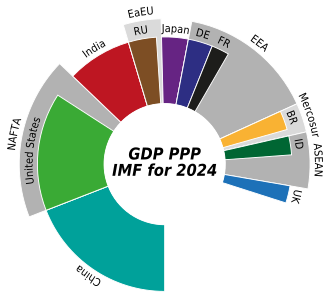
How Purchasing Power Parity Works
To standardize comparisons across different nations, economists use the international dollar. This is a hypothetical currency unit that allows for a direct comparison of the purchasing power of different countries. By using this standardized unit, we can see how much a "basket" of goods and services actually costs in different regions.
A classic example of the difference between nominal and PPP rankings can be seen when comparing Germany and India. While Germany may rank higher in nominal GDP, India's rank rises significantly when adjusted for PPP. This is because the local cost of goods in India is lower, meaning the same amount of money can purchase a larger volume of goods and services within the country.
Applications and Limitations
While PPP is highly effective for gauging domestic market size and global poverty thresholds, it has specific limitations. It is less effective when measuring international financial flows between countries or when attempting to compare the quality of identical luxury goods across borders. Because of its ability to reflect real-world costs, the United Nations utilizes PPP data when constructing the Human Development Index (HDI).
Key Facts
- GDP (PPP) adjusts for inflation and the local cost of living to provide a more accurate view of economic capacity.
- The international dollar is the standardized unit used to facilitate these global comparisons.
- PPP is a core component used by the United Nations to calculate the Human Development Index.
- Major economic data is compiled by institutions such as the International Monetary Fund (IMF), the World Bank, and the CIA.
- The metric includes both tradable goods (like electronics) and non-tradable goods (like local services) to create a representative economic basket.
Economic Data Sources and Methodology
Global economic statistics are gathered from several primary sources, each with slightly different scopes and methodologies:
- IMF International Financial Statistics (IFS): Provides estimates for 196 economies, including 189 U.N. member states and various distinct jurisdictions like Hong Kong and Taiwan.
- World Bank: Compiles data for 180 of the 193 United Nations member states, as well as Hong Kong and Macau.
- CIA World Factbook: Offers historical and updated data, often including non-sovereign entities and territories.
| Source | Scope of Economies | Primary Unit | Key Focus |
|---|---|---|---|
| IMF | 196 economies | Millions of international dollars | International Financial Statistics |
| World Bank | 180+ economies | Millions of international dollars | UN Member States & SARs |
| CIA | Various territories | Varies (rebased to 2007) | World Factbook updates |
Economic Milestones: Reaching Major Thresholds
Throughout history, certain nations have reached significant GDP (PPP) milestones. These milestones track the progression of global economic giants as they cross specific trillion-dollar thresholds.
The Path to $1 Trillion and Beyond
The United States was the first to reach the $1 trillion milestone in 1969. Since then, many other nations have joined this group. For instance, Japan reached the $1 trillion mark in 1980, and China reached it in 1991. As economies grow, they move through higher tiers, such as the $10 trillion and $20 trillion marks, currently dominated by the United States and China.
Future Economic Projections
Economic forecasting allows us to predict when emerging economies might reach major milestones. For example, projections suggest that Indonesia and Brazil may reach the $6 trillion threshold in the late 2020s, while countries like Vietnam and the Philippines are also expected to see significant growth in the coming years.
Frequently Asked Questions
What is the main difference between nominal GDP and GDP (PPP)?
Nominal GDP uses current market exchange rates, which can be volatile and do not reflect local purchasing power. GDP (PPP) adjusts for the cost of living and inflation, showing how much goods and services can actually be bought within a country.
Why is the international dollar used in these calculations?
The international dollar is a standardized unit that allows economists to compare the purchasing power of different countries on an equal footing, removing the distortions caused by varying exchange rates.
Does GDP (PPP) include all types of goods?
Yes, comprehensive surveys like the International Comparison Program include both tradable goods (items that can be sold internationally) and non-tradable goods (local services) to estimate a representative basket of all goods.
Which organizations provide the most reliable GDP (PPP) data?
The most widely recognized data comes from the International Monetary Fund (IMF), the World Bank, and the CIA World Factbook.
Is GDP (PPP) useful for measuring international trade?
No, GDP (PPP) is limited when measuring financial flows between countries. It is much more effective for assessing domestic market size and the standard of living within a specific nation.