Funk Rock: The High-Energy Fusion of Groove and Grit
Funk rock is a dynamic fusion genre that blends the rhythmic, syncopated grooves of funk with the power and intensity of rock. By marrying the danceable energy of R&B with the distorted textures of rock and roll, the genre created a sonic bridge that influenced everything from the psychedelic experiments of the 1970s to the aggressive alternative sounds of the 1990s.
The roots of this sound stretch back to the mid-1950s. James Brown and other music historians credit Little Richard and his road band, the Upsetters, as the first to inject a "funk" feel into the rock and roll beat, sparking the transition from fifties rock to the funk of the sixties.
Key Facts
- Origins: Emerged in the United States between the late 1960s and early 1970s.
- Core Elements: Combines funk's rhythmic emphasis with rock's instrumentation and energy.
- Key Figures: George Clinton (the "godfather" of the genre), Sly Stone, and Prince.
- Evolution: Led to derivative styles such as funk metal, punk-funk, and the Minneapolis sound.
- Instruments: Primarily driven by bass guitar, electric guitar, drums, keyboards, saxophone, and vocals.
The Evolution of Funk Rock
The Pioneers: 1960s and 1970s
The late 1960s saw the first recorded incarnations of funk rock through acts like Sly and the Family Stone, who scored hits with "Sing a Simple Song" and "Thank You (Falettinme Be Mice Elf Agin)." Even the legendary Jimi Hendrix explored these sounds on the album Electric Ladyland with tracks like "Gypsy Eyes."
By 1970, George Clinton became the central figure of the movement. Through his "P-Funk" collective—comprising the bands Parliament and Funkadelic—Clinton integrated former James Brown band members like Bootsy Collins and Maceo Parker to redefine the genre. The 1971 classic Maggot Brain stands as a definitive funk rock milestone.
Other early innovators included Grand Funk Railroad, who pioneered a bass-driven hard rock funk style, and Frank Zappa, who merged the styles on albums such as Overnite Sensation. Groups like Mother's Finest and Redbone also pushed the boundaries, though they often found themselves too loud for traditional black clubs and overlooked by R&B labels.
| Era | Key Artists | Defining Characteristics |
|---|---|---|
| 1960s-70s | P-Funk, Sly and the Family Stone, Jimi Hendrix | Psychedelic soul, heavy bass grooves, experimental structures. |
| 1980s | Prince, Red Hot Chili Peppers, Talking Heads | Integration of New Wave, synth-pop, and punk influences. |
| 1990s | Rage Against the Machine, Primus, Lenny Kravitz | Rise of funk metal, distorted guitars, and hip-hop fusion. |
| 2000s-Present | N.E.R.D., Exiles of the Nation, 3rdeyegirl | Art-rock blends, neo-soul influences, and modern psychedelic funk. |
The New Wave and Synth Influence: 1980s
In the 1980s, the genre branched out. New wave and post-punk bands like Talking Heads and Blondie incorporated funk elements, while Queen achieved massive success with the Chic-inspired beat of "Another One Bites the Dust." This era also saw the rise of synth-funk, where artists like Howard Jones and Thomas Dolby blended funk beats with electronic synthesizers.
Simultaneously, the Red Hot Chili Peppers began blending punk rock with funk, eventually collaborating with George Clinton on their album Freaky Styley.
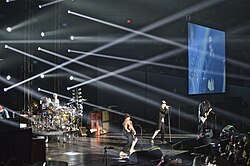
The Rise of Funk Metal: 1990s
The 1990s introduced a heavier iteration known as funk metal. While standard funk rock uses a "crunchier" distorted guitar and remains beat-driven, funk metal employs heavy distortion and aggressive guitar sounds. This style was championed by bands such as Rage Against the Machine, Primus, Faith No More, and Incubus.
Other artists continued to refine the fusion; Lenny Kravitz became a prominent figure by mixing rock riffs with funk rhythms in tracks like "Always on the Run." Even the jam band Phish developed a specific variation called "cow funk," heard on their 1998 release The Story of the Ghost.
Modern Era: 2000s to Present
Funk rock continues to evolve through diverse artists. In 2005, Defiance Douglass formed Exiles of the Nation, introducing "ExileMusik," a blend of art and psychedelic funk rock. Prince continued his exploration of the genre until his later years, notably with his all-female backing band 3rdeyegirl and the 2014 album Plectrumelectrum.
Frequently Asked Questions
What is the difference between funk rock and funk metal?
Funk rock generally features a lighter, "crunchier" guitar sound and is more rhythmic and beat-driven in the R&B tradition. Funk metal uses much heavier, distorted guitar sounds and emphasizes the aggression of heavy metal.
Who is considered the "godfather" of funk rock?
George Clinton is widely regarded as the godfather of the genre, primarily through his work with Parliament and Funkadelic (collectively known as P-Funk).
Which early artists are credited with starting the funk rock sound?
Little Richard and the Upsetters are credited with first putting funk into the rock and roll beat in the mid-1950s, while Sly and the Family Stone and Jimi Hendrix were early recorded pioneers in the late 1960s.
What is "cow funk"?
"Cow funk" is a style of funk-influenced music developed by the Vermont-based jam band Phish, most notably featured on their 1998 album The Story of the Ghost.
How did the 1980s change the sound of funk rock?
The 1980s saw the integration of New Wave, post-punk, and synthesizers, leading to the emergence of synth-funk and a more polished, radio-friendly sound used by artists like Prince and Talking Heads.