Frost Formation: The Science of Ice Crystals and Their Impact
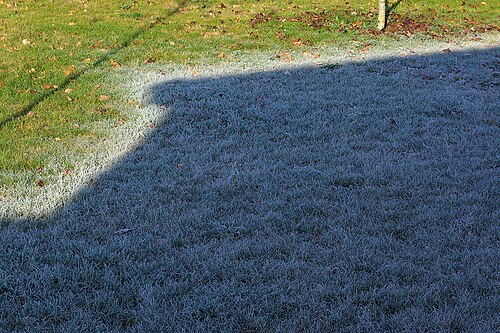
Frost is more than just a cold morning aesthetic; it is a precise physical process where water vapor transforms directly into ice on a solid surface. Unlike dew, which condenses into liquid water before freezing, frost occurs when water vapor deposits onto a freezing surface without ever becoming a liquid. This phenomenon happens when the air becomes supersaturated—meaning it contains more water vapor than it can normally hold at a specific temperature.
The temperature at which this process begins is known as the dew point. When the temperature of a surface drops below this point and remains below the freezing point of water, water vapor is forced out of its gaseous state and undergoes a phase change directly into a solid. This process is called desublimation.
Key Facts
- Formation: Frost forms via desublimation, moving directly from gas (vapor) to solid (ice).
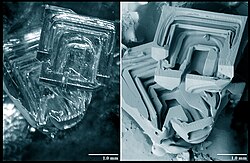
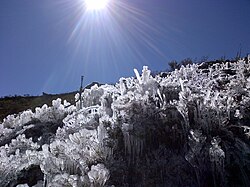
- Crystalline Structure: Crystals can be dendritic (tree-like), acicular (needle-like), or blade-like depending on air pressure, temperature, and turbulence.
- Plant Sensitivity: A "light frost" occurs between -2 and 0 °C, while a "hard frost" is any temperature below -2 °C.
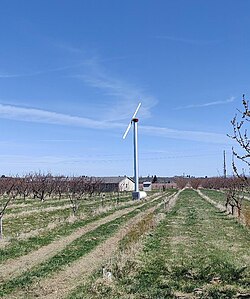
- Protection: Farmers use wind machines, helicopters, and sprinkler irrigation to protect crops from freezing.
- Cosmic Presence: Frost-like volatile condensations have been observed on Mercury, Mars, and Pluto.
The Mechanics of Crystal Growth
The growth of frost begins with seed crystals. As more water molecules attach to these seeds, they develop into complex fractal patterns. The resulting appearance depends on the environment: if the crystals scatter light in all directions, the frost appears white; if they are sparse or specific in structure, they may appear clear or even invisible (black frost).
Surface characteristics also play a role. For instance, water vapor adsorbs more efficiently to glass than to paint, which is why car windows often frost over before the rest of the vehicle. In very cold, calm, and heavily saturated air—such as during an ice fog—large hoar-frost crystals can grow rapidly.
Types of Frost
Hoar Frost
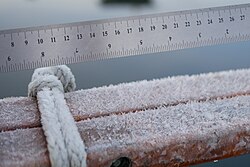
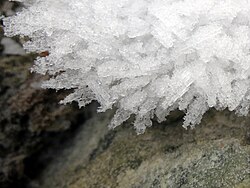
Derived from an Old English word meaning "showing signs of old age," hoar frost gives vegetation a white, hair-like appearance. It is categorized by where it forms:
- Air Hoar: Deposits on elevated objects like tree branches, wires, and plant stems.
- Surface Hoar: Fern-like crystals that deposit directly onto existing snow or ice.
Advection and White Frost
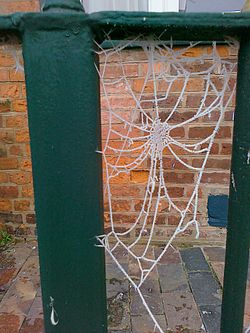
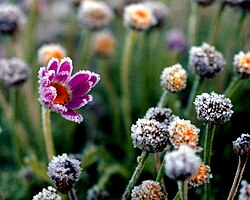
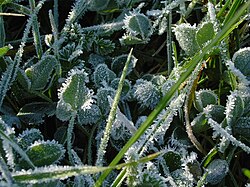
Advection frost (or wind frost) consists of tiny ice spikes that form when very cold wind blows over surfaces. These typically form against the direction of the wind and often appear as rimming on the edges of leaves and flowers.
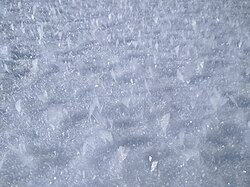
White frost occurs in highly humid conditions (relative humidity above 90%) and temperatures below -8 °C (18 °F). It forms as a heavy coating of interlocking, needle-shaped crystals on snow surfaces.
Other Varieties
- Window Frost: Specifically forms on glass surfaces.
- Black Frost: Occurs at very low temperatures and extremely low humidity, leaving no visible ice crystals.
- Rime: Forms under supercooled wet conditions.
Impact on Vegetation
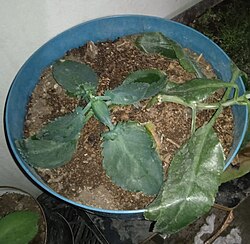
Frost can be devastating to plant life. While some plants can enter a supercooled liquid state—surviving temperatures between -4 and -12 °C without freezing—the actual formation of ice crystals can rupture cell walls and cause permanent damage.
Plants are generally categorized by their tolerance:
- Frost-Sensitive: Vines (beans, grapes, melons) and nightshades (tomatoes, peppers, eggplants) are often damaged by light frosts.
- Frost-Tolerant: Root vegetables (carrots, beets) and leafy greens (spinach, lettuce) can withstand lower temperatures.
- Hardy Perennials: Plants like Hosta become dormant, often turning brown or losing leaves entirely until spring.
Biological Triggers
Certain bacteria, such as Pseudomonas syringae, act as nucleating agents that trigger frost formation at higher temperatures (around -2 °C), increasing the likelihood of plant damage. Conversely, "ice-minus" bacteria lack these proteins, resulting in less frost damage.
Frost Protection and Prevention
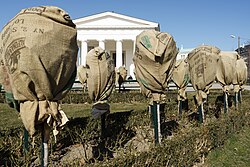
To protect sensitive crops, various agricultural techniques are employed to manipulate air temperature and movement:
- Air Mixing: Wind machines (large propellers) and helicopters are used to pull warmer air down from inversion layers and prevent cold air from pooling on the ground.
- Latent Heat Irrigation: Spraying crops with water exploits the latent heat of freezing. As the water freezes, it releases heat, preventing the plant tissue from dropping significantly below zero.
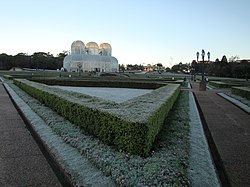
- Physical Barriers: Greenhouses are used in colder capitals, such as Curitiba, Brazil, to shield sensitive species.
Global and Extraterrestrial Occurrences
While most of the lowland tropics are frost-free, frost occurs at high altitudes (above 3,000 meters near the equator). In the United States, only the Florida Keys, southern Florida, and the Channel Islands are reliably frost-free.
Beyond Earth, frost-like deposits are common: Mercury has water ice and sulfur mixtures in permanently shadowed craters; Mars recently showed water frost on the peak of Olympus Mons; and Pluto is dominated by nitrogen and methane frosts.
| Frost Type | Primary Cause | Visual Characteristic | Typical Location |
|---|---|---|---|
| Hoar Frost | Desublimation in low humidity | White, hair-like or fern-like | Branches, wires, snow |
| Advection Frost | Cold wind over surfaces | Tiny spikes/rimming | Edges of leaves, poles |
| White Frost | High humidity (>90%), <-8 °C | Large interlocking needles | Snow surfaces |
| Black Frost | Very low humidity/temp | Invisible/No ice | Plant tissues |
Frequently Asked Questions
What is the difference between frost and dew?
Dew forms when water vapor condenses into liquid water on a cool surface. Frost forms when water vapor transforms directly into ice crystals (desublimation) because the surface is below the freezing point.
What is a "hard frost"?
A hard frost is defined as temperatures dropping below -2 °C (28 °F), which is more damaging to a wider variety of plants than a "light frost" (between -2 and 0 °C).
How do wind machines protect crops?
Wind machines blow air horizontally to mix the atmosphere, preventing cold air from settling in low-lying areas and bringing warmer air down from higher layers.
Can plants survive below freezing without frosting?
Yes, through a process called supercooling, some leaves can remain in a liquid state down to -4 or -12 °C, provided there is no nucleation site to trigger ice crystal formation.
Where is frost found in space?
Frost-like deposits have been found on Mercury (water ice/sulfur), Mars (water frost on Olympus Mons), and Pluto (nitrogen and methane frosts).