Friedberg, Hesse: A Journey Through Imperial History and Military Legacy
Perched atop a basalt plateau overlooking the Usa river, Friedberg is a city where layers of history converge. From the strategic fortifications of the Roman Empire to its status as a powerful medieval trade hub and its modern role as a significant U.S. military installation, Friedberg offers a unique glimpse into the political and social evolution of the Hesse region.
Ancient Foundations and Roman Influence
Human activity in Friedberg dates back to the Mesolithic period, with settlement relics discovered in the suburb of Bruchenbrücken. However, the city's strategic importance became evident during the Roman era. Castle Hill served as a Roman military camp, forming part of the limes—the fortified border of the Roman Empire. Many historians believe this site is the castellum in monte tauno mentioned in 1st-century AD records.
Archaeological excavations have preserved various Roman ruins, including thermae (public baths). This Roman presence continued until approximately 260 AD, when the settlement was abandoned as Roman forces retreated to the Rhine frontier.
The Medieval Era and the Noble Republic
The old city was refounded by the Hohenstaufen dynasty of the Holy Roman Empire, leveraging its location on vital trading routes. In its early days, Friedberg was an economic rival to Frankfurt am Main, bolstered by a successful annual trading fair. In 1211, the city was granted a charter, becoming a Free Imperial City (Freie Reichsstadt), meaning it was subject only to the Holy Roman Emperor.
Despite its success, the city was often plagued by internal strife. A bitter rivalry existed between the politically independent city and the castle of Friedberg. This competition was so intense that it once resulted in the citizens ransacking and destroying the castle.
Between the 14th and 15th centuries, Friedberg developed a unique "noble republic." This system saw twelve noble families sharing a single castle. From 1337 to 1498, a formalized constitution governed the castle, allowing knightly families to elect a Burggraf (burgrave), two Baumeister (master builders), and twelve Regimentsburgmannen. These officials managed the community's representation, building maintenance, and city governance. This structured noble republic continued until the Napoleonic era, when the city was incorporated into the Grand Duchy of Hesse (Hesse-Darmstadt).
Jewish Heritage and Remembrance
Friedberg once hosted a thriving Jewish community. While many emigrated to the United States and Palestine prior to the Holocaust, those who remained were deported to Treblinka in 1942. Today, the city preserves this history through several memorials, including the Judenbad (a medieval Jewish ceremonial bath) which now honors Jewish soldiers who fought in World War I, an arson memorial for the old synagogue, and a commemorative plaque at a local secondary school.
Notably, the city is also the birthplace of Sir Ernest Oppenheimer, the diamond mining entrepreneur and former owner of De Beers.
The American Era: Ray Barracks
In the 20th century, Friedberg became synonymous with the U.S. Army through the establishment of Ray Barracks. Operating from approximately 1956 to 2007, the installation housed the 3rd Brigade 3rd Armored Division and later the 1st Brigade 1st Armored Division (known as "Ready First") from 1992 until the base's closure.
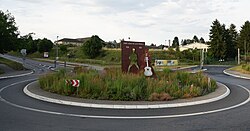
The barracks are most famous for their connection to Elvis Presley. While serving in the 1st Bn 32nd Armor, Presley's unit's tanks and motor pool were used as filming locations for the 1960 movie GI Blues. Presley lived in nearby Bad Nauheim, and his legacy persists in the city via Elvis Presley Platz in the main shopping center and the Elvis Aaron Presley Mess Hall, which he originally funded.
Ray Barracks also served as the first duty station for future U.S. Secretary of State General Colin Powell, who arrived as a Second Lieutenant in 1958. Other notable military figures, including future Army Generals Albert Bryant, Jr. and Martin Dempsey, also commanded the 4th Battalion, 67th Armor ("Bandits") at this location.
Key Facts
- Roman Origins: Site of a Roman military camp (limes) and public baths, abandoned by 260 AD.
- Imperial Status: Became a Free Imperial City in 1211 under the Holy Roman Empire.
- Noble Republic: A rare constitutional system where twelve noble families shared governance of the castle.
- Military Legacy: Home to Ray Barracks (1956–2007), a key U.S. Army installation.
- Famous Residents: Duty station for Elvis Presley and Colin Powell; birthplace of Sir Ernest Oppenheimer.
| Era | Key Feature | Significant Detail |
|---|---|---|
| Roman | Limes Fortification | Military camp and public baths (thermae) |
| Medieval | Free Imperial City | Economic rivalry with Frankfurt; 1211 charter |
| 14th-15th Century | Noble Republic | Constitutional governance by twelve noble families |
| Modern (1956-2007) | Ray Barracks | U.S. Army base; connection to Elvis Presley |
Frequently Asked Questions
What was the "noble republic" of Friedberg?
The noble republic was an unusual political arrangement between the 14th and 15th centuries where twelve noble families shared a single castle and governed through a formalized constitution, electing officials like the Burggraf and Baumeister.
How is Elvis Presley connected to Friedberg?
Elvis Presley was stationed at Ray Barracks in Friedberg while serving in the U.S. Army. His unit's equipment was used in the film GI Blues, and he funded the base's mess hall. The city now has a square named Elvis Presley Platz in its honor.
What remains of the Roman presence in the city?
Remains of a Roman military camp on Castle Hill and the ruins of Roman public baths (thermae) have been found and conserved.
Who is Colin Powell in relation to Friedberg?
Former U.S. Secretary of State and four-star General Colin Powell had his first military duty station at Ray Barracks in 1958, serving as a Second Lieutenant.
What happened to the Jewish community in Friedberg?
Once prosperous, the community was devastated during World War II. While some fled earlier, the remaining Jewish residents were deported to Treblinka in 1942. Today, the Judenbad and other memorials commemorate their history.