Frederiksen's Managerial Journey: From Youth Coaching to International Success
The trajectory of a football manager is often defined by a blend of patience, tactical evolution, and the ability to develop raw talent. For Frederiksen, this journey began remarkably early, starting his coaching path at the age of 20 with youth teams at B 1913 in his hometown of Odense. Over the following decades, he would evolve from a youth specialist into a championship-winning manager across two different European leagues.
Early Foundations at B.93 and Lyngby
Frederiksen's professional growth accelerated in 1997 when he joined B.93 in Østerbro, Copenhagen. He spent several years honing his craft within the youth divisions, eventually leading the under-16 team and progressing with them to the under-18 level by the 2003–04 season. By 2005, he had risen to oversee the entire youth department while serving as an assistant coach for the first team in the Danish 2nd Division (the third tier of Danish football).
In late 2005, Frederiksen transitioned to Lyngby Boldklub. His impact was immediate; he led the under-19 team to a second-place national finish in his first season and a third-place finish in 2007. His administrative and strategic capabilities were recognized in 2008 when he was appointed head of talent and joined the board of the Lyngby Boldklub aktieselskab.
The turning point in his career arrived on March 23, 2009, when he was promoted to head coach of the first team following the dismissal of Henrik Larsen. In a unique professional arrangement, Frederiksen balanced his coaching duties with a role as chief operating officer (COO) and HR manager at Danske Bank. Despite this dual responsibility, he successfully led Lyngby to promotion to the Danish Superliga during the 2009–10 season.
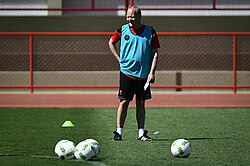
Upon reaching the top flight, Frederiksen eventually transitioned to full-time management. By September 2011, he had severed ties with the Danske Bank Group to focus entirely on Lyngby, where he also took charge of transfers and earned his UEFA Pro Licence (the highest coaching certification available in Europe).
European Ambitions with Esbjerg fB
In May 2013, Frederiksen took the helm at Esbjerg fB. His tenure was marked by a significant foray into European competition. He guided the club through the Europa League group stages, securing victories over Standard Liège and Elfsborg before reaching the round of 32, where they were eliminated by the Italian side Fiorentina. Domestically, he secured a fifth-place finish in his debut season.
The following season proved more challenging. While Esbjerg initially progressed in the Europa League by defeating Kairat Almaty, they were eliminated in the third round by Ruch Chorzów on away goals. A winter transfer window that saw the departure of key players like Jakob Ankersen, Eddi Gomes, and Martin Pušić left the team struggling. Although they avoided relegation with a final-day win over FC Vestsjælland, Frederiksen was dismissed on August 10, 2015, after a poor start to the 2015–16 season.
National Duty and the Brøndby Triumph
Following his departure from Esbjerg, Frederiksen shifted his focus to the international stage, managing the Denmark under-21 team from August 2015. He successfully qualified the squad for the UEFA European Under-21 Championships in both 2017 and 2019.
In June 2019, he returned to club football with Brøndby IF. His tenure at Brøndby was characterized by tactical flexibility; he famously shifted from a 4–3–3 to a 3–5–2 formation in October 2019 to neutralize rivals FC Copenhagen. This tactical shift, combined with his ability to integrate young talents like Morten Frendrup and Anis Ben Slimane after the sale of senior players, propelled the club forward.
The pinnacle of his time at Brøndby came on May 24, 2021, when the club defeated Nordsjælland 2–0 to secure their first league title in 16 years. However, after a dip in form during the 2022–23 season, he was dismissed in November 2022.
International Success at Lech Poznań
On July 1, 2024, Frederiksen embarked on his first managerial role outside Denmark, joining the Polish Ekstraklasa club Lech Poznań. His impact in Poland was immediate and dominant. In his first full season, he led the club to their ninth league title and was named the Ekstraklasa Coach of the Season.
Despite challenges including long-term injuries to key players and a mixed run in the UEFA Conference League—where the team reached the round of 16 before falling to Shakhtar Donetsk—Frederiksen maintained domestic dominance. He secured a second consecutive Ekstraklasa title on May 16, 2026, with a 3–1 victory over Radomiak Radom. This success earned him a second consecutive Coach of the Season award and a contract extension through 2028.
Key Facts
- Early Start: Began coaching youth teams at age 20.
- Dual Career: Simultaneously served as Lyngby head coach and COO of Danske Bank during the 2009–10 season.
- Major Honors: Won the Danish Superliga with Brøndby IF (2021) and two consecutive Ekstraklasa titles with Lech Poznań (2025, 2026).
- International Experience: Managed Denmark U21 to two European Championship qualifications.
- Individual Accolades: Two-time Ekstraklasa Coach of the Season.
| Club/Team | Role | Key Achievement |
|---|---|---|
| B.93 | Youth/Assistant Coach | Head of Youth Department |
| Lyngby Boldklub | Head Coach | Promotion to Danish Superliga |
| Esbjerg fB | Head Coach | Europa League Round of 32 |
| Denmark U21 | Manager | Qualified for Euro U21 (2017, 2019) |
| Brøndby IF | Head Coach | Danish Superliga Title (2021) |
| Lech Poznań | Manager | Two Ekstraklasa Titles (2025, 2026) |
Frequently Asked Questions
When did Frederiksen start his coaching career?
Frederiksen began coaching at the age of 20, working with youth teams at B 1913 in Odense.
Which clubs did Frederiksen lead to league championships?
He led Brøndby IF to the Danish Superliga title in 2021 and Lech Poznań to two consecutive Ekstraklasa titles in 2025 and 2026.
What was unique about his time at Lyngby Boldklub?
During the 2009–10 season, he managed the first team while simultaneously serving as the chief operating officer (COO) and managing an HR unit at Danske Bank.
How did Frederiksen perform with the Denmark national youth team?
As the manager of the Denmark under-21 team, he successfully qualified the squad for the UEFA European Under-21 Championships in both 2017 and 2019.
What tactical change helped Brøndby IF defeat FC Copenhagen?
Frederiksen switched the team's formation from a 4–3–3 to a 3–5–2 in October 2019, which proved effective in neutralizing the opposition's strikers.