Frankie Trumbauer: The C-Melody Saxophone Pioneer of Early Jazz
In the formative years of American jazz, few musicians left as distinct a mark on the saxophone as Frankie Trumbauer. Known to his peers as "Tram," Trumbauer was a virtuoso of the 1920s and 1930s who bridged the gap between early Dixieland and the sophisticated soloing styles that would define the swing era. While most saxophonists of his time gravitated toward the alto or tenor, Trumbauer championed the C-melody saxophone—a rare instrument sized and pitched between the two.
Trumbauer's legacy is defined by his technical precision, his sophisticated compositions, and a legendary musical partnership with cornetist Bix Beiderbecke. His influence extended far beyond his own recordings, shaping the sound of future jazz giants and remaining a symbol of the genre's early innovation.
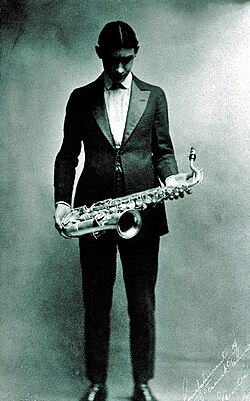
Key Facts
- Primary Instrument: C-melody saxophone (also played alto sax, bassoon, and clarinet).
- Defining Recording: "Singin' the Blues" (1927), inducted into the Grammy Hall of Fame.
- Major Influence: Cited by jazz legend Lester Young as his primary influence.
- Dual Career: A professional musician and a skilled aviation test pilot.
- Notable Collaborators: Bix Beiderbecke and guitarist Eddie Lang.
Early Life and Musical Foundations
Born Orie Frank Trumbauer on May 30, 1901, in Carbondale, Illinois, Trumbauer grew up in St. Louis, Missouri. He was born into a musical environment; his mother directed theater and saxophone orchestras, providing him with an early foundation in music. Of part Cherokee ancestry, Trumbauer began his professional journey with the Ray Miller and Edgar Benson bands.
He soon joined the Mound City Blue Blowers, a St. Louis group that gained national prominence through recordings on the Brunswick label. This period established Trumbauer as a rising talent in the jazz scene, leading to his role as musical director for Jean Goldkette's Victor Recording Orchestra, where he recruited the brilliant Bix Beiderbecke.
The Golden Era: Collaborations and Recordings
The late 1920s marked the peak of Trumbauer's creative output. After a brief stint with Adrian Rollini's New Yorkers, Trumbauer joined the Paul Whiteman Orchestra in 1927, where he would spend much of the next decade. During this time, he maintained a separate recording contract with Okeh Records, allowing him to lead small group sessions.
It was during these sessions that Trumbauer, Beiderbecke, and guitarist Eddie Lang recorded the 1927 hit "Singin' the Blues." Originally a 1920 release by the Original Dixieland Jass Band, Trumbauer's version became a jazz classic, lauded for its innovative phrasing and technical brilliance.
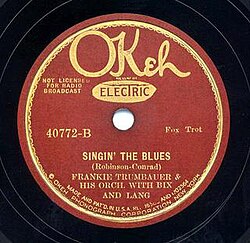
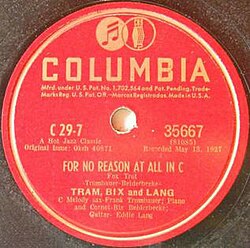
Trumbauer's discography is vast, featuring landmark tracks such as "Krazy Kat," "Trumbology," and "Tailspin." In 1931, he recorded the first hit version of "Georgia on My Mind." His technical mastery was further highlighted by his use of double tonguing, an articulation technique that allowed for rapid-fire note execution on wind instruments.
A Life Between Music and Aviation
Trumbauer's life took an unexpected turn in 1939. A skilled pilot, he stepped away from full-time music to join the Civil Aeronautics Authority (CAA). During World War II, he served as a test pilot for North American Aviation, where he was responsible for training military crews to operate the B-25 Mitchell bomber.
Though he continued to perform and record—including work with the NBC Orchestra and a band co-led with Mannie Klein (where he performed as "Frank Trombar")—aviation became his primary source of income after 1947. He eventually settled in Kansas City, Missouri, where he passed away from a heart attack on June 11, 1956, at the age of 55.
Legacy and Honors
Frankie Trumbauer's impact on jazz is most evident in the playing of Lester Young. Young explicitly credited Trumbauer as his "man" and primary influence, adopting a cool, linear approach to the saxophone that mirrored Trumbauer's sophisticated style.
His contributions have been recognized by the highest cultural institutions in the United States. "Singin' the Blues" was not only inducted into the Grammy Hall of Fame in 1977 but was also added to the Library of Congress National Recording Registry in 2005. In 2001, Ken Burns' PBS documentary Jazz used a photograph of Trumbauer as an iconic image to symbolize the entire genre.
| Category | Details |
|---|---|
| Primary Instrument | C-melody saxophone |
| Key Collaborators | Bix Beiderbecke, Eddie Lang, Paul Whiteman |
| Famous Works | "Singin' the Blues", "Georgia on My Mind" (1931) |
| Non-Musical Career | CAA Test Pilot (B-25 Mitchell bomber) |
| Major Influence | Lester Young |
Frequently Asked Questions
What is a C-melody saxophone?
The C-melody saxophone is a now-uncommon instrument that is larger than an alto saxophone but smaller than a tenor saxophone, pitched in the key of C.
Who was Frankie Trumbauer's most famous collaborator?
His most significant musical partnership was with cornetist Bix Beiderbecke, with whom he recorded some of the most innovative jazz of the late 1920s, often accompanied by guitarist Eddie Lang.
How did Trumbauer influence Lester Young?
Lester Young cited Trumbauer as his primary influence, drawing from Trumbauer's sophisticated melodic approach and phrasing to develop his own legendary saxophone style.
What was Trumbauer's role during World War II?
Trumbauer served as a test pilot with North American Aviation and trained military crews on how to operate the B-25 Mitchell bomber.
Which of his recordings is the most historically significant?
The 1927 recording of "Singin' the Blues" is his most landmark work, having been inducted into both the Grammy Hall of Fame and the U.S. Library of Congress National Recording Registry.