Frank Sinatratraditional popjazz singerswing musicCapitol Records

Frank Sinatra: The Life and Legacy of Ol' Blue Eyes

Frank Sinatra: The Life and Legacy of Ol' Blue Eyes Few figures in the 20th century loom as large over the landscape of popular music and entertainment as Frank Sinatra. Known as "Ol' Blu...

Frank Sinatra: The Life and Legacy of Ol' Blue Eyes

Few figures in the 20th century loom as large over the landscape of popular music and entertainment as Frank Sinatra. Known as "Ol' Blue Eyes," Sinatra was more than just a singer; he was a cultural phenomenon who redefined the role of the male vocalist and became a global symbol of sophistication and style. From his humble beginnings in New Jersey to the glittering lights of Las Vegas, his journey is a testament to resilience, artistry, and an unwavering commitment to his craft.

Throughout a career spanning six decades, Sinatra mastered a variety of genres, including traditional pop, jazz, swing, and big band. His ability to blend technical precision with raw emotional honesty allowed him to connect with audiences across generations, leaving an indelible mark on the history of the American songbook.
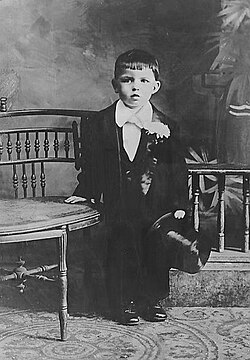
Sinatra at age three, c. 1918–1919

Key Facts

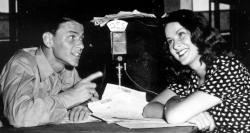
Sinatra with Alida Valli, c. 1940s
  • Full Name: Francis Albert Sinatra
  • Active Years: 1935–1995
  • Primary Genres: Traditional pop, jazz, swing, and big band
  • Major Record Labels: RCA Victor, Columbia, Capitol, and Reprise
  • Notable Affiliations: Member of the Rat Pack
  • Key Honors: Presidential Medal of Freedom (1985)

Musical Evolution and Career Milestones
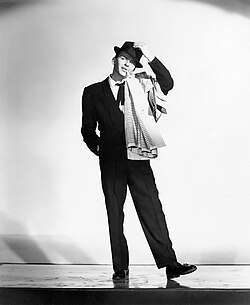
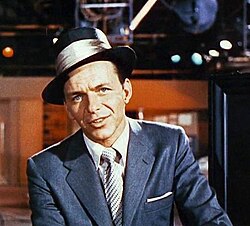
Sinatra in 1957 publicity shot

Early Beginnings (1935–1942)

Sinatra's professional journey began in the mid-1930s. He first gained attention as part of the Hoboken Four, appearing on Major Bowes' Amateur Hour in 1935. His early development was shaped by his time with the Harry James band and, most significantly, the Tommy Dorsey orchestra, where he honed the phrasing and breath control that would become his trademarks.
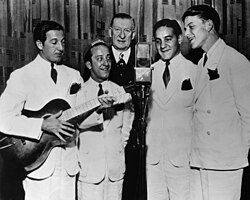
Sinatra (far right) with the Hoboken Four on Major Bowes' Amateur Hour in 1935

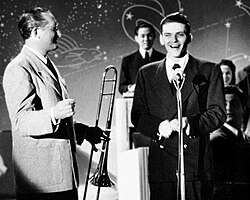
Sinatra and Tommy Dorsey in Ship Ahoy (1942)

The Rise of Sinatramania and World War II

By the early 1940s, Sinatra had become a superstar. This era, characterized by the fervent devotion of young female fans known as "bobby-soxers," was termed Sinatramania. During World War II, he continued to perform and record, contributing to the morale of the era through appearances at the Hollywood Canteen and broadcasts on the Armed Forces Radio.
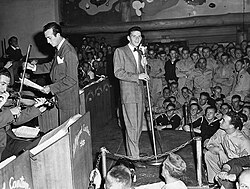
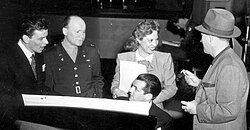
Sinatra performing with Harry James at the Hollywood Canteen in 1943

Sinatra (left) on the Armed Forces Radio in 1944 with Dinah Shore and Bing Crosby (right)

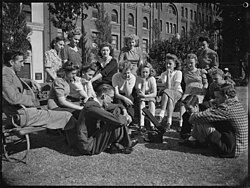
Young Sinatra fans listening to his records on a portable gramophone in Sydney, Australia, 1945

The Columbia Years and Career Slump

From 1946 to 1952, Sinatra recorded for Columbia Records. Despite early success with albums like The Voice of Frank Sinatra, this period eventually saw a decline in his popularity and commercial viability, leading to a challenging career slump.
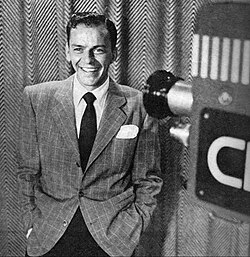
Sinatra in November 1950

The Capitol Revival and Reprise Era

Sinatra's career experienced a massive revival in the 1950s after signing with Capitol Records. Working with arranger Nelson Riddle, he created some of his most enduring works, including Songs for Swingin' Lovers! and In the Wee Small Hours. In 1960, seeking greater creative control, he founded his own label, Reprise Records.
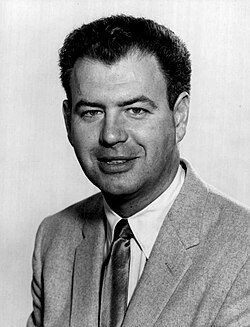
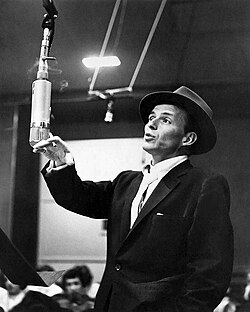
Nelson Riddle, Sinatra's album arranger for Capitol Records

Sinatra recording at Capitol Studios, c. 1955

Later Career and Final Projects

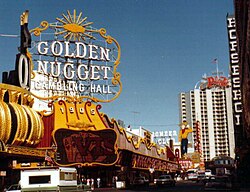
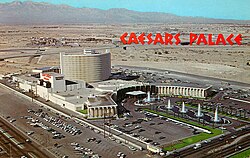
After a brief period of "retirement" in the 1970s, Sinatra returned to the stage and studio. His later years were marked by high-profile residencies in Las Vegas, including a significant deal with the Golden Nugget in 1982, and the release of the successful Duets series in the 1990s.
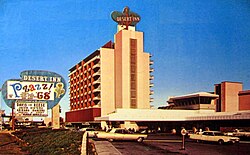
The Desert Inn, Las Vegas, where Sinatra began performing in 1951

Caesars Palace in 1970, where Sinatra performed from 1967 to 1970 and 1973 onwards

Sinatra signed a $16 million three-year deal with the Golden Nugget Las Vegas in 1982.

Film, Television, and Stage

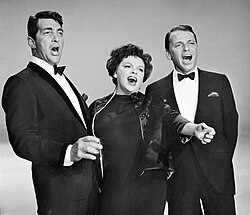
Sinatra with Dean Martin and Judy Garland in 1962

Beyond music, Sinatra was a formidable presence in cinema. His film career spanned from musical debuts in the 1940s to dramatic roles in the 1950s and 60s. He appeared in notable films such as Anchors Aweigh, High Society, and Pal Joey, as well as the later crime drama Tony Rome.
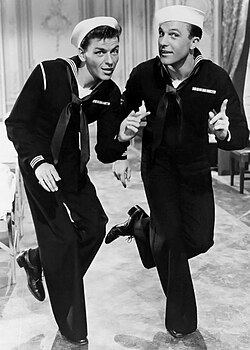
Black-and-white photograph of two dancing men in sailor suits
Sinatra and Gene Kelly in Anchors Aweigh (1945)

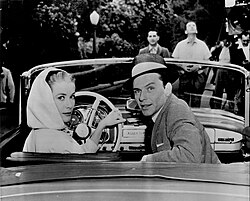
Sinatra with Grace Kelly on the set of High Society (1956)

Sinatra in Pal Joey (1957)

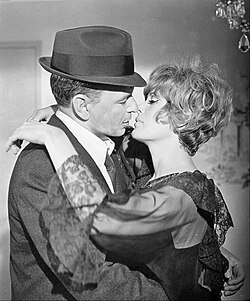
Sinatra with Jill St. John in Tony Rome (1967)

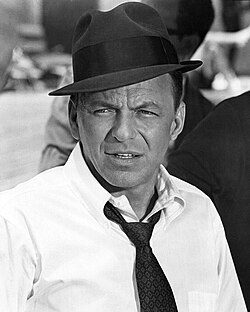
Sinatra in Tony Rome (1967)

Personal Life and Public Image

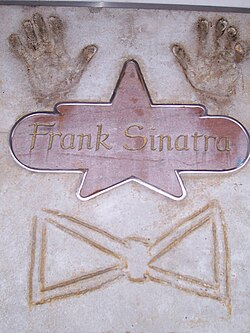
Handprint of Sinatra. Atlantic City Boardwalk, New Jersey, US, 2006

Sinatra's personal life was as publicized as his professional one. He was married four times, most notably to Nancy Barbato, Ava Gardner, Mia Farrow, and Barbara Marx. He was also known for his complex personality, his alleged links to organized crime, and his passionate political activism. An ardent supporter of the Democratic Party until the early 1970s, he maintained relationships with various world leaders, including President Richard Nixon.
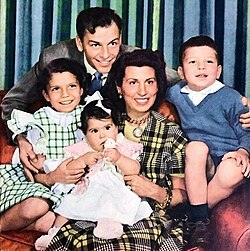
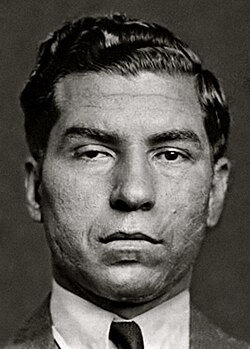
Photo family portrait of a husband, wife, two young children, and an infant.
Family portrait, 1949. Sinatra with (from left) Nancy, Tina, Nancy Barbato and Frank Jr.

Mobster Lucky Luciano

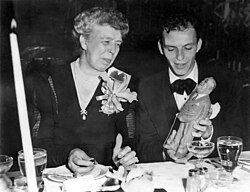
Sinatra, pictured with former First Lady Eleanor Roosevelt in 1947, was an ardent supporter of the Democratic Party until the early 1970s.

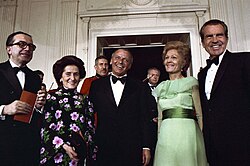
Sinatra (center) with President Richard Nixon and Italian Prime Minister Giulio Andreotti in 1973

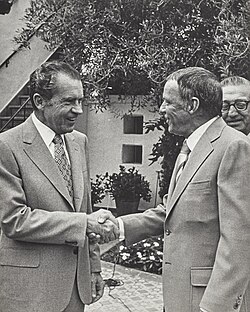
Sinatra shaking hands with President Richard Nixon in 1972

Legacy and Honors

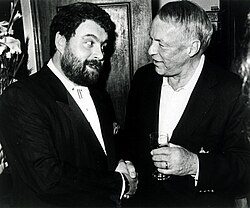
Brendan Grace and Sinatra in 1991

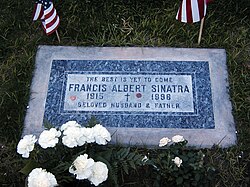
Frank Sinatra passed away on May 14, 1998, at the age of 82. He is interred at Desert Memorial Park in Cathedral City, California. His legacy persists through countless tribute albums by artists ranging from Tony Bennett to Amy Winehouse, and his enduring presence on the Hollywood Walk of Fame, where he holds three stars for recording, television, and motion pictures.
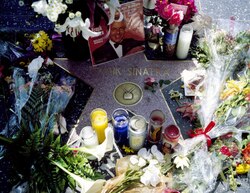
Fans covered flowers on Sinatra's star on the Hollywood Walk of Fame after he died in 1998

Sinatra's grave, as seen in 2004, located at Desert Memorial Park in Cathedral City, California (gravestone replaced in 2021)

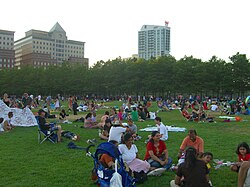
Frank Sinatra Park on the Hudson River Waterfront Walkway, 4th of July, 2010

Category Details
Primary Occupations Singer, Actor, Activist
Key Record Labels RCA Victor, Columbia, Capitol, Reprise
Notable Collaborators Nelson Riddle, Count Basie, Duke Ellington, Antonio Carlos Jobim
Major Awards Presidential Medal of Freedom
Spouses Nancy Barbato, Ava Gardner, Mia Farrow, Barbara Marx

Frequently Asked Questions

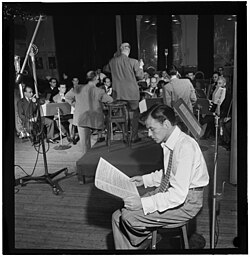
Sinatra with Axel Stordahl at the Liederkrantz Hall in New York, c. 1947
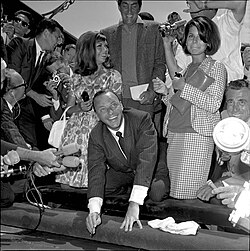
Sinatra leaving his signature in concrete at Grauman's Chinese Theatre in Hollywood, California on July 21, 1965
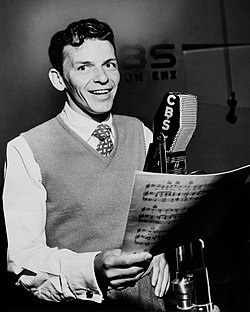
Sinatra on CBS Radio in 1944
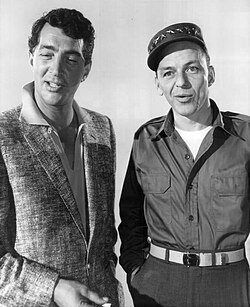
Dean Martin with Sinatra on The Dean Martin Show in 1958
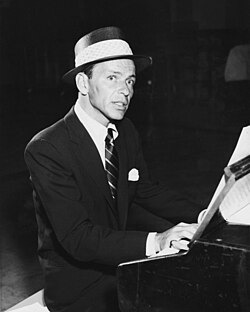
Sinatra in 1955
Sinatra in 1955
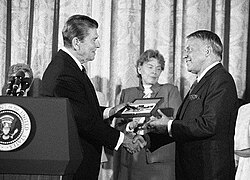
Sinatra being awarded the Presidential Medal of Freedom by President Ronald Reagan in 1985.
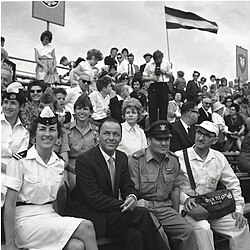
Sinatra watching an IDF military parade during a visit to Israel, 1962

What was "Sinatramania"?

Sinatramania refers to the intense fan frenzy, particularly among young women known as "bobby-soxers," that surrounded Frank Sinatra during the early 1940s.

Which record label did Frank Sinatra found?

Frank Sinatra founded Reprise Records in 1960 to gain more artistic and professional independence over his recordings.

Who was Nelson Riddle?

Nelson Riddle was a renowned arranger and conductor who worked closely with Sinatra during his Capitol Records years, helping to define his signature sound.

What were some of Sinatra's most famous films?

Some of his most notable films include Anchors Aweigh, High Society, Pal Joey, and Tony Rome.

Where is Frank Sinatra buried?

Frank Sinatra is buried at Desert Memorial Park in Cathedral City, California.

References

  1. On his original birth certificate, Sinatra's name was recorded incorrectly as "Frank Sinestro", a clerical error. In May 1945, he officially corrected the name on his birth certificate to "Francis A. Sinatra".[3]
  2. The house at 415 Monroe Street burned down and no longer exists.[6] The site is marked by a brick archway with a bronze plaque on the sidewalk that reads, "Francis Albert Sinatra: The Voice".[6] The building at 417 Monroe Street has a "From Here to Eternity", sign with images of an Oscar statue.[7] It was opened as a museum by Ed Shirak in 2001, but closed after five years because of maintenance issues.[6]
  3. Other sources incorrectly say Catania.[10]
  4. In 1920, Prohibition of alcohol became law in the US. Dolly and Marty ran a tavern during those years, allowed to operate openly by local officials who refused to enforce the law.[24]
  5. Sinatra's loss of employment at the newspaper led to a life-long rift with Garrick. Dolly said of it, "My son is like me. You cross him, he never forgets."[31]