Fort Rupert: Coal Mining and Colonial Fortifications
In the mid-19th century, the intersection of industrial ambition and colonial defense led to the establishment of Fort Rupert. Driven by the discovery of coal and the strategic needs of the British Admiralty, the Hudson's Bay Company (HBC) sought to secure a foothold in a region defined by both natural wealth and intense local conflict.
The Origins of Fort Rupert
The HBC first identified coal deposits in the area in 1835. However, these resources remained untapped for a decade because there was no viable market for them. This changed with the arrival of steamboats, which created a sudden demand for fuel.
By the early 1840s, the HBC recognized that the closure of Fort McLoughlin had been a strategic error. Motivated by the Admiralty's interest in coal, the company sought a new location. In 1849, Captain William Henry McNeill, supported by John Work, oversaw the construction of Fort Rupert. The site was named in honor of Prince Rupert of the Rhine, the first governor of the HBC.
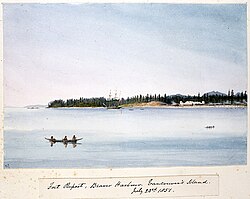
Defensive Architecture and Design
Fort Rupert was designed primarily for protection against the Nahwitti, the fierce local warriors of the region. The fort featured a stockade standing 5 metres (18 ft) high, with two bastions—projecting parts of the fortification—that housed cannons.
The fort's layout was nearly square, paralleling Wah-wese Creek with the following dimensions:
- Northwest side: 62 metres (202 ft)
- Northeast side: 63 metres (207 ft)
- Southeast side: 62 metres (202 ft)
- Southwest side: 61 metres (200 ft)
Despite these walls, the fort was manned by only about a dozen Europeans. Their only link to the outside world was a steamboat operated by the HBC that visited twice a year.
Coal Mining and Labor Unrest
Construction was finalized in 1851, the same year Robert Dunsmuir was appointed as the foreman for a crew of immigrant coalminers. The operation was fraught with tension; many of the Scottish miners refused to perform tasks unrelated to mining. Furthermore, the workers were dissatisfied with the limited protection provided by the HBC against armed attacks outside the fort walls.
The HBC maintained strict discipline. Workers who refused their duties were placed on rations and kept in irons. For those who chose to desert, the risks were even higher, as they faced potential death at the hands of the Nahwitti.
The mining venture was short-lived, ceasing in 1852. Following the shutdown, Robert Dunsmuir was reassigned to HBC coal operations in Nanaimo.
The Reality of the Fort's Defenses
While the stockade appeared imposing, the actual defensive capabilities were minimal. The fort contained only two small, rusted cannons. The HBC recognized that defending the post against overwhelming numbers would be futile. The vulnerability of the garrison was highlighted by the fact that individual Nahwitti warriors would occasionally climb the outside walls to leer down at the occupants inside.
Key Facts
- Established: 1849 by Captain William Henry McNeill and John Work.
- Purpose: Coal extraction for steamboats and Admiralty interests.
- Defense: A 5-metre high stockade with two bastions and two small cannons.
- Labor: Staffed by immigrant Scottish miners under foreman Robert Dunsmuir.
- Duration: Mining operations ceased in 1852.
- Location: Situated along Wah-wese Creek.
| Feature | Detail |
|---|---|
| Wall Height | 5 metres (18 ft) |
| Northwest Wall | 62 metres (202 ft) |
| Northeast Wall | 63 metres (207 ft) |
| Southeast Wall | 62 metres (202 ft) |
| Southwest Wall | 61 metres (200 ft) |
| Garrison Size | Approximately 12 Europeans |
Frequently Asked Questions
Why was Fort Rupert established?
It was established in 1849 to exploit coal deposits for the steamboat market and to satisfy the interests of the British Admiralty, while replacing the strategic void left by the closure of Fort McLoughlin.
Who were the Nahwitti?
The Nahwitti were the local warriors in the vicinity of the fort who posed a constant security threat to the HBC personnel and miners.
What happened to the miners who disobeyed orders?
Miners who refused to perform their duties were placed on rations and kept in irons.
How effective were the fort's defenses?
The defenses were largely symbolic; with only two small, rusted cannons and a small garrison, the fort could not withstand an attack by overwhelming numbers, and Nahwitti warriors were known to climb the walls to taunt the occupants.
When did coal mining at Fort Rupert end?
Mining operations ceased in 1852, leading to the reassignment of foreman Robert Dunsmuir to Nanaimo.