Football End Positions: Evolution from Single Wing to Modern Edge Rushers
In the early days of American football, the game was played with far less specialization than the complex systems seen today. Before the era of two platoons—a system where teams utilize separate units for offense and defense—players who lined up at the edges of the line on both sides of the ball were simply known as "ends." This unified terminology persisted until approximately the 1960s, reflecting a time when versatility was the primary requirement for any athlete on the field.
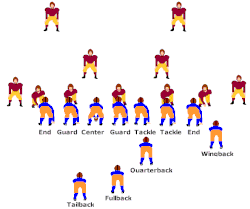
The Evolution of Offensive Ends
As the game evolved, particularly with the proliferation of the forward pass, the role of the offensive end split into several specialized positions based on their alignment relative to the line of scrimmage (the imaginary line separating the offense and defense before a play begins).
Tight Ends and Split Ends
A tight end is an offensive player who lines up close to the other linemen. This unique position serves a dual purpose: they are the only linemen permitted to run routes or catch passes in addition to their blocking duties.
Conversely, a split end lines up at a distance from the offensive line to create more space for receiving routes. Historically, Bill Carpenter is recognized as the first "Lonesome end," a precursor to these more spaced-out alignments.
The Rise of the Wide Receiver
In the modern era, the term wide receiver has become an umbrella term that encompasses both split ends and flankers. While split ends line up on the line of scrimmage, flankers are wide receivers who align in split positions but stand behind the line. In contemporary play-calling, these roles are frequently referred to as "X" and "Z" receivers.
The Role of Defensive Ends
On the defensive side of the ball, the end position has shifted toward speed and pressure. While traditionally called the defensive end, the 21st century has seen the rise of the term edge rusher.
The primary objective of the edge rusher is to pressure the quarterback (rushing the passer) and prevent offensive runs from breaking out toward the outer edges of the line, a tactic known as containment. Because defensive formations are not restricted by the same rigid rules as offensive formations, these players often share roles with other positions depending on the specific defensive scheme employed by the coach.
Interestingly, the cornerback serves as the defensive counterpart to the split end. Despite the name, the cornerback typically lines up on or near the line of scrimmage, making them technically an end in terms of alignment.
Key Facts
- Two Platoons: The system of separating offensive and defensive units, which ended the era of players being called "ends" for both sides.
- Tight End: The only offensive lineman capable of both blocking and catching passes.
- X and Z: Modern designations often used to replace the terms "split end" and "flanker."
- Containment: The defensive act of stopping offensive runs from reaching the outer edges of the line.
- Edge Rusher: The modern term for a defensive end focused on rushing the passer.
| Position | Alignment | Primary Role |
|---|---|---|
| Tight End | Close to offensive line | Blocking and receiving |
| Split End (X) | Distance from line | Receiving passes |
| Flanker (Z) | Behind line of scrimmage | Receiving passes |
| Edge Rusher | Defensive edge | Pass rushing and containment |
| Cornerback | On/near line of scrimmage | Defensive coverage |
Frequently Asked Questions
What is the difference between a split end and a flanker?
The primary difference is their alignment; a split end lines up on the line of scrimmage, whereas a flanker lines up behind the line of scrimmage.
Who was the first "Lonesome end"?
Bill Carpenter was the first player to occupy the "Lonesome end" position.
What does "containment" mean in a defensive context?
Containment refers to the defensive end's responsibility to stop offensive runs from getting around the outside edges of the line of scrimmage.
Why are wide receivers now called X and Z receivers?
These terms are modern shorthand used by coaches and players to replace the older terminology of "split end" and "flanker."
Is a cornerback considered an end?
Technically, yes, because they usually line up on or near the line of scrimmage, serving as the defensive counterpart to the split end.