Five Civilized Tribes: History, Removal, and the Struggle for Citizenship
The Five Civilized Tribes is a term used to describe five major indigenous nations originally located in the Southeastern United States. Long before European contact, these societies were shaped by the Mississippian culture, characterized by complex social structures and urban development. Over centuries, these tribes navigated the pressures of American expansion, cultural assimilation, and forced relocation, eventually establishing new homes in what is now Oklahoma.
Initially, these tribes operated under matrilineal kinship systems, where property and hereditary positions were passed through the mother's family line.
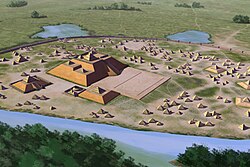
Foundations of the Mississippian Culture
From 800 to 1500 CE, the Mississippian culture flourished across the Midwestern, Eastern, and Southeastern United States. This era was defined by the development of surplus food through cultivation, which allowed for the growth of dense populations and the emergence of specialized artisan classes.
These societies were highly organized, featuring:
- Hereditary Governance: Political and religious elites led chiefdoms of varying complexity.
- Urban Planning: Towns often spanned hundreds of acres with planned streets divided into public and residential zones.
- Earthwork Mounds: The culture is well-known for constructing large, complex mounds for ceremonial and political purposes.
- Military Organization: High levels of military structure supported these expanding chiefdoms.
The Era of Cultural Transformation
Following the American Revolutionary War and the Treaty of Paris in 1784, the new United States government sought to influence Native American societies. President George Washington and Secretary of War Henry Knox implemented a policy of cultural transformation. Washington believed that while Native Americans were biologically equal to Europeans, their societies were inferior and should be "civilized."
Washington's six-point plan focused on regulating land purchases, promoting commerce, and encouraging the adoption of European-style farming and education. To implement this, the government appointed Indian agents, such as Benjamin Hawkins, to live among the tribes and encourage assimilation.
The Five Tribes adopted various practices they found useful, including:
- Establishing formal schools and adopting yeoman farming.
- Converting to Christianity.
- Building European-style homes.
- Adopting the practice of chattel slavery, holding enslaved African Americans as forced workers.
As the invention of the cotton gin made short-staple cotton profitable, American settlers pushed further into the Deep South, encroaching on tribal lands in Georgia, Alabama, Louisiana, and Mississippi, often leading to armed conflict.
Forced Removal and the Indian Territory
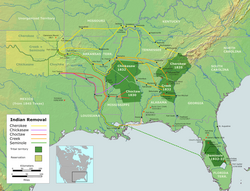
In the early 19th century, the US government shifted from a policy of assimilation to one of forced removal. Under the leadership of President Andrew Jackson, Congress passed legislation in 1830 to fund the relocation of tribes east of the Mississippi River to the west.
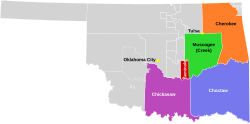
Most members of the Five Tribes were moved to the Indian Territory (modern-day Kansas and Oklahoma) by 1840. The Cherokee Nation resisted this move until 1838, resulting in the Cherokee Trail of Tears, during which thousands died. This removal was enforced by President Martin Van Buren via the Treaty of New Echota, despite opposition from the majority of the Cherokee people.
The Civil War and the Freedmen
During the American Civil War, the Five Tribes largely supported the Confederacy, partly due to promises of statehood if the South won. Enslaved Black people were viewed by some tribal members as "movable property" and a way to transport capital to the West.
After the war, the US government required the tribes to sign new peace treaties, emancipate their slaves, and grant citizenship to freedmen who wished to stay. While the Cherokee, Creek, and Seminole nations generally granted these rights, the Chickasaw and Choctaw nations resisted. The Chickasaw, in particular, never offered full citizenship to freedpeople, treating them as second-class citizens or requiring them to petition for citizenship through non-Native processes.
As a penalty for refusing to grant citizenship to freedmen, the US government seized more than half of the Chickasaw territory without compensation.
![Cherokee Nation Historic Courthouse in Tahlequah, Oklahoma, built in 1849, the oldest public building in present-day Oklahoma[22]](/images/9d/b2/9db2fb11cb74821f18f8155ea7826cc7f6c3f277222a188d2d1d01693e0cae0b.jpg)
Land Allotment and Statehood
In the late 19th century, the Dawes Act sought to dismantle communal tribal land ownership. The government allocated 160-acre plots to individual heads of households, labeling remaining land as "surplus" to be sold to non-Native settlers. This process was designed to extinguish Indian land titles and dissolve tribal governments.
In 1893, the "Cherokee Strip" was opened to settlement during the Oklahoma Land Run. By 1907, the Indian Territory and Oklahoma Territory merged to form the state of Oklahoma.
Modern Citizenship Struggles
In the 20th and 21st centuries, disputes arose over tribal membership, particularly regarding the Dawes Rolls—the census used to determine land allotments. Because registrars often classified anyone with African American features as a "Freedman" regardless of biological Indian descent, many descendants of mixed race were excluded from tribal membership when blood quantum or specific roll categories were enforced.
These disputes became more acute as gaming casinos increased tribal revenues. However, progress has been made; in 2017, the Cherokee Nation updated its constitution to grant full citizenship to the Cherokee Freedmen.
Key Facts
- Original Culture: Influenced by the Mississippian culture (800–1500 CE), known for large earthwork mounds and hereditary chiefdoms.
- Forced Migration: The Indian Removal Act of 1830 led to the relocation of the Five Tribes to Indian Territory (Oklahoma/Kansas).
- The Trail of Tears: The forced march of the Cherokee Nation in 1838, resulting in thousands of deaths.
- Civil War Ties: Most of the Five Tribes allied with the Confederacy, leading to mandatory post-war treaties and emancipation requirements.
- Land Loss: The Dawes Act broke up communal lands into 160-acre individual allotments to encourage assimilation and open land to settlers.
- Recent Progress: The Cherokee Nation officially reinstated citizenship for Freedmen in 2017.
| Tribe | Key Historical Event | Post-Civil War Status of Freedmen |
|---|---|---|
| Cherokee | Trail of Tears (1838) | Citizenship restored in 2017 |
| Choctaw | Early removal to Indian Territory | Historically denied full citizenship |
| Chickasaw | Loss of territory for denying citizenship | Historically denied full citizenship |
| Creek | Relocation to Indian Territory | Generally granted citizenship rights |
| Seminole | Relocation to Indian Territory | Generally granted citizenship rights |
Frequently Asked Questions
What were the Five Civilized Tribes?
They were five major indigenous nations from the Southeastern US—the Cherokee, Choctaw, Chickasaw, Creek, and Seminole—who adopted various European-American cultural practices, including farming, Christianity, and written constitutions.
What was the purpose of the Dawes Act?
The Dawes Act aimed to break up communal tribal lands into individual 160-acre allotments. This was intended to assimilate Native Americans into a culture of private property and open "surplus" land to non-Native settlers.
Who are the Freedmen of the Five Tribes?
Freedmen are the descendants of African Americans who were enslaved by members of the Five Tribes. Following the Civil War, treaties required the tribes to emancipate these individuals and grant them citizenship.
Why were the Dawes Rolls controversial?
The rolls were often inaccurate because registrars frequently categorized individuals based on physical appearance rather than ancestry, often listing people of mixed race as "Freedmen" even if they had documented Indian blood.
What happened to the Chickasaw Nation after the Civil War?
Because the Chickasaw Nation refused to grant citizenship to their freedpeople, the US government penalized them by seizing more than half of their territory without compensation.