Fishing History: The Evolution of Angling from Survival to Sport
Fishing has transitioned from a fundamental means of survival to a sophisticated global pastime. While the exact origins of recreational angling are obscured by time, evidence suggests that fly fishing—the act of using an artificial lure to mimic insects—was practiced in Japan as early as the 9th century BCE. Similarly, the Roman writer Claudius Aelianus described fly fishing in Macedonia between 175 and 235 CE. In these early contexts, however, the practice was driven by necessity rather than leisure.
The shift toward fishing as a recreational pursuit became more evident in England, possibly arriving with the Norman Conquest of 1066. By the late 15th century, the activity had gained enough prestige to be documented in writing, marking the beginning of a literary tradition that would define the sport for centuries.
Key Facts
- Earliest English Essay: Published in 1496 by Dame Juliana Berners.
- Defining Work: Izaak Walton's The Compleat Angler (1653) popularized fishing as a spiritual and social art.
- Technical Milestone: Charles Kirby invented the Kirby bend hook in 1655, a design still used today.
- Scientific Influence: Alfred Ronalds' 1836 work on entomology set the standard for modern fly-fishing literature.
- Modern Trends: Kayak fishing has emerged as a popular method for stealth and accessibility.
The Birth of Recreational Angling in England
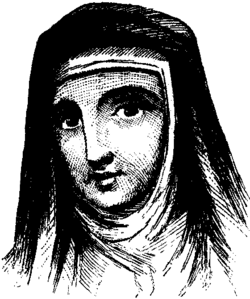
The first known English essay on recreational fishing, Treatyse of Fysshynge wyth an Angle, was published in 1496. Attributed to Dame Juliana Berners, the prioress of the Benedictine Sopwell Nunnery, this work appeared in the Boke of Saint Albans. At the time, angling was viewed as a pursuit for the nobility; the publisher, Wynkyn de Worde, even expressed concern that if non-gentlemen practiced it immoderately, they might destroy the resource.
By the early 17th century, the sport entered the realm of poetry. John Dennys published The Secrets of Angling in 1613. This work is historically significant for the footnotes provided by editor William Lawson, which contain the first recorded mention of the phrase to cast a fly.
The Golden Age of Angling Literature
Following the English Civil War, a surge of interest in angling led to a proliferation of instructional texts. Robert Venables published The Experienced Angler in 1662, while Richard Franck became the first to describe salmon fishing in Scotland and identify the burbot.
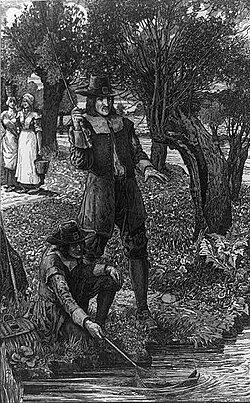
The most influential work of this era was Izaak Walton's The Compleat Angler, published in 1653. More than 300 editions have been printed, blending practical advice with folklore, recipes, and moral meditations. The book's central character, Piscator, represents the ideal angler who finds tranquility in friendship and nature.
Technical Advancements and Commercialization
As the sport grew, so did the need for specialized equipment. In 1655, Charles Kirby developed an improved fishing hook and the Kirby bend (an offset point hook), both of which remain staples of the industry. By the 18th century, fishing gear moved from general stores to specialized shops.
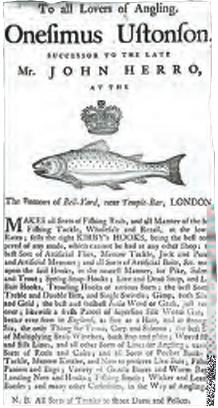
The town of Redditch became a production hub after the Great Fire of London in 1666. In 1761, Onesimus Ustonson established a leading trading shop, eventually receiving Royal Warrants from three successive monarchs. Ustonson is also credited with being the first to advertise the multiplying winch, an early form of the fishing reel made of brass.
The Scientific and Global Expansion
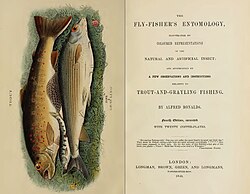
The 19th century brought a scientific approach to the sport. Alfred Ronalds utilized a bankside fishing hut as an observatory to study trout behavior. His 1836 publication, The Fly-fisher's Entomology, combined detailed observations with 20 color plates, establishing the standard for how artificial flies are described and illustrated today.
The expansion of the British railway network democratized the sport, allowing the middle and lower classes to visit rivers and coasts. This era also saw the rise of international travel, with English anglers traveling to Norway to pursue large salmon.
Regional Styles: Dry-Fly vs. Wet-Fly
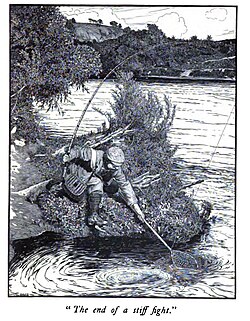
In Southern England, particularly on the chalk streams of Hampshire and Surrey, dry-fly fishing (keeping the fly on the water's surface) became an elitist standard. Conversely, wet-fly fishing (submerging the fly) remained popular in Northern England and Scotland. G.E.M. Skues later challenged the dry-fly purists by proving the effectiveness of nymph and wet-fly techniques on southern chalk streams.
The American Influence
In the United States, anglers were less rigid about methodology, adapting both dry and wet techniques to local conditions. American anglers are credited with pioneering the use of artificial lures for bass, developing the bass popper and spinner/fly lures. In the late 19th century, figures like Theodore Gordon popularized fly fishing in the Catskill Mountains of New York.
The sport's cultural reach expanded further through the works of Ernest Hemingway, who popularized fly fishing in his fiction, such as The Sun Also Rises. Additionally, the invention of the motorized boat led to the birth of big-game fishing, pioneered by marine biologist Dr. Charles Frederick Holder in 1898.
Modern Participation and Trends
Contemporary fishing continues to evolve. In the United States, the Outdoor Industry Association noted a net gain of 300,000 participants between 2017 and 2018, despite a high churn rate (the rate at which people quit and join the activity) of 18.5%. In 2018, participants averaged 17.9 fishing days per year.
| Year/Era | Key Figure/Work | Contribution |
|---|---|---|
| 1496 | Dame Juliana Berners | First English essay on recreational fishing |
| 1613 | John Dennys | First mention of "casting a fly" |
| 1653 | Izaak Walton | Published The Compleat Angler |
| 1655 | Charles Kirby | Invented the Kirby bend hook |
| 1761 | Onesimus Ustonson | Commercialized tackle and multiplying winches |
| 1836 | Alfred Ronalds | Pioneered fly-fishing entomology |
| 1898 | Dr. Charles F. Holder | Pioneered big-game fishing |
Frequently Asked Questions
Who wrote the first English essay on recreational fishing?
The first English essay, titled Treatyse of Fysshynge wyth an Angle, was published in 1496 and is attributed to Dame Juliana Berners, the prioress of the Benedictine Sopwell Nunnery.
What is the significance of The Compleat Angler?
Written by Izaak Walton in 1653, it is one of the most famous books on angling, blending practical instruction with philosophy and poetry to popularize fishing as a tranquil, spiritual art.
What is the difference between dry-fly and wet-fly fishing?
Dry-fly fishing involves using a lure that floats on the surface of the water, a method that became an elitist standard in Southern England. Wet-fly fishing involves lures that sink below the surface, a technique widely used in Scotland and Northern England.
How did the industrial revolution affect fishing?
The expansion of the railway network allowed more people from different social classes to access fishing waters. Additionally, the industry became commercialized, with towns like Redditch becoming centers for tackle production.
What is kayak fishing?
Kayak fishing is a modern method that uses small, stealthy boats to reach areas inaccessible by land or larger boats, adding a layer of complexity and challenge to the sport.