Firewood-gatherer: The Unique Architect of the South American Grasslands
The firewood-gatherer (Anumbius annumbi) is a distinctive member of the ovenbird family, Furnariidae. Found across the open landscapes of South America, this bird is renowned not only for its unique appearance—which bears a striking resemblance to a pipit—but also for its extraordinary nest-building capabilities. As the sole member of its genus, it represents a specialized lineage within the Furnariinae subfamily.
Key Facts
- Scientific Name: Anumbius annumbi
- Conservation Status: Least Concern (IUCN 3.1)
- Distribution: Argentina, Brazil, Paraguay, and Uruguay
- Distinctive Feature: Builds massive cylindrical nests from thorny twigs
- Diet: Seeds and both adult and larval arthropods
- Status: Monotypic genus (no recognized subspecies)
Taxonomy and Physical Description
Taxonomically, the firewood-gatherer is most closely related to the lark-like brushrunner (Coryphistera alaudina), with evidence suggesting they may be sister species. Because it is the only species within the genus Anumbius, it is classified as monotypic.
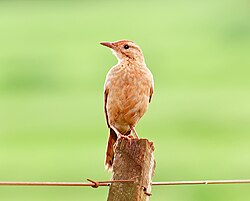
Measuring between 18 and 20 cm in length and weighing between 27 and 45 g, the firewood-gatherer possesses a plumage that is consistent across both sexes. Adults are characterized by a light brownish to grayish-brown face featuring a wide whitish supercilium (the stripe of feathers above the eye) and a brownish stripe behind the eye. Their forehead is a dull rufous color, while the crown is sandy or dull brown with narrow blackish streaks. The underparts transition from a white throat with black speckles to a reddish-light brown upper breast, eventually fading into a pale buffy belly.
Juveniles differ slightly from adults, lacking the rufous forehead and possessing an ochraceous throat and darker underparts.
Distribution and Habitat
The firewood-gatherer is widely distributed across several South American nations. Its range extends from Goiás and Minas Gerais in Brazil, south through Rio Grande do Sul, across central and eastern Paraguay, throughout nearly all of Uruguay, and into northern Argentina, reaching as far south as the Río Negro Province.
This species thrives in open environments at elevations from sea level up to 1,000 meters (3,300 ft). Preferred habitats include:
- Seasonally wet grasslands and pastures
- Agricultural fields and savannas
- Scrublands and the edges of open woodlands
- Tree stands located near farmhouses
Behavior and Ecology
Movement and Diet
The firewood-gatherer is a year-round resident within its range. It primarily feeds on seeds and arthropods in both their larval and adult stages. Foraging typically occurs in pairs or small groups, which may include nest helpers, gleaning food from the ground and low-lying vegetation.
The Art of Nesting
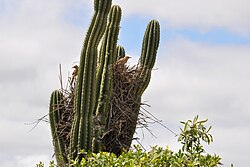
The most remarkable aspect of the firewood-gatherer's biology is its nest. Breeding occurs during the austral spring and summer (September to February), often with two broods per season. The species is believed to be monogamous, and offspring from the first brood frequently assist in building the nest for the second.
The nest is a massive cylinder woven from thorny twigs, typically reaching 110 cm (43 in) in height and 40 cm (16 in) in width, though some specimens have been recorded at double this size. The structure features an entrance hole near the top that leads through a winding tunnel to a nesting chamber lined with feathers, plant fibers, and other soft materials. These nests are placed conspicuously on isolated trees, utility pole crossbars, or other exposed substrates, usually within 4 meters of the ground, though they can be found as high as 24 meters.
Vocalization
Pairs often sing in duets. Their song is described as a high series of hurried, staccato notes followed by a descending rattle (e.g., "djip-djip-drrrr") or a rough, bubbly, accelerating series of trilled notes. Their standard call is a sharp "stchick".
Conservation Status
The IUCN classifies the firewood-gatherer as Least Concern. The species maintains a very large range, and while the exact population size is unknown, it is believed to be increasing. The bird is highly adaptable, tolerating moderate grazing and anthropogenic (human-caused) disturbances; it may even benefit from deforestation due to the creation of more open landscapes.
| Feature | Details |
|---|---|
| Length | 18–20 cm |
| Weight | 27–45 g |
| Nest Size | Typically 110 cm high x 40 cm wide |
| Clutch Size | 3–5 eggs |
| Incubation Period | Approximately 16 days |
| Fledging Period | 17–18 days after hatching |
Frequently Asked Questions
What makes the firewood-gatherer's nest unique?
The nest is exceptionally large for the bird's size, consisting of a thorny twig cylinder with a winding tunnel leading to the inner chamber, often placed in highly visible locations.
Where can the firewood-gatherer be found in the wild?
It is native to South America, specifically in Argentina, Brazil, Paraguay, and Uruguay, inhabiting open grasslands, savannas, and agricultural areas.
Does the firewood-gatherer have any subspecies?
No, the firewood-gatherer is a monotypic species, meaning it is the only member of its genus and has no recognized subspecies.
What do firewood-gatherers eat?
Their diet consists of seeds as well as adult and larval arthropods, which they glean from the ground and low vegetation.
Is the firewood-gatherer an endangered species?
No, it is listed as Least Concern by the IUCN due to its large range and ability to adapt to human-altered landscapes.