Faulhaber's Formula: Summing the Powers of Integers
In the realm of number theory, calculating the sum of the first n positive integers raised to a specific power p is a classic problem. While simple addition works for small sets, mathematicians sought a general way to express these sums as polynomials. This solution is known as Faulhaber's formula, named after the 17th-century mathematician Johann Faulhaber.
At its core, Faulhaber's formula provides a systematic method to find the sum of the p-th powers of the first n positive integers. In modern mathematical notation, the formula is expressed as a polynomial in n, utilizing binomial coefficients (the number of ways to choose k elements from a set of n) and Bernoulli numbers (a sequence of rational numbers that appear frequently in analysis and number theory).
Key Facts
- Purpose: Expresses the sum of the first n integers raised to the power p as a polynomial of degree p+1.
- Core Components: The formula relies on Bernoulli numbers and binomial coefficients.
- Historical Scope: Special cases were known since antiquity (Pythagoreans, Archimedes), but the general formula was refined by Jacob Bernoulli and later proven by Carl Jacobi.
- Faulhaber Polynomials: For odd powers, the sum can be expressed as a polynomial of the triangular number sum.
- Modern Applications: The formula connects to the Riemann zeta function and can be solved using matrix algebra.
Foundational Examples
To understand the general formula, it is helpful to look at the most common power sums. These are often encountered in basic algebra and geometry:
- p = 1: The sum of the first n integers is the formula for triangular numbers:
n(n + 1) / 2. - p = 2: The sum of squares results in square pyramidal numbers:
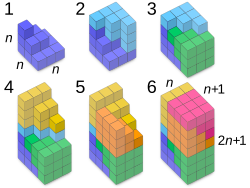
n(n + 1)(2n + 1) / 6. - p = 3: The sum of cubes is the square of the first power sum:
(n(n + 1) / 2)2.
The Mathematical Framework
The general form of Faulhaber's formula involves the second Bernoulli numbers (denoted as Bk). These numbers are identical to the first Bernoulli numbers, except for the value at k = 1, where the second kind is positive and the first is negative.
The formula is structured such that the sum of the p-th powers is a polynomial function of n. While Johann Faulhaber knew the results for at least the first 17 cases, it was Jacob Bernoulli who, in 1713, published Summae Potestatum in his work Ars Conjectandi, introducing the coefficients now known as Bernoulli numbers.
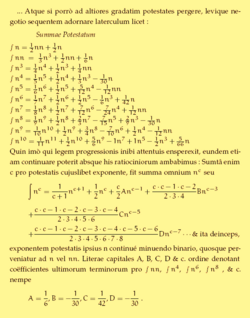
A rigorous proof for all odd powers was not established until 1834 by Carl Jacobi, who utilized the development of infinite series and exponential functions to generate Bernoulli numbers.
Historical Evolution
Ancient Discoveries
Long before the general formula, ancient mathematicians solved specific cases:
- Pythagorean School: Identified the sum of the first n integers and the fact that the sum of the first n odd numbers is a perfect square.
- Archimedes: Developed a formula for the sum of squares in his work Spirals.
- Nicomachus of Gerasa: Discovered the formula for the sum of cubes.
![Proof without words for p = 3 [16]](/images/bd/73/bd73f651b057f8fceb47963862c212116abd53e99f2cf3915ad8d53ec25807aa.webp)
The Middle and Modern Periods
Between antiquity and the 19th century, mathematicians like Al-Karaji, Ibn al-Haytham, Pierre de Fermat, and Blaise Pascal contributed to the recursive solution of power sums. Pascal, in particular, used an identity that allowed the derivation of a polynomial of degree p if the previous polynomials were already known.
In the modern era, researchers have moved toward matrix methods. By using triangular matrices derived from Pascal's triangle, it is possible to calculate the coefficients of the power-sum polynomials without directly calculating Bernoulli numbers.
Advanced Variations and Connections
Faulhaber Polynomials
Some authors use the term Faulhaber polynomials to describe the observation that if p is odd, the sum is a polynomial function of the triangular number sum S1 = n(n+1)/2. For example, the sum of cubes (p=3) is simply S12.
The Riemann Zeta Function
Faulhaber's formula has a deep connection to the Riemann zeta function, a fundamental function in number theory. Heuristically, the formula suggests a relationship where the sum of powers relates to the value of the zeta function for negative integers through analytic continuation.
Umbral Calculus
In umbral calculus, Bernoulli numbers are treated as if the index were an exponent (treating Bk as Bk). This allows the formula to be written in a compact, symbolic form, which is then expanded using the binomial theorem to retrieve the actual Bernoulli numbers.
Summary of Power Sums
| Power (p) | Name/Type | Formula |
|---|---|---|
| 1 | Triangular Numbers | n(n + 1) / 2 |
| 2 | Square Pyramidal Numbers | n(n + 1)(2n + 1) / 6 |
| 3 | Sum of Cubes | (n(n + 1) / 2)2 |
Frequently Asked Questions
Who is Faulhaber's formula named after?
It is named after Johann Faulhaber, an early 17th-century mathematician who identified the first 17 cases of power sums and noted the existence of polynomials for odd powers.
What are Bernoulli numbers?
Bernoulli numbers are a sequence of rational numbers that appear as coefficients in Faulhaber's formula and are essential in various areas of mathematical analysis and number theory.
How does the matrix method differ from the traditional formula?
The matrix method uses linear algebra and Pascal's triangle to find polynomial coefficients, avoiding the need to calculate Bernoulli numbers directly.
What is the relationship between the sum of cubes and the sum of integers?
According to Nicomachus's theorem, the sum of the first n cubes is exactly equal to the square of the sum of the first n integers.
Can this formula be used for any arithmetic progression?
Yes, while the standard Faulhaber's formula handles successive integers, the method can be generalized to find polynomials for any arithmetic progression using complex numbers and matrix formulas.