European Union Governance, Institutions, and Integration
The European Union (EU) is a unique supranational political and economic union consisting of 27 member states. From its origins in post-war cooperation to its current complex structure, the EU integrates legislative, judicial, and financial systems to foster stability and prosperity across the continent.
Key Facts
- Member States: 27 countries currently comprise the European Union.
- Founding Documents: The union's legal framework is built on treaties, starting with the Schuman Declaration (1950) and the Treaty of Paris (1951).
- Monetary Union: The Eurozone consists of member states that have adopted the euro as their official currency.
- Borderless Travel: The Schengen Area allows for the abolition of internal border controls between participating countries.
- Scientific Support: The Joint Research Centre (JRC) serves as the European Commission's science and knowledge service, providing independent scientific advice for EU policy.
The Institutional Framework
The EU operates through a sophisticated system of executive, legislative, and judicial bodies that ensure the democratic legitimacy and legal consistency of its policies.
Executive and Legislative Bodies
The European Council provides the general political direction, while the European Commission, currently led by President Von der Leyen, acts as the executive arm. The European Parliament serves as the legislative body, with the 10th session running from 2024 to 2029 under President Metsola.
Judicial and Auditory Oversight
The Court of Justice of the EU ensures that EU law is interpreted and applied uniformly across all member states. Financial transparency is maintained by the European Court of Auditors and the European Central Bank, the latter of which manages the Economic and Monetary Union (EMU) under President Lagarde.
Economic and Territorial Integration
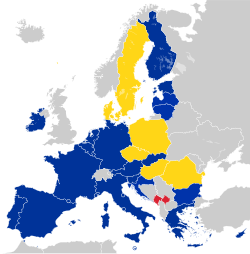
Integration within the EU occurs at different speeds and levels, creating various zones of cooperation based on specific treaties and agreements.
The Eurozone and Economic Area
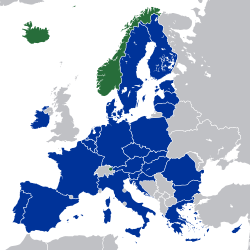
The Eurozone includes members such as Germany, France, and Italy, while some states, like Denmark, maintain an opt-out. Beyond the EU, the European Economic Area (EEA) extends the single market to include Iceland, Liechtenstein, and Norway.
The Schengen Area and Euratom
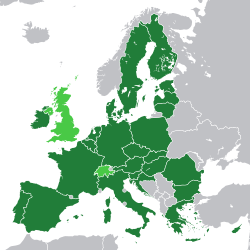
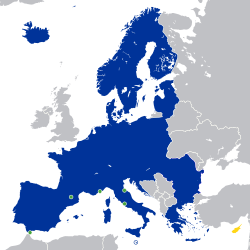
The Schengen Area facilitates free movement, with new expansions occurring as recently as January 2025. Parallel to the political union, Euratom (the European Atomic Energy Community) coordinates nuclear research and safety among its members.
Legal Foundations and Policy
EU law is governed by the principle of primacy, meaning EU law takes precedence over national law in areas of shared competence. The Acquis refers to the accumulated body of EU law and obligations that any new member state must adopt.
Key legal instruments include:
- Regulations: Binding legislative acts that apply immediately across the EU.
- Directives: Acts that set goals for member states to achieve through their own national laws.
- Decisions: Binding acts addressed to specific recipients.

Summary of EU Integration Zones
| Framework | Primary Purpose | Key Feature | Notable Non-EU Members |
|---|---|---|---|
| European Union (EU) | Political and Economic Union | Supranational Governance | N/A |
| Eurozone | Monetary Integration | Common Currency (Euro) | N/A |
| Schengen Area | Border Integration | No Internal Border Checks | Norway, Switzerland, Iceland |
| EEA | Market Integration | Single Market Access | Norway, Iceland, Liechtenstein |
| Euratom | Nuclear Cooperation | Atomic Energy Research | United Kingdom (historical) |
Frequently Asked Questions
What is the difference between the EU and the EEA?
The European Union is a full political and economic union with its own legislative bodies. The European Economic Area (EEA) is an agreement that allows non-EU countries (Iceland, Liechtenstein, and Norway) to participate in the EU's single market without being full EU members.
How does the Schengen Area differ from the EU?
The EU is a political entity, whereas the Schengen Area is a specific agreement regarding the abolition of internal border controls. Some EU members have opt-outs from Schengen, and some non-EU members are full participants.
What is the role of the European Central Bank?
The European Central Bank (ECB) manages the euro, maintains price stability, and oversees the Economic and Monetary Union (EMU) to ensure financial stability across the Eurozone.
What is the 'Acquis' in EU law?
The Acquis is the entire body of common rights and obligations that are binding on all EU member states, including treaties, legislation, and case law from the Court of Justice.
Who provides scientific advice to the European Commission?
The Joint Research Centre (JRC) is the official science and knowledge service of the European Commission, employing scientists to provide independent support for EU policy decisions.