Esteban Echeverría: The Father of Argentine Romanticism
Esteban Echeverría (1805–1851) was a pivotal figure in the birth of Argentine literature. A poet, fiction writer, and liberal activist, Echeverría did more than just write; he acted as a cultural promoter who sought to align Argentine letters with the social and physical realities of his homeland. As one of Latin America's most influential Romantic authors, his work blended artistic passion with a fierce commitment to political liberty.
Key Facts
- Born: September 2, 1805, in Buenos Aires.
- Died: January 19, 1851, in Montevideo, Uruguay.
- Education: Studied at the Sorbonne in Paris.
- Literary Movement: A leading proponent of Romanticism in Latin America.
- Core Philosophy: Influenced by the democratic nationalism of Giuseppe Mazzini and the utopian socialism of Henri de Saint-Simon.
- Major Works: El Matadero and La Cautiva.
Life and Political Activism
Echeverría's intellectual foundation was shaped during five transformative years in Paris between 1825 and 1830. During this period, he immersed himself in the Romantic Movement—an artistic and intellectual current emphasizing emotion and individualism—which was then at its peak in France. Upon returning to Buenos Aires, he became a catalyst for this movement in Argentina, producing early works such as Los Consuelos (1834) and Las rimas (1837).
In 1840, Echeverría joined a circle of young intellectuals to form the Asociación de Mayo (May Association), named after the May Revolution that sparked Argentina's journey toward independence. The group's mission was to create a national literature that reflected the authentic identity of the country. However, Echeverría's liberal ideals put him in direct conflict with the caudillo (military-political leader) of Buenos Aires, Juan Manuel de Rosas. This political friction eventually forced Echeverría into exile in Uruguay, where he spent the remainder of his life until his death in 1851.
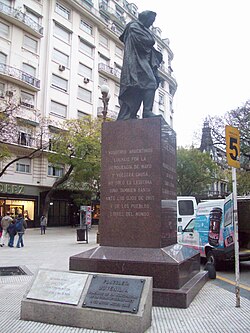
Literary Contributions and Themes
Echeverría is most renowned for his short story El matadero ("The Slaughter Yard"). Written between 1838 and 1840 but not published until 1871, the story is a cornerstone of Latin American literature. It serves as a political allegory, utilizing the setting of a slaughterhouse to illustrate the clash between civilization and barbarism.
In this narrative, the "barbarism" is represented by Rosas and his violent henchmen, while "civilization" is embodied by a cultivated young protagonist who is murdered by the thugs. This dichotomy—the struggle between European-style refinement and primitive violence—was a central theme also explored by the thinker Domingo Faustino Sarmiento.
Beyond his prose, Echeverría authored La cautiva ("The Captive"), a long narrative poem depicting a white woman abducted by Mapuche Indians. This work remains one of the most significant pieces of 19th-century Latin American poetry.
Summary of Echeverría's Profile
| Category | Details |
|---|---|
| Alma Mater | Sorbonne |
| Key Influences | Giuseppe Mazzini, Henri de Saint-Simon |
| Political Stance | Romantic Liberalism |
| Primary Themes | Civilization vs. Barbarism, National Identity |
| Legacy | Esteban Echeverría Partido (founded 1913) |
Complete List of Works
- Elvira o la novia del Plata (1832)
- Don Juan (1833)
- Himno del dolor (1834)
- Los consuelos (1834)
- Al corazón (1835)
- Rimas (1837)
- Apología del matambre (1837)
- El matadero (1838–1840)
- La cautiva
- El Dogma Socialista
- Cartas a un amigo
- Other works include: Carlos, Mangora, La Pola, Canciones, Peregrinaje de Gualpo, El ángel caído, Ilusiones, La guitarra, Avellaneda, Mefistófeles, La noche, and La diamela.
Frequently Asked Questions
What is the significance of "El Matadero"?
It is a landmark of Latin American literature that uses a slaughterhouse as a political allegory to critique the regime of Juan Manuel de Rosas, contrasting the "barbarism" of the regime with the "civilization" of the educated elite.
How did Paris influence Echeverría's work?
Spending five years at the Sorbonne (1825–1830) allowed Echeverría to absorb the spirit of the Romantic Movement and the utopian socialist ideas of Henri de Saint-Simon, which he later integrated into his writing and activism in Argentina.
What was the Asociación de Mayo?
The Asociación de Mayo was a group of young Argentine intellectuals organized in 1840. Their goal was to develop a national literature that responded to the specific social and physical realities of Argentina.
Why did Esteban Echeverría go into exile?
He was forced into exile in Uruguay in 1840 due to his political opposition to the caudillo Juan Manuel de Rosas, whose absolute power Echeverría viewed as an obstacle to civic rights and democracy.
What is the theme of "La Cautiva"?
La cautiva is a narrative poem that tells the story of a white woman who has been abducted by Mapuche Indians, reflecting 19th-century perspectives on the frontier and national identity.