Eschwege: A Blend of Medieval Charm and Vibrant Culture
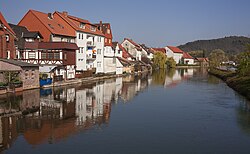
Nestled along the scenic banks of the river Werra, Eschwege is a town where history and modernity coexist. From its well-preserved medieval core, characterized by rows of traditional timber-frame houses (buildings constructed with heavy timbers joined by mortise and tenon), to its bustling international festivals, the town offers a rich tapestry of experiences for visitors and sports enthusiasts alike.
The town's aesthetic is defined by its historic architecture and natural beauty, making it a prime destination for those seeking the quaint atmosphere of the Hessian countryside.
Key Facts
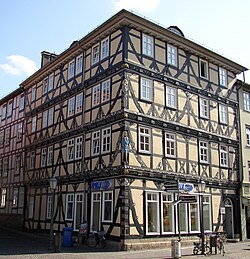
- Historic Core: Features a medieval center with extensive timber-frame architecture.
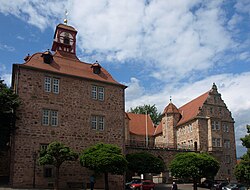
- Landmark Palace: Schloss Eschwege serves as the district administration seat and houses the Dietemann figure.
- Water Sports Hub: The Werratalsee features an international-standard 2,000m rowing course.
- Major Events: Home to the traditional Johannisfest and the large-scale Open Flair music festival.
- Unique Folklore: Features the Frau Holle well and the hourly appearance of the Dietemann mascot.
Historic Architecture and Landmarks
The architectural heart of Eschwege is its medieval town core. Visitors can explore the marketplace, which is surrounded by historic timber-frame houses, and visit the Heimatmuseum (local history museum) located within this scenic area.
The Landgraves’ Palace and Folklore
Schloss Eschwege (the Landgraves’ Palace) is a central landmark. Originally built as a castle in 1386 and expanded during the 16th and 17th centuries, it has served as the seat of the district administration since 1821. The palace is home to the Dietemann tower, where the Dietemann—a man with a horn and a symbol of the people of Eschwege—appears every hour to blow his horn.
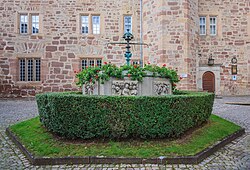
Adjacent to the palace is the Frau Holle well, constructed in 1930. This site features reliefs depicting key scenes from the famous fairytale of the same name.
Towers and Civic Buildings
The town's skyline is dotted with significant structures, including:
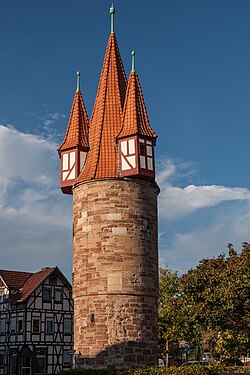
- Dünzerbacher Torturm: A 17th-century tower and former prison, representing one of the last remnants of the city's fortifications.
- Nikolaiturm: A former church tower dating back to 1455.
- Karlsturm: Located on the Schulberg (Cyriakusberg), this tower is the final remnant of an 11th-century women's foundation.
- Bismarckturm: A tower built in 1903 on the Leuchtberg.
- Hochzeitshaus: The "Wedding House," which has served as a municipal community center since 1578.
Religious and Cultural Sites
Eschwege's spiritual history is visible in the Neustädter Kirche St. Katharina and the Marktkirche St. Dionys. Other notable sites include the Hospital chapel, the former synagogue (now a New Apostolic church), and the monastery, which is the seat of the Eschwege monastery brewery. For those interested in local lore, the Hexenkeller ("Witches' Cellar") is a point of interest.
Museums and Green Spaces
Cultural exploration continues at the Stadtmuseum Eschwege (town museum), the Eschweger Zinnfiguren- und Miniaturenkabinett (specializing in tin figures and miniatures), and the "Freunde der Eisenbahn" railway museum.
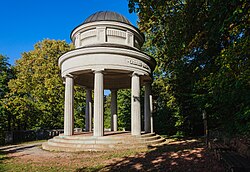
Nature lovers can visit the Palace garden, the Botanical garden, or the Sophiengarten. The Leuchtbergpark offers scenic paths around the Greater and Lesser Leuchtberg, while the Werratalsee provides a expansive recreation area between Eschwege and Schwebda.
Sports and Recreation
The Werratalsee is a premier destination for athletics. It hosts a rowing regatta course that is unique in Hesse; expanded in 2008 to 2,000 meters, it meets international dimensions and hosts the Hesse rowing championships.
Beyond rowing, the lake is used for sailing, organized by the Werrertalsee und Segelclub WSSC 1969 Eschwege e.V., which welcomes guests at its marina. The area also features a riding facility that hosts the North Hesse Championships in dressage and show jumping.
The town is also active in team sports, with football clubs such as SV 07 Eschwege, FC Eschwege 1988 e.V, and FFV Palm Strikers Eschwege. The Eschwege Gymnastic and Sport Club is the district's largest, offering everything from handball and swimming to a cycling department established in 2005. Tennis enthusiasts are served by TC Eschwege e.V., whose teams compete in the Gruppenliga.
Annual Events and Festivals
Eschwege is renowned for its vibrant calendar of events. The Johannisfest is a famous four-day music and drinking festival traditionally held on the first Sunday of July. It features the "Kränzewickeln" (wreath winding), school parades (Maienzug), and the appearance of the Dietemann mascot, concluding with fireworks and a lantern sendoff by the rowing club.
For music lovers, the Open Flair Festival, usually held on the second weekend of August, is the region's largest music festival, attracting international and German performers.
Other notable events include:
- WerraMan Triathlon: An annual event in late August/early September consisting of 400m swimming, 23km cycling, and 5km walking.
- Wurschtfest: A sausage festival held in September.
- Hüttenzauber: A pre-Christmas event at the marketplace.
- Weekly Markets: Held every Wednesday and Saturday morning at the Obermarkt.
| Category | Key Highlight | Notable Feature |
|---|---|---|
| Architecture | Schloss Eschwege | Dietemann tower and Frau Holle well |
| Nature | Werratalsee | 2,000m international rowing course |
| Festivals | Johannisfest | Traditional parades and music |
| Music | Open Flair | Largest regional music festival |
| Sports | WerraMan | Annual triathlon in late summer |
Frequently Asked Questions
What is the Dietemann?
The Dietemann is a local mascot and symbol of the people of Eschwege. He is a figure of a man with a horn located in the tower of Schloss Eschwege, where he appears every hour to blow his horn.
When is the Johannisfest held?
It is traditionally held on the first Sunday in July. However, if the Hessian summer holidays begin in June, the festival is moved to the last Sunday before the holidays start.
What makes the Werratalsee rowing course special?
It is unique in Hesse and was expanded in 2008 to 2,000 meters, providing international dimensions that allow the town to host international competitions and the Hesse rowing championships.
What are the details of the WerraMan Triathlon?
The WerraMan is a popular triathlon held annually in late August or early September. The course consists of a 400m swim, a 23km cycle, and a 5km walk.
Which museums can be visited in Eschwege?
Visitors can explore the Stadtmuseum (town museum), the Heimatmuseum in the Old Town, the "Freunde der Eisenbahn" railway museum, and the Eschweger Zinnfiguren- und Miniaturenkabinett.