Encyclopædia Britannica: A History of the World's Most Famous Reference Work
For over two centuries, the Encyclopædia Britannica has served as a global benchmark for knowledge and scholarship. From its origins as a Scottish venture during the Enlightenment to its current status as a digital powerhouse, the Britannica has evolved through fifteen editions, adapting its format and philosophy to meet the changing needs of learners and researchers.
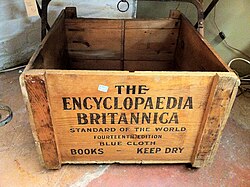
The publication's journey is marked by a transition from scholarly treatises written by a few experts to a massive, systematized effort to organize all human knowledge, eventually moving from heavy wooden shipping crates to the instant accessibility of the World Wide Web.
Key Facts
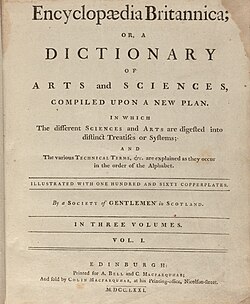
- Founded: First published in serial installments between 1768 and 1771 in Edinburgh.
- Editions: 15 major editions produced, with the 2010 print version being the final one.
- Evolution: Transitioned from a Scottish-led project to American ownership and eventually to a digital-first model.
- Key Innovation: Introduced the "New Plan" of mixing short articles with long, detailed treatises.
- Final Print Format: The 2010 Global Edition consisted of 30 volumes and over 18,000 pages.
The Five Eras of Britannica
1. The Scottish Foundations (1768–1824)
The Britannica began as a project by Scottish printers Colin Macfarquhar and Andrew Bell. It was first released as the Encyclopædia Britannica, or, A Dictionary of Arts and Sciences, compiled upon a New Plan. This "New Plan" was a structural innovation that combined short articles with longer treatises (comprehensive formal essays) in a single alphabetical sequence.
While often linked to the Scottish Enlightenment, the early editions were compiled largely by William Smellie using various sources, rather than contributions from local Scottish intellectuals. Over time, the work evolved from a local project into a symbol of British identity.
2. The Scholar's Era (1827–1901)
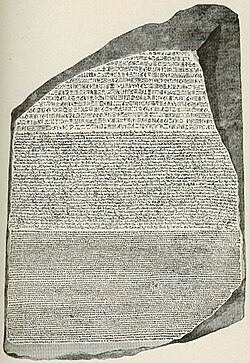
Managed by the firm A & C Black, this period saw the Britannica attract the world's most respected authorities. The 7th edition introduced the first general index, a feature that remained standard for over a century. The 9th edition, overseen by Thomas Spencer Baynes, is widely regarded as the "Scholar's Edition" due to its rigorous academic depth and the exclusion of biographies of living persons.
3. American Influence and Mass Marketing (1901–1973)
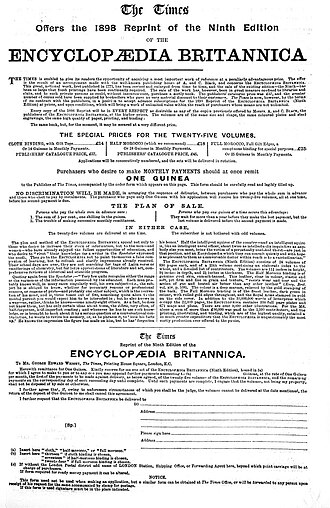
The turn of the century brought American ownership and a shift toward direct marketing and door-to-door sales. To appeal to a broader mass market, articles were simplified. Under the leadership of Elkan Harrison Powell in the 1930s, the company shifted to a policy of continuous revision, moving away from the previous practice of updating the work only every 25 years.
In 1943, the company was donated to the University of Chicago, where it was managed by William Benton until 1973.
4. Systematizing Knowledge (1974–1994)
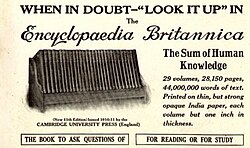
The 15th edition, known as the New Encyclopædia Britannica, attempted a radical reorganization under Mortimer J. Adler. The goal was to systematize all human knowledge by splitting content into three parts: the Propædia (outline of knowledge), the Micropædia (ready reference), and the Macropædia (in-depth articles). This structure was initially criticized for its complexity and lack of a separate index, leading to a complete reorganization and re-release in 1985.
5. The Digital Transition (1994–Present)
The rise of electronic encyclopedias like Encarta and Wikipedia forced the Britannica to pivot. In 1996, the company was acquired by Swiss billionaire Jacqui Safra. By 2012, the company announced it would cease production of new print editions, focusing exclusively on digital tools and the online edition.
Despite the digital shift, the company returned to print in 2020 with the Britannica All New Children's Encyclopedia: What We Know and What We Don't, aimed at younger readers.
Edition Summary
| Edition/Era | Key Characteristic | Notable Change |
|---|---|---|
| 1st–6th | Foundational | Introduced the "New Plan" of articles and treatises. |
| 9th | Scholar's Edition | Highest level of academic rigor; no living biographies. |
| 11th | Mass Market | Shift to American ownership and direct sales. |
| 15th | New Encyclopaedia Britannica | Divided into Propædia, Micropædia, and Macropædia. |
| 2010 | Global Edition | Final print edition; 30 volumes, 18,251 pages. |
Frequently Asked Questions
What was the "New Plan" used in the first edition?
The "New Plan" was an organizational method that mixed two different types of entries—short articles and longer, detailed treatises—within a single alphabetical sequence.
Why was the 9th edition called the "Scholar's Edition"?
It is considered the most scholarly of all editions because it focused on high-level academic research and excluded biographies of people who were still living.
How did the 15th edition differ from previous versions?
The 15th edition reorganized knowledge into three distinct sections: the Propædia, Micropædia, and Macropædia, aiming to systematize all human knowledge rather than just providing a reference list.
When did Britannica stop printing its main encyclopedia?
The company announced in 2012 that it would no longer produce new print editions, with the 2010 15th edition (and the Global Edition) serving as the final print versions.
Who currently owns the Encyclopædia Britannica?
The company was purchased by Swiss billionaire Jacqui Safra in 1996.