Enantiornithes: The Dominant Birds of the Cretaceous Period
During the Cretaceous period, the skies were not ruled by the ancestors of modern birds, but by a diverse and successful group known as Enantiornithes. Existing between 136 and 66 million years ago, these "opposite birds" represented one of the most widespread and ecologically diverse lineages of early avians. From the forests of China to the coastlines of North America and the plains of Argentina, Enantiornithes filled nearly every avian niche imaginable.
Unlike modern birds (Neornithes), Enantiornithes were a distinct branch of the Ornithothoraces, a clade of advanced feathered dinosaurs. While they shared many similarities with today's birds, their skeletal structure—particularly the shoulder joint—was fundamentally different, which is how they earned their name.
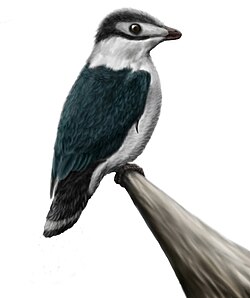
Key Facts
- Temporal Range: Early to Late Cretaceous (136–66 Ma).
- Global Distribution: Fossils found in China, Spain, Argentina, USA, Myanmar, Russia, and Madagascar.
- Defining Feature: A unique shoulder joint structure that is the "opposite" of modern birds.
- Diversity: Included specialized forms such as piscivores (fish-eaters), climbers, and potential nectar-feeders.
- Extinction: They vanished during the Cretaceous-Paleogene (K-Pg) extinction event.
Anatomy and Physical Characteristics
The Skull and Beak
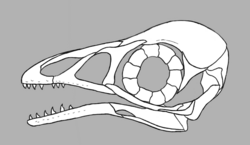
The skulls of Enantiornithes varied significantly based on their diet. While many possessed teeth, some evolved toothless beaks, such as Imparavis and Navaornis. Some species showed extreme specializations; for example, Brevirostruavis possessed an enlarged hyoid bone, suggesting a feeding style similar to modern hummingbirds or woodpeckers.
Wings and Flight
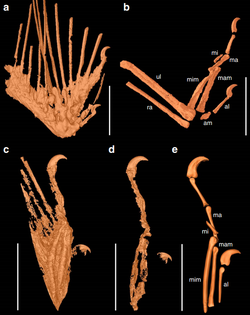
Enantiornithes were capable fliers. Some species, like Eoalulavis, possessed an alula—a specialized thumb-feather that controls airflow at slow speeds, a feature still essential for modern birds. Their wing structures varied from the robust bones of Fortunguavis, adapted for climbing, to the highly maneuverable wings of Huoshanornis.
Tail and Pygostyle
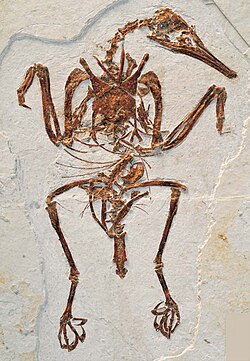
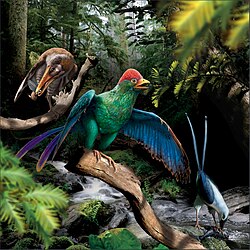
The tail of an enantiornithine was typically short, ending in a pygostyle (a fused bone at the end of the tail). Many species displayed elaborate plumage for courtship or balance, including the paired ribbon-like feathers seen in Cratoavis or the massive "pintail" fan of Yuanchuavis, which was longer than the bird's own body.
Biology and Ecology
Diet and Predation
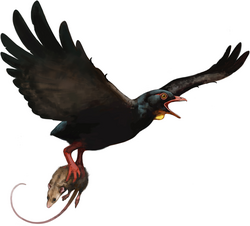
The ecological roles of Enantiornithes were vast. Piscivorenantiornis was specialized for eating fish, while Avisaurus was a formidable predator capable of preying on small prehistoric mammals. Others likely relied on insects, fruits, or nectar.
Life History and Development
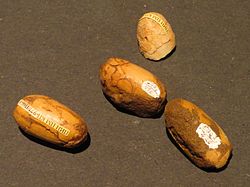
Evidence suggests a complex life history. Fossil specimens like Avimaia have been found with unlaid eggs inside the body, providing insight into their reproductive biology. Furthermore, juvenile specimens such as Monoenantiornis show that their skeletal features developed progressively as they aged.
Classification and Diversity
Enantiornithes are divided into several key families, each with distinct morphological traits:
| Family | Notable Genus | Key Characteristic |
|---|---|---|
| Avisauridae | Avisaurus | Often larger, some with predatory habits. |
| Bohaiornithidae | Bohaiornis | Diverse group, often with robust braincases. |
| Longipterygidae | Longipteryx | Specialized for perching and diverse tail feathers. |
| Pengornithidae | Pengornis | Included some of the largest members of the group. |
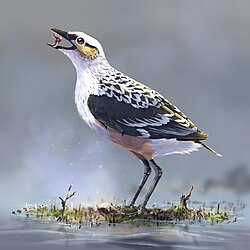
| Gobipterygidae | Gobipteryx | Short-snouted forms from Asia. |
Frequently Asked Questions
What does "Enantiornithes" mean?
The name comes from the Greek words for "opposite" and "birds," referring to the unique arrangement of their shoulder joint, which is the mirror image of the joint found in modern birds.
Did Enantiornithes have teeth?
Most Enantiornithes had teeth, but the group was diverse. Some genera, such as Imparavis and Navaornis, evolved toothless beaks.
How did they differ from modern birds?
Beyond the shoulder joint, they differed in their growth patterns and the structure of their pygostyle. They also lacked the specific skeletal refinements that allowed modern birds to survive the K-Pg extinction.
Where were the most fossils found?
While they were global, a vast number of well-preserved specimens have been discovered in China, particularly within the Jehol biota (such as the Jiufotang and Yixian Formations).
Why did they go extinct?
Enantiornithes disappeared approximately 66 million years ago during the Cretaceous-Paleogene extinction event, which wiped out the non-avian dinosaurs and many other prehistoric lineages.